That should be all the information you need to solve for the Internet uploading std. crossword clue! Be sure to check more clues on our Crossword Answers. The post Internet uploading std. Crossword Clue appeared first on Try Hard Guides.
Author: admin

The post Vitalik Buterin Calls for “Open Source and Verifiable” Self-Driving Cars appeared com. On November 2, Ethereum (ETH) co-founder Vitalik Buterin sent a short but pointed message into the tech ether: “We need open source and verifiable self-driving cars.” The tweet landed like a provocation and a challenge at once, a call for transparency in a field where code, models and sensor streams decide life-or-death outcomes, and where opaque, proprietary stacks have so far dominated the road. At first glance, the line reads like a principled manifesto: open source as a check against proprietary secrecy, and verifiability as a guardrail for trust and accountability. But there’s a deeper technical case folded into that phrase. Autonomous systems are not just software; they are sensor networks, machine-learning pipelines, communications infrastructures and legal constructs. Making them “verifiable” means building mechanisms to prove, to regulators, to courts, and to the public, that a vehicle was running a particular software version, that its decision-making process met a safety contract, or that a sensor reading was authentic and unaltered. Blockchain and modern cryptography offer practical ways to stitch those proofs together without turning every car into a streaming data breach. Immutable Ledger The simplest blockchain analogy is the immutable ledger. If a vehicle publishes cryptographic hashes of critical telemetry, software manifests, or signed attestations onto a permissioned ledger, investigators can later show that the evidence they examine matches what the car itself declared at the time. That is the idea behind several academic proposals and prototypes: fragmented ledgers for vehicle forensics, “vehicle passports” that anchor attestations off-chain while keeping proof on-chain, and permissioned blockchains that constrain who can write or read sensitive automotive records. Those systems aim to preserve privacy while maintaining tamper-evidence, a vital balance when the raw sensor logs from LIDAR, radar and cameras are privacy goldmines. But verifiability at the scale required by autonomous vehicles also.

Former Undisputed WWE Universal Champion Roman Reigns has been away from the Stamford-based promotion since accidentally losing a Street Fight against Bronson Reed at Crown Jewel: Perth Premium Live E.

El Pollo Loco: The Dark Horse Of Small-Cap Restaurants

The earnest superhero team-up tale “The Fantastic Four: First Steps” and Tracy Morgan returning to TV with a new comedy called “Crutch” are some of the new television, films, music and games headed to a device near you. Also among the streaming offerings worth your time this week, as selected by The Associated Press’ entertainment.
That should be all the information you need to solve for the Teddy bear or G. I. Joe, e. g. crossword clue! Be sure to check more clues on our Crossword Answers. The post Teddy bear or G. I. Joe, e. g. Crossword Clue appeared first on Try Hard Guides.

I know Bill, and we have been to dinner many times. He spoke at one of our conferences back in the 1990s, and he was not so neoconservative back then. He attempted to steal [.].

DEAR HELOISE: I work as a nurse in the ICU in a major metropolitan hospital. As many people know, hospitals have relaxed their rules about the length of a visitor’s visit, have done away with age limits for children to.

The post Standard Chartered CEO Predicts Blockchacom. Hong Kong aligns with fintech-driven economic strategies. Potential $20 billion in Bitcoin ETF inflows expected. Standard Chartered CEO Bill Winters announced on November 3 that both the bank and Hong Kong SAR leadership foresee eventual blockchain settlement for all transactions and full currency digitization. Winters’ statement underscores institutional and governmental commitment to blockchain, which could drive significant financial market shifts, impacting cryptocurrencies like Bitcoin and Ethereum, amid global digital currency trends.” This bold prediction underscores a strong commitment to blockchain integration and digital currency foresight. Standard Chartered is strategically aligning itself with governmental agendas, positioning for potential first-mover advantages as blockchain frameworks become prevalent. Yet, no public fund allocations or new projects were announced explicitly alongside this statement. Geoffrey Kendrick, Head of Digital Assets Research, Standard Chartered, “I would expect at least another $20 billion by year-end [in Bitcoin ETF inflows], a number which would make my $200, 000 year-end forecast possible.” Blockchain Adoption’s Broader Financial Implications Explained Did you know? Standard Chartered’s move echoes previous blockchain adoptions by global financial institutions, including pilots from BlackRock and JPMorgan, reinforcing the ongoing transition to digital assets. According to CoinMarketCap, Bitcoin (BTC) is priced at $107,904. 20, with a market cap of formatNumber(2152011730482, 2) and dominance at 59. 53%. It has experienced a 1. 90% drop over the last 24 hours, contributing to a 90-day decrease of 5. 56%. Trading volume surged by 71. 14%, marking an active trading landscape. Bitcoin(BTC), daily chart, screenshot on CoinMarketCap at 04: 02 UTC on November 3, 2025.
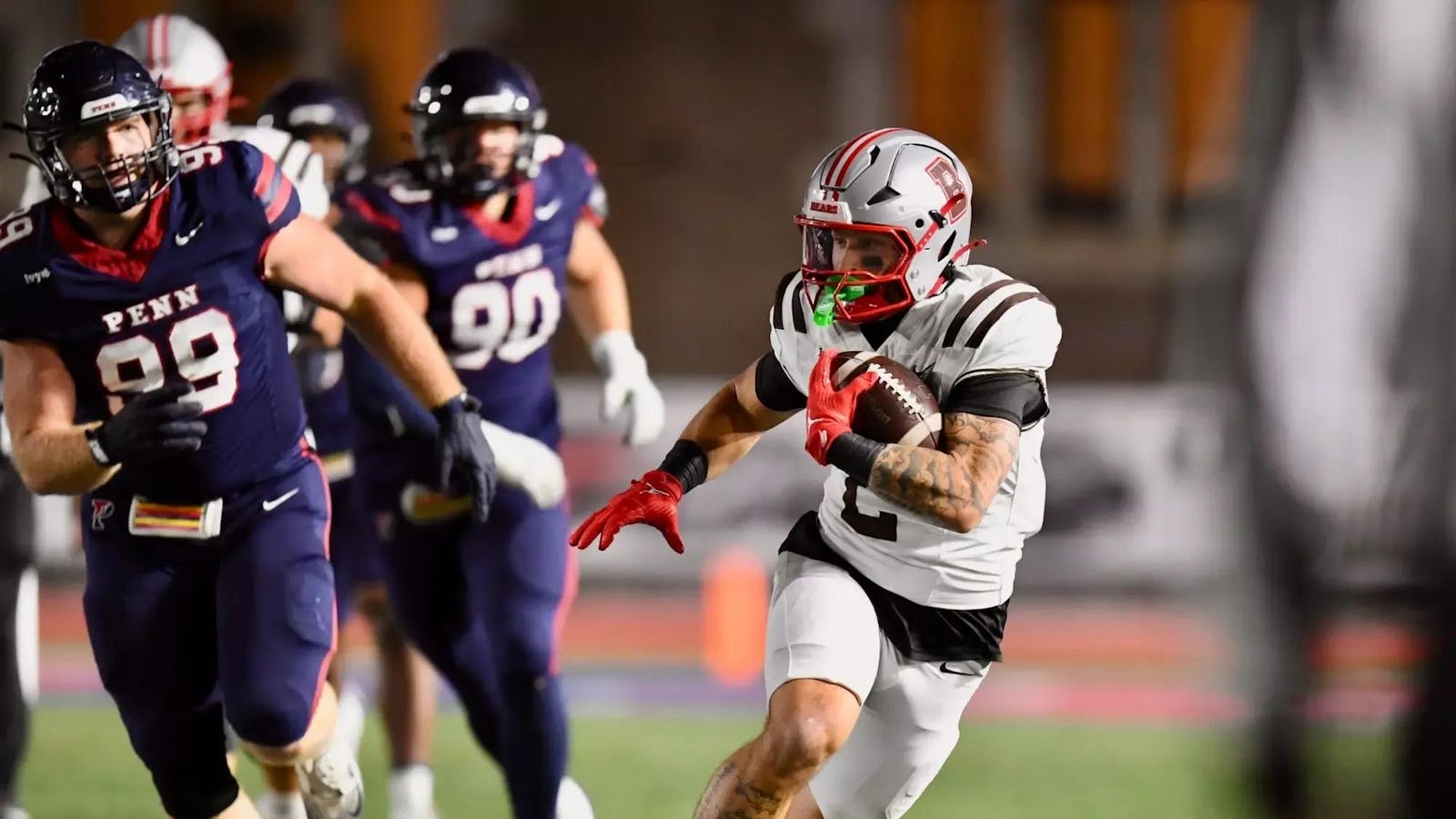
Despite rallying in the second half, the Brown football team (3-4, 0-4 Ivy) fell 28-21 to Penn (5-2, 3-1) on Halloween. Following an encouraging 3-1 start to the season, the Bears have slid to three consecutive losses and have yet to defeat an Ivy League opponent. The Quakers put up 21 first-half points, jumping out to an early multiple-possession lead they never relinquished. “I think we have to look at some ways to start a little faster,” Head Coach James Perry ’00 said in a post-game interview. “There was a stretch of really good football that we played . but we started the game poorly.” Although Brown’s first drive started with an explosive play — receiver Trevor Foley ’28 high-pointed a one-on-one ball for 35 yards on the second play from scrimmage –movement quickly stalled. Facing a fourth-and-7 at Penn’s 28-yard line, quarterback James Murphy ’27 forced the ball into tight coverage. Penn defensive back Jayden Drayton tipped the ball into the air. His teammate, Josh Narcisse, snatched it and found a running lane, returning the ball for 30 yards. The Quakers capitalized on the mistake, strategically plodding downfield with a stack of short gains. A low bullet by Penn quarterback Liam O’Brien sent his offense to the 1-yard line, where tailback Donte West took a run up the gut to create a 7-0 Penn lead. The Bears did not let that slide. In just five plays, the offense moved to Penn’s 44-yard line, where the receiving corps put their stamp on the drive. Securing Murphy’s toss on a short crossing route, Ty Pezza ’26 cruised toward the goal line, running along the left hash. A firm red-zone block by Foley ensured Pezza remained untouched en route to tying up the match. Continuing Penn’s attack, O’Brien conducted another strong performance. In 10 plays, the Quakers moved 70 yards downfield and across the goal line. A 21-yard rush by O’Brien propelled Penn to Bruno’s 9-yard line, and on the very next play, the Quakers scored on a completion to Bisi Owens. After a quick response to Penn’s first touchdown, the Bears stalled on offense after the second. Creating only 1 first down, Brown faced a third-and-8 on their own 36-yard line. Rolling right, Murphy was chased by Quaker defenders and was forced to throw the ball away. A punt followed, sending the ball back to Penn. Once more, a deftly designed charge put the Quakers into the end zone. After gradual movement to their own 48-yard line, Penn ramped up the intensity. O’Brien completed a 19-yard pass –then a 24-yarder — then an 8-yard checkdown to the 1-yard line. From there, running back Sean Williams Jr. leapt through a gap between Bruno’s defensive line, giving the Quakers a 21-7 advantage. Suddenly facing a two-score uphill climb, Bruno’s offense was revived. Moving the sticks in two plays or less, Murphy completed each of his 5 pass attempts throughout the drive, taking the Bears to Penn’s 24-yard line. On a third-and-5, Brown turned to the passing game once more. Murphy put up a one-on-one ball for Solomon Miller ’26, who head tapped his defender en route to the end zone. For a breathtaking moment, Brown had sliced the lead in half. But then an offensive pass interference penalty dashed Bruno’s hopes, leading to yet another punt. Penn’s drive to close out the half went 65 yards but the Quakers ultimately came up short after missing a 51-yard field goal and headed into halftime with a 14-point lead. Coming out of the locker room, Bruno showed increased energy. After the Quakers managed to move the ball to Brown’s 32-yard line, the Bears’ defense took a stand. Ivy League sack leader Ike Odimegwu ’27 got to O’Brien on second down, and on third down, the defensive front kept up the pressure. Owen Clarke ’26 blew through a hole in the offensive line and in a last-ditch attempt to escape a sack, O’Brien released a wayward pass. The ball drifted just above the head of running back Tommy Lafayette and into the waiting hands of Bruno linebacker John Perdue ’26. Wasting no time, the Bears’ offense capitalized on the sudden turnover. Their second snap resulted in a 16-yard reception at the left sideline for Miller. Just a few plays later, on a third-and-15, tight end Levi Linowes ’27 found a seam, received the ball in-stride and held off a Penn defender to reach the Quakers’ 8-yard line. On fourth down, after Penn stopped three consecutive goal-to-go attempts, Bruno unveiled some Halloween trickery. Before the snap, receiver Najih Rahman ’27 went in motion from the slot position. After passing in front of Murphy, he circled into the backfield, running a swing route to the right. Catching Murphy’s pitch, Rahman feigned a run before tossing a touchdown pass to Pearson Hill ’28. Reflecting on Brown’s second-half start, Perry said, “I’m really proud of the guys, how we came out in the second half, how they worked, how they stuck together.” But Penn had no intention of allowing Bruno to close the gap. On their first series, the Quakers caught the Bears off-guard on a third-down run and Williams broke free, dashing 40 yards to the 1-yard line. Another rushing touchdown pushed Penn’s lead to 28-14. On the subsequent kickoff, a flag for an invalid fair catch signal set the Bears back to their own 11-yard line. Undeterred, Murphy began his offense’s journey downfield. Aided by consecutive quick strikes to Pezza, a 15-yard roughing the passer penalty and a 25-yard toss to Foley, the Bears reached Penn’s red zone. But there, the Quakers’ defensive front stood tall, forcing a fourth-and-10. Drew Crabtree ’29 took the field for a 28-yard field goal attempt, but his kick sailed wide left, taking Bruno’s momentum with it. The next 3 drives resulted in punts –2 for Penn and 1 for Brown –taking valuable time off the game clock. When the Bears’ offense emerged for another drive, only 8 minutes remained. Following a second-down sack, on third-and-19, Foley created the contest’s premier play. Pinned against the right sideline and facing a high-arcing ball, Foley extended his right arm into the night sky while falling backwards, corralling the ball with just one palm. The play was later named SportsCenter’s top highlight of the day. Energized by the miraculous grab, Brown eagerly bounded downfield toward the goal line. From Penn’s 14-yard line, Murphy delivered to Foley, who fought off Quaker defenders and lunged onto the navy turf of the end zone. Suddenly, the Bears were only one score behind and poised to endanger Penn’s once-assured victory. But for a final time, the Quakers’ offense drove convincingly. Winding down the clock, Penn collected first down after first down, eventually progressing all the way to Brown’s 1-yard line before kneeling out for a victory. “It’s really easy to be motivated,” Murphy reflected in a post-game interview. “We have three more opportunities to go play football and put it all on the line for the seniors.” The Bears will be back in action when they host Yale (5-2, 3-1) on Saturday. Kickoff is slated for noon.