TALLAHASSEE, Fla. In a rare display of political alignment, Florida’s top Republicans, Democrats, environmental groups, and even some of President Donald Trump’s closest allies in the state are loudly rejecting the administration’s new plan to expand offshore drilling near Florida’s coast. Gov. Ron DeSantis, who has long insisted Florida’s beaches and military testing zones remain off-limits, renewed his warnings this week, urging Trump to stick with the protections he signed in 2020. DeSantis, Democrats, environmentalists join forces to oppose new Gulf drilling “Now what the Interior Department is proposing to do is really to go back off that policy,” said DeSantis, Friday. “I think that would weaken protections we worked really hard to establish offshore.” The Interior Department’s proposal would open new waters for oil and gas development, aiming to boost domestic production and lower prices. But in Florida, where drilling in state waters is already barred by the state constitution, the idea has landed with a thud. Military, Environment, and Bipartisan Pushback Opposition is emerging from every corner of the state’s political landscape. U. S. Rep. Jimmy Patronis, a Republican whose district includes major military installations, warned new rigs could jeopardize critical national security operations in the Eastern Gulf. “The right hand is not talking to the left hand,” Patronis said. ”The Department of the Interior is hard charging to try to drive down gas prices. So they’re trying to do everything they can to throw it and see what sticks to the wall.” State Trump administration announces plan for new oil drilling off Florida Matthew Daly and Matthew Brown Patronis argues drilling could disrupt hypersonic missile testing and other weapons development within the Gulf Test and Training Range. He’s circulated a letter to the White House, signed by most of Florida’s GOP delegation, reminding federal leaders that military testing and energy exploration “are not compatible.” It comes as environmental groups say the risks extend far beyond defense. “Floridians don’t want their treasure trashed,” said JP Brooker with Ocean Conservancy. He warns that drilling puts fisheries, sea turtles, beaches, and billions in tourism revenue at risk. “It’s a political no-brainer,” said Brooker. “The ocean in Florida is like corn. It’s like corn in Iowa, right? It’s something that you have to care about and care about supporting, regardless of your political background, if you want to have a chance of getting elected.” Democrats Also Sound the Alarm Democrats, too, say the plan is unnecessary and dangerous. “Big oil does not need any more help right now,” said U. S. Rep. Kathy Castor, Thursday evening. “They are doing fine and they hold over 2, 000 active leases in the Gulf already.” Florida Democratic Party Chair Nikki Fried called the proposal a “nonstarter,” pointing to memories of the Deepwater Horizon disaster just 15 years ago. National Politics Biden permanently bans offshore drilling in 625 million acres of ocean David Goldman, Ella Nilsen and Matt Egan, CNN “Florida has a long history of bipartisan support against drilling off our coastlines,” she said in a statement. “Our state’s fragile ecosystem and economy would be irreparably harmed if this proposal were to move forward.” A History of Avoiding Drilling Near Florida The bipartisan resistance echoes earlier victories for drilling opponents: In 2018, voters approved a constitutional amendment banning drilling in state waters. That same year, then-Gov. Rick Scott secured a pledge from Interior Secretary Ryan Zinke that Florida would be protected: “We are not drilling off the coast of Florida.” In 2020, Trump signed a memorandum extending the federal offshore drilling moratorium until 2032.
https://www.wptv.com/news/state/desantis-democrats-environmentalists-join-forces-to-oppose-new-gulf-drilling
Tag: environmentalists

Between languages and ladders
Summer ended on the first weekend of October. The morning was bright, embodying every cliché made for it, and the weather was cool enough for a walk. This is how I like Lahore: breathable, on my side for once, full of possibilities.
At this year’s Indus Conclave, there was something for everyone. For the environmentalists, just as smog season approaches; for the economists whose arguments should see past the confines of drawing-room walls; for literature enthusiasts hoping to continue to learn (long after our time), to never exit the endless, living conversation of our respective fields.
On entering Hall One in Alhamra, the first thing you saw was *A Gentle Apocalypse*, curated by Saher Sohail. It didn’t announce itself as an exhibition so much as a quiet arrangement of restlessness: a shrine-like cabinet lined with terracotta bowls of herbs and seeds, the glow of its rain-blue panels catching the eye immediately, painted hands caught mid-motion — praying, pleading, offering, perhaps all at the same time.
The wall text explaining the art installation spoke of progress as a double-edged sword: the promise of creation that’s shadowed by loss. There was no sound in the room despite the significant number of viewers, just the low hum of conversation and tyre screeches heard from outside. I lingered there longer than I meant to. There was something in the textures, the earth, the pigment, and the repetition of motifs that suggested the fragility of all systems built to last.
It felt like a prelude to the day’s conversations, though I didn’t know it then: that uneasy space between what must be preserved and what must evolve, between the languages we inherit and the ones we are still learning to use.
—
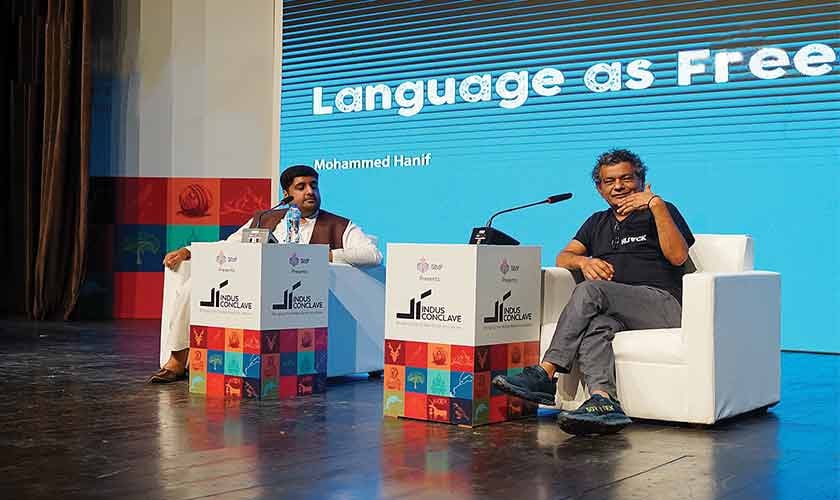
The first session I attended was on *Language as Freedom*, where Jasir Shahbaz spoke to Muhammad Hanif about his career as a novelist. With *A Case of Exploding Mangoes* and *Our Lady of Alice Bhatti*, Hanif has established himself as a stalwart of Pakistani fiction in English. The conversation sounded like an intimate reflection.
Here was a senior writer speaking to his once-student, who grew up speaking Punjabi, detoured into an English-medium education, and later returned to his mother tongue. He spoke of government schools and the slow shift to English-medium classrooms, of the early confusion of sitting through an hour-long lecture without understanding a single word.
English, for him, he said, was first an obstacle, but later a practice. Perhaps the novelist’s task is not to make things understood but to let them be said in whatever language allows them to exist.
Hanif reflected on how this generation became fluent in English literature yet distanced from its own. He said they could speak fluently but felt hollow. Some feelings, he said, cannot be translated. What followed was less confession than diagnosis: an entire country still measuring intellect by accent.
There was no bitterness in his tone, only irony, humour, and a peculiar tenderness. The writer spoke of returning to Punjabi through his YouTube vlogs after years of writing in English. He said he was driven not by nostalgia but necessity — a way to breathe again.
When he turned to teaching, he said, it was exhausting but also the only way to stay porous, to keep language alive through others.
—
If the first session was about a return, the second began with a departure.
Reading from her new novel, *A Splintering*, Dur-e Aziz Amna opened with a line that could have belonged to either writer: “So let my story begin with rage.” Her protagonist leaves the village for the city, trading mud for marble, faith for aspiration. The rain that falls on her first night in Karachi sounds, she says, like thunder, like the nuclear tests on television.
The conversation that followed traced the novel’s moral topography: class as aspiration, education as ticket and trap, gender as a multiplying rather than reflecting mirror.
Tara’s hunger for self-advancement, Amna noted, was admirable and frightening in equal measure. When does ambition become transgression? When does survival begin to look like betrayal?
These questions, too, refused to stay contained in fiction. They spoke to a middle class perpetually anxious about slipping: too cautious to risk falling, too constrained to truly rise.
“The middle,” she said, “is where you learn how much you can lose.”
Listening to her felt less like attending a literary discussion and more like being handed a mirror — one that showed how our social preoccupations quietly govern our moral choices.
—
Placed side by side, both sessions seemed to be in conversation with one another. One writer returned to his mother tongue; the other wrote in English but refused to over-explain Pakistan to outsiders.
Both resisted the colonial habit of simplification. Both understood that to write from here is to inhabit contradiction: to long for a wider audience and yet distrust its gaze; to carry one’s native language like a hidden rhythm beneath every English sentence.
If Hanif found refuge in humour, Amna sought clarity in anger. One built bridges through translation; the other tore them down to expose what translation conceals.
Their concerns converged on education, mobility, and the fragility of self-expression in a country still divided by language.
What emerged was a portrait of the writer not as oracle but as witness — one who records the everyday negotiations between privilege and belonging.
Both spoke, too, of teaching: of younger writers afraid to be funny, afraid to sound local.
Their advice was the same, though phrased differently: to write as one truly is, not as one thinks a writer should sound.
—
I had to leave early. Outside, Lahore was already shifting into a haze; people were queuing up for chips, for samosas; a group of students was singing Nusrat Fateh Ali Khan with a guitar.
Had I left with a better understanding than when I entered? Is that the job of a novelist: to have their readers understand?
Perhaps not; perhaps the novelist’s task is not to make things understood but to let them be said in whatever language allows them to exist.
https://www.thenews.com.pk/tns/detail/1350024-between-languages-and-ladders