

The cryptocurrency market is witnessing something remarkable as ETH ETFs continue their impressive performance streak. For the third consecutive day, U. S. spot Ethereum ETFs have recorded substantial inflows, totaling $78. 5 million on November 25 alone. This consistent positive momentum signals growing institutional confidence in Ethereum’s potential. Why Are ETH ETFs Gaining Such Massive Traction? The recent surge in ETH ETFs popularity isn’t accidental. Major financial institutions are leading the charge, with Fidelity’s FETH attracting $47. 54 million and BlackRock’s ETHA pulling in $46 million. These substantial investments demonstrate that institutional players see long-term value in Ethereum exposure through regulated ETF products. However, the picture isn’t entirely one-sided. Grayscale’s ETHE experienced $23. 33 million in outflows, suggesting some investors are rebalancing their portfolios. Meanwhile, Grayscale’s Mini ETH added $8. 29 million, showing that different ETH ETF products are serving varied investor preferences. What Makes ETH ETFs So Appealing to Investors? ETH ETFs offer several compelling advantages that explain their growing popularity: Regulated exposure to Ethereum without direct cryptocurrency ownership Institutional-grade security and custody solutions Simplified investment process through traditional brokerage accounts Tax-efficient structure compared to direct cryptocurrency holdings Liquidity and transparency of exchange-traded products The consistent inflows into ETH ETFs reflect a broader trend of cryptocurrency institutionalization. As more traditional investors seek Ethereum exposure, these ETF products provide the perfect bridge between conventional finance and digital assets. How Do ETH ETFs Impact the Broader Market? The success of ETH ETFs extends beyond just the products themselves. These consistent inflows create positive ripple effects throughout the entire Ethereum ecosystem. When institutions invest in ETH ETFs, they’re essentially buying underlying Ethereum, which can: Increase overall market liquidity Provide price stability through diversified ownership Validate Ethereum’s long-term investment thesis Attract more developers and projects to the ecosystem Moreover, the competition among providers like Fidelity, BlackRock, and Grayscale drives innovation and better product offerings for investors. This healthy competition ensures that ETH ETFs continue evolving to meet investor needs. What Does the Future Hold for ETH ETFs? Looking ahead, the trajectory for ETH ETFs appears promising. Three consecutive days of substantial inflows suggest this isn’t a temporary phenomenon but rather the beginning of sustained institutional interest. As regulatory clarity improves and more investors understand the benefits of ETH ETFs, we can expect: Increased daily trading volumes More diverse ETH ETF products Potential approval of additional Ethereum-based financial products Greater mainstream adoption of cryptocurrency investments The current momentum in ETH ETFs represents a significant milestone for cryptocurrency adoption. It demonstrates that digital assets are becoming an integral part of diversified investment portfolios, with Ethereum leading the charge in the smart contract platform space. Frequently Asked Questions What are ETH ETFs? ETH ETFs are exchange-traded funds that track the price of Ethereum, allowing investors to gain exposure to ETH without directly buying and storing the cryptocurrency. Why are ETH ETFs seeing consistent inflows? ETH ETFs are attracting consistent inflows due to growing institutional confidence, regulatory clarity, and the convenience they offer traditional investors seeking cryptocurrency exposure. Which ETH ETF providers are performing best? Currently, Fidelity’s FETH and BlackRock’s ETHA are leading with $47. 54 million and $46 million in recent inflows respectively. Are there risks with investing in ETH ETFs? Like any investment, ETH ETFs carry market risk, but they eliminate the technical risks associated with direct cryptocurrency ownership like hacking or lost private keys. How do ETH ETF inflows affect Ethereum’s price? Substantial ETH ETF inflows can create buying pressure on the underlying Ethereum, potentially supporting price appreciation over time. Can retail investors access ETH ETFs? Yes, retail investors can buy and sell ETH ETFs through their regular brokerage accounts, making Ethereum investment accessible to everyone. Found this analysis of ETH ETFs insightful? with fellow investors and cryptocurrency enthusiasts on your social media platforms to spread the knowledge about Ethereum’s growing institutional adoption! To learn more about the latest Ethereum trends, explore our article on key developments shaping Ethereum institutional adoption.
https://bitcoinethereumnews.com/ethereum/eth-etfs-attract-78-5m-in-third-consecutive-day-of-massive-inflows/
Tag: exchange-traded

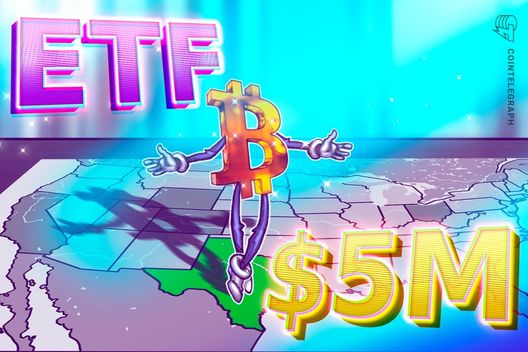
Texas buys the Bitcoin dip, acquiring $5M of BlackRock’s IBIT
The Texas state government has made a major Bitcoin move, snapping up $5 million worth of shares in BlackRock’s spot Bitcoin exchange-traded fund, with another $5 million lined up for a self-custodied Bitcoin buy. The government made the purchase on Nov. Bratcher said that the Texas government will eventually “self-custody Bitcoin,” but as it’s still finalizing the process, the initial $5 million “allocation was made with BlackRock’s IBIT ETF.” “$10M is allocated from general revenue but not all $10M has been allocated,” he added. Commenting on Texas’ purchase, Pierre Rochard, the CEO of The Bitcoin Bond Company, said the move signals a significant shift in attitude toward Bitcoin in just a short amount of time, noting: “In five years we went from ‘governments will ban bitcoin’to ‘governments are only buying a small amount of bitcoin’. Hyperbitcoinization has happened, is happening, and will continue to happen.” It is unclear if this move is directly related to the state’s plan for a strategic Bitcoin (BTC) reserve. In June, Governor Gregg Abbot officially authorized the creation of a state-managed fund to hold BTC as part of the state’s long-term financial assets, utilizing public funds to build the treasury. As outlined in the initial bill greenlit by Abbot, only assets with a market cap over $500 billion are eligible for inclusion in the reserve, a threshold met by Bitcoin but not by BlackRock’s IBIT. However, the move still signals a step forward in Texas’s BTC adoption plans. While its Bitcoin plans are progressing, Texas may not just stop at digital gold. In mid-October, Texas state Senator Charles Schwertner, one of the lawmakers behind the state’s strategic Bitcoin reserve bill, told Cointelegraph that Ether (ETH) may be next, if its market cap can get and stay above $500 billion. “If Ethereum maintains its market cap over 24 months, I think it’s reasonable and prudent to give direction that Ethereum could be added to the cryptocurrency [reserve],” he said. Wisconsin bought $100M of BlackRock’s BTC ETF in 2024 While some have claimed Texas is the first state to snap up BTC through IBIT, the state of Wisconsin’s investment board actually oversaw the purchase of almost $100 million worth of IBIT shares in May last year, filings show. “Pretty sure that’s the only ETF to ever be owned by all three. More wild stuff for a not-yet-even-two-years-old fund.” IBIT is down around 10% year-to-date, despite the growing embrace of Bitcoin by the US government under the Trump Administration this year. At the time of writing, IBIT is sitting at $49. 56, and is up a mere 0. 22% in after-hours trading.
https://cointelegraph.com/news/texas-snaps-5m-blackrock-bitcoin-etf-amid-btc-dip
Solana and XRP ETFs Defy Outflows as Markets Face Heavy Outflows
While spot Bitcoin and Ether exchange-traded funds (ETFs) are facing some of the biggest daily outflows since they launch, two new altcoin products are bucking the trend. Despite the broader market rout, Solana (SOL) and XRP (XRP) ETFs have yet to record a single outflow day since launch, according to crypto ETF data aggregator SoSoValue. This makes the two altcoin ETFs rare green marks in an otherwise red ETF landscape. The inflows are becoming substantial. Data shows that Solana-based spot ETFs have accumulated nearly $500 million in net inflows, while XRP ETFs have seen $410 million in cumulative net inflows to date. The divergence comes amid one of the most severe multi-week outflow streaks in spot Bitcoin (BTC) and Ether (ETH) ETF history. While flagship crypto products are seeing large-scale redemptions, steady inflows into new ETFs suggest a small but notable hint of conviction among investors exploring exposure beyond the two largest assets. XRP and Solana ETFs log consistent inflows amid market stress On Thursday, Bitwise Asset Management launched its XRP ETF under the ticker “XRP.” The ETF made a strong debut, pulling in $105 million on its first trading day, according to SoSoValue data. Asset manager Canary’s XRPC added another $12. 8 million on Thursday, bringing total inflows to $118 million on the day. Canary CEO Steven McClurg congratulated Bitwise on the launch, saying that they’re “rooting” for them despite being competitors in the space. Canary has also contributed to the consistency of XRP ETF inflows. It currently holds the record for the largest XRP ETF inflow day, pulling in $243 million in inflows on Nov. 14 for XRPC. Solana-based ETFs displayed a similar pattern of resilience, recording consistent daily inflows even as the broader markets declined. SOL-based ETF products attracted between $8. 26 million and $55. 61 million per day this week, with Nov. 19 marking the strongest daily inflow. Related: Memecoin market sinks to 2025 low as $5B wiped out in a day Solana and XRP tokens are in the red despite ETF gains Despite the steady gains posted by SOL and XRP-based ETFs, the underlying assets behind the exchange-traded products saw poor performances in the past month. Solana declined by 32. 5% in the past month and 10. 9% in the last week, according to CoinGecko data. At the time of writing, the token trades at $122. 94, representing a 52. 3% decline in the last year. Meanwhile, XRP performed similarly recently, declining by 21. 2% over the last 30 days and 16. 6% over the last week. However, its yearly chart tells a different story. The asset currently trades at $1. 86, representing a 49. 9% increase over the past year, according to CoinGecko.
https://bitcoinethereumnews.com/tech/solana-and-xrp-etfs-defy-outflows-as-markets-face-heavy-outflows/


VanEck launches Solana ETF, stakes for investors
VanEck, Grayscale launch Solana ETFs; price swings, inflows key VanEck launched its Solana exchange-traded fund on Nasdaq on Nov. 17, providing institutional access to the cryptocurrency, the company announced. The fund was seeded with an initial basket purchased at the end of October, according to regulatory filings. VanEck will waive the sponsor fee for a limited period on the first tranche of assets, though the ETF charges a unified expense ratio. State Street Bank will serve as administrator, with crypto custody provided by two major custodians, the filings showed. The fund plans to stake a portion of its Solana (SOL) holdings through third-party validators, with staking rewards accruing to the fund’s net asset value, according to the custodian. The initial staking provider has agreed to waive its fee during the fee-waiver period. Grayscale launched a spot Solana fund in late October, accumulating significant assets by mid-November driven by record inflows in its first days, making it the first U. S.-listed Solana ETF. Grayscale charges a management fee and recently reduced its staking fee until the fund reaches a certain size, passing most staking yield to investors, according to company statements. Solana’s price has declined sharply in recent weeks, trading well below its level from a month earlier as of mid-November, according to market data. The token peaked earlier in the year and has been correcting since. Market analysts have identified a nearby price band as critical support. A break below that level could push prices lower, while a sustained move above a higher threshold would signal weakening bearish momentum, analysts stated. Trading volumes have increased with volatility. Some analysts have projected sizable combined inflows for Solana-linked funds in their first year. The performance of the new funds will depend on Solana’s price trajectory, according to market observers.
https://bitcoinethereumnews.com/tech/vaneck-launches-solana-etf-stakes-for-investors/

XRP Price Hits $2.5: Ripple ETF Debut on DTCC Sparks Hope of $10 Rally
**XRP Price Analysis: Bounces Off Key Support, Eyes Potential Rally Toward $10**
XRP price recently bounced off the crucial $2.10–$2.20 support zone and is now attempting to break above the $2.50 resistance level. Market expert Ali Martinez shared an insightful chart suggesting a significant upside potential for XRP, forecasting a possible rally up to $10 following a retest of the $1.90 support level.
—
### XRP Price Faces Critical Resistance Around $2.50
Currently, XRP is trading around $2.28 after experiencing weeks of sideways movement. The $2.50 level represents a dense resistance zone, situated near a major supply area known as an order block. This zone also aligns closely with the 200-day moving average. Together, these technical factors create a substantial barrier as the moving averages, the previous supply block, and the upper boundary of a descending wedge pattern converge.
Despite being trapped inside the descending wedge, XRP shows promising signs of flipping bullish once trading volume increases sufficiently.
—
### Bullish Flag Formation and Potential Pullback to $1.90
Ali Martinez highlights that XRP’s price action is forming a bullish flag pattern—a technical setup that often precedes a strong upward move. This setup includes the possibility of a brief pullback to $1.90, which may serve as a final support test before the next rally phase.
According to Martinez, this minor dip could act as a necessary reset and attract fresh buying interest. If bulls regain control, there’s a clear path for XRP to surge toward the $10 mark.
—
### Liquidity Wall Between $2.55 and $2.75 Poses Short-Term Challenge
Another analyst, Steph is Crypto, analyzed the latest Binance XRP/USDT liquidation heatmap and identified a massive liquidity wall between $2.55 and $2.75. The heatmap shows an intense concentration of leverage and potential liquidation clusters in this range, highlighted by bright yellow zones indicating heavy trading activity.
XRP’s ongoing recovery from the $2.10 level indicates strong buyer support, which has helped maintain momentum so far. However, approaching the liquidity wall near $2.75 presents a crucial test. A successful breakout above this resistance could trigger fresh buying pressure, potentially accelerated by short-sellers covering their positions.
On the other hand, a failure to breach this zone might lead to a short-term pullback before any further upward movement.
—
### All Five Proposed Spot Ripple ETFs Now Listed on the DTCC
Significant progress is underway regarding the potential U.S. launch of spot XRP exchange-traded funds (ETFs). All five proposed Ripple ETF funds—from Bitwise, Franklin Templeton, 21Shares, Canary Capital, and CoinShares—are now officially listed on the Depository Trust & Clearing Corporation (DTCC) platform.
This move indicates that preparations for their launch later this month are advancing steadily. The updated ETF filings include standardized language designed to streamline the SEC’s review process under existing 8(a) procedures, consistent with previous digital asset ETF approvals.
—
### Summary
– XRP price bounced off key support at $2.10–$2.20 and aims to break above $2.50.
– A bullish flag pattern is developing, with a possible retest at $1.90 before a major rally.
– Intense liquidity and resistance exist between $2.55 and $2.75, posing a challenge.
– All five proposed spot XRP ETFs have been listed on the DTCC, signaling potential imminent U.S. approval.
Traders and investors will want to watch these critical technical levels and regulatory developments, as they could set the stage for XRP’s next major move.
https://bitcoinethereumnews.com/finance/xrp-price-hits-2-5-ripple-etf-debut-on-dtcc-sparks-hope-of-10-rally/

Solana Rebounds as Major Institutions Add Exposure and ETFs Continue to See Inflows
**Altcoins: Institutional Appetite for Solana Surges as Major Financial Players Reveal ETF Holdings**
Institutional interest in Solana is gaining significant momentum, with financial heavyweights Rothschild Investment and PNC Financial Services disclosing their holdings in newly launched Solana exchange-traded funds (ETFs). These filings arrive amid continued inflows into Solana products, even as Bitcoin and Ethereum funds face substantial redemptions.
### Major Institutions Acquire Solana ETF Shares
In recent disclosures to the U.S. Securities and Exchange Commission, Rothschild Investment LLC, which manages approximately $1.5 billion in assets, reported owning 6,000 shares of the Volatility Shares Solana ETF (SOLZ), valued at around $132,000. Likewise, PNC Financial Services, overseeing close to $569 billion in assets, revealed possession of 1,453 SOLZ shares worth approximately $32,000.
These institutions join a growing list of traditional financial players—including Heck Capital Advisors, Belvedere Trading, and Tactive Advisors—that have steadily increased their exposure to Solana through ETF vehicles.
### Bitwise Solana ETF Maintains Strong Momentum
Adding to the bullish sentiment around Solana, Bitwise’s Solana ETF recorded inflows exceeding $126 million during its first full week of trading, marking eight consecutive days of net gains. This surge in interest contrasts sharply with Bitcoin and Ethereum ETFs, which collectively saw $2.6 billion in outflows during the same period, indicating a notable shift in institutional demand toward Solana.
Over the past two weeks, the Bitwise Solana Staking ETF (BSOL) and the Grayscale Solana ETF (GSOL) have together accumulated around $336 million in inflows. The BSOL fund alone accounts for $323.8 million, driven by investor enthusiasm for Solana’s staking yields and strong on-chain performance.
### SOL Price Rebounds from Key Support Levels
Reflecting this growing optimism, Solana’s price climbed nearly 5% in the last 24 hours, trading around $169 after bouncing off recent lows near $150. According to CoinMarketCap, this price recovery coincides with rising ETF inflows and a more than 50% increase in trading volume—both signs of renewed market confidence.
Technical indicators further underscore improving sentiment. The daily chart shows SOL rebounding from its mid-October slump, with momentum indicators beginning to turn upward. The MACD histogram is nearing a bullish crossover zone, while the Relative Strength Index (RSI) has moved back above 43.
Analysts point to the $150 price level as critical support, noting that sustained buying pressure could propel SOL toward the $180-$200 range. Meanwhile, data from Coinglass reveals a 3% increase in open interest to $7.8 billion. Futures positions on CME and Binance have jumped 5% and 4%, respectively—another indication of strengthening bullish positioning.
### Institutional Interest Could Redefine Solana’s Market Outlook
The combination of steady ETF inflows and growing institutional exposure highlights Solana’s transformation from a rapidly developing blockchain project into an established, investment-grade asset. With ETFs providing regulated entry points for traditional investors, Solana’s integration into mainstream finance appears poised for significant expansion.
—
*The information provided in this article is for educational purposes only and does not constitute financial, investment, or trading advice. Coindoo.com does not endorse or recommend any specific investment strategy or cryptocurrency. Always conduct your own research and consult with a licensed financial advisor before making any investment decisions.*
—
**About the Author**
Alex is an experienced financial journalist and cryptocurrency enthusiast with over eight years covering the crypto, blockchain, and fintech industries. His in-depth articles offer clear insights into the latest developments and trends in digital assets. Alex’s approach breaks down complex concepts into accessible content, helping readers stay informed about important market topics. Follow his publications for the latest updates.
https://bitcoinethereumnews.com/finance/solana-rebounds-as-major-institutions-add-exposure-and-etfs-continue-to-see-inflows/

Can ETH Flip Key Resistance? Whales Move From Solana to $TAP Amid 50X Growth Forecasts
The crypto market is showing signs of life after the Ethereum price regained a key level. But can it revisit its 30-day high? Meanwhile, an interesting trend has emerged during the recent market pullback: Solana coin whales are doubling down on Digitap (AP), hailed as the best crypto to buy now.
At the forefront of the PayFi and banking revolution, Digitap is arguably the most promising crypto to buy at this stage. Interestingly, it is still in its early stages, priced at just $0.0268. Significantly undervalued and buoyed by bold forecasts — including a potential 50x surge — it may well be the best crypto presale opportunity of 2025.
—
### Can the Ethereum Price Break Past $4,000?
After dropping to $3,000 earlier this week, the Ethereum price is slowly reclaiming lost ground. Bulls have pushed the altcoin price above $3,300, which could signal the start of a strong rebound.
A key level to watch is $4,000, as breaking past this threshold would not only boost investors’ confidence but also pave the way for greater gains. If Ethereum can flip its monthly resistance level of $4,755 into support, the altcoin could enter price discovery mode.
A new ETH high would be a welcome relief for many, as it often marks the beginning of altseason. Additionally, inflows into ETH ETFs are expected to contribute to the Ethereum price rally. With a potential reversal unfolding, ETH might be one of the best cryptos to buy now.
—
### Solana Coin Underwhelms Despite Bullish Catalysts
The launch of SOL ETFs on Wall Street was initially seen as a strong bullish catalyst, with many analysts tagging Solana as one of the best cryptos to buy. However, the reality so far has been different.
Despite inflows into these exchange-traded funds, the Solana coin price remains in a downtrend. It has declined nearly 20% on its weekly chart and around 30% on its monthly chart, giving a bearish outlook overall.
Currently, Solana is trading near $160, well below its 30-day high of $235. Crypto analyst Matt has pointed out a new support level around $160 but didn’t rule out bears pushing SOL down further toward $140. For now, SOL might not be the best crypto to buy.
—
### Digitap: The Next 50X DeFi Gem — Why It’s a Steal at $0.0268
Digitap is an innovative project positioned at the crossroads of decentralized finance (DeFi) and traditional banking, offering users the best of both worlds. With early funding surpassing $1.4 million, it’s being hailed as the best crypto presale of the year.
Currently in round 2 of its ongoing ICO, Digitap tokens are priced at $0.0268—a significantly undervalued entry point. The price is expected to rise to $0.0297 in the next stage, with a projected 422% gain from the launch price of $0.14. Moreover, a 50x surge is anticipated after Digitap’s market debut, making it a must-have for investors seeking high returns.
Beyond the promising price forecasts, Digitap’s real-world application strengthens its bullish case. The Digitap Money app, recently launched on the App Store, enables users to hold multiple assets and spend from one unified balance. Its virtual and physical cards are co-branded with Visa, allowing for global acceptance coupled with instant cashback on every purchase.
**Use the code “DIGITAP15” for 15% off first-time purchases!**
—
### AP: A Better Alternative Than ETH and SOL
Digitap (AP) is emerging as the best crypto to buy now for its significant growth potential and practical spending utility. As a low-cap coin supported by a strong DeFi-TradFi narrative, it has ample room for growth, underpinning forecasts of up to 50x returns.
While Ethereum may rebound and Solana could reclaim some lost ground, Digitap’s mainstream appeal and innovative solutions make it a standout opportunity for investors.
—
### Get Involved Now
Digitap is live NOW! Discover more about this exciting project and take advantage of the ongoing presale.
**Presale | Website | Social**
Don’t miss your chance to get in early on one of 2025’s most promising crypto projects.
https://bitcoinethereumnews.com/ethereum/can-eth-flip-key-resistance-whales-move-from-solana-to-tap-amid-50x-growth-forecasts/

21Shares Sparks 20-Day Countdown with New Filing for Spot XRP ETF
**21Shares Files for Spot XRP ETF: What It Means, Why It Matters, and What Comes Next**
Big news hit the XRP community this week: 21Shares, the Swiss-based asset manager, filed a key amendment for its spot XRP ETF. While this might sound like routine paperwork, it could be a game-changer for how altcoins reach U.S. investors.
Let’s break down what happened, why it matters, and what could come next.
—
### Key Takeaways
– **21Shares’ new filing starts a 20-day clock. If the SEC stays silent, the ETF could become effective around November 27, 2025.**
– **XRP surged nearly 5% immediately after the filing, as traders bet on potential U.S. approval of the ETF.**
– **This legal move might fundamentally shift the race between crypto issuers, regulators, and the market for altcoin exposure.**
—
## What Section 8(a) Actually Does
When a company submits an 8(a) amendment, the Securities and Exchange Commission (SEC) gets 20 days to respond. The agency can choose to comment, delay, or simply do nothing. If it stays silent, the registration becomes effective automatically.
This is why the new filing matters: it shortens what’s often a long, open-ended review. Instead of waiting months for word, 21Shares is forcing a clear timeline. After previously filing for a spot XRP ETF earlier this year—and seeing no movement while the SEC focused on Bitcoin and Ethereum products—the company’s new move says: “We’re ready. Your move.”
—
## A Tactical Decision
Analysts say the timing of this filing is deliberate. It arrived on November 7, just days after renewed optimism about altcoin-based ETFs. Bitcoin and Ethereum ETF approvals have already paved the way, and major asset managers are now testing whether those precedents can extend to other tokens.
If the SEC lets the 20-day window expire, without comment or delay, 21Shares’ ETF could become the first regulated spot XRP fund available to U.S. investors—a historic shift, even as XRP’s legal status continues to be debated in court.
—
## Ripple Effects in the Market
### XRP’s Instant Reaction
Within an hour of the filing’s appearance in the SEC database, XRP spiked almost 5%, jumping from around $2.20 to $2.32. Volumes soared on Binance, Coinbase, and Bybit as speculators piled in. Derivatives desks also saw a burst of new long positions, showing that the market views this filing as more than a formality.
Some analysts called it a “signal flare” moment for XRP—a sign that institutional investors are warming up to the token, after years of skepticism.
### Investor Sentiment Turns Cautiously Optimistic
The boost isn’t just about price. For years, XRP has occupied an odd middle ground: large enough to matter, but too controversial to touch. This new ETF filing supports the idea of tokens not simply as speculative assets, but as infrastructure for payments and liquidity. If that narrative catches on, the ETF could attract traders who previously dismissed XRP as a relic of early crypto.
—
## The Broader ETF Landscape
### Where 21Shares Fits In
21Shares is no stranger to the ETF race. With a suite of European crypto ETPs and U.S. applications in partnership with ARK Invest, the firm has proved it’s willing to challenge U.S. regulatory boundaries—even at the risk of rejection.
Competitors like Franklin Templeton and Grayscale have hinted at their own XRP strategies, closely watching the outcome. If 21Shares leads the way, it could set the standard for how future altcoin ETFs are structured, from custody arrangements to redemption models.
### Potential Custodians and Market Depth
While the filing doesn’t specify a custodian, industry insiders point to Coinbase Custody or Anchorage Digital—both already approved for Bitcoin and Ethereum ETFs.
Liquidity is not a concern. XRP routinely ranks among the top-five most-traded cryptos by daily volume, often surpassing $2 billion. However, ETF success will also rely on seamless share creation/redemption for authorized participants and strong investor trust in the fund’s transparency once trading begins.
—
## Unanswered Questions and Regulatory Uncertainty
No one can say for sure if the SEC will intervene. The agency could pause the countdown with a simple letter requesting revisions—similar to what it’s done with Bitcoin ETFs. But if it remains silent, the XRP ETF could slip through by procedural default, shaking up assumptions that only Bitcoin and Ethereum “deserve” spot treatment.
Some see this moment as a bold stress test of regulatory boundaries. Others view it as a strategic push to advance the market conversation, even if approval doesn’t happen right away.
Either way, the next few weeks will be crucial. They could define whether XRP graduates from a long-debated token into a regulated, exchange-traded asset that institutions can finally hold.
—
**Read More:**
– [21 ETP: Unlocking Institutional Access to On-Chain Derivatives](#)
– [Bitcoin and Gold ETFs Shock Wall Street With Rare Top 10 Trading Surge](#)
—
**Stay tuned for updates as the SEC’s countdown progresses. The XRP ETF is now in play—and the entire altcoin market could be watching what happens next.**
https://bitcoinethereumnews.com/tech/21shares-sparks-20-day-countdown-with-new-filing-for-spot-xrp-etf-3/


Ethereum joins Bitcoin in recording third-largest weekly ETF outflow at $508M
Key Takeaways:
Ethereum recorded $508 million in net outflows this week, marking the third-largest weekly redemption since the launch of its spot ETF. During the same period, Bitcoin ETFs also experienced significant investor withdrawals.
Ethereum’s weekly ETF outflow highlights a substantial movement of capital from spot Ethereum ETFs—regulated investment funds that directly track the price of Ethereum. Bitcoin ETFs, which hold the foundational cryptocurrency, faced similar investor withdrawals, indicating a broader trend across major digital asset funds.
Analysts suggest that these ETF outflows for both Ethereum and Bitcoin point to short-term institutional caution amid growing market uncertainty. The withdrawals may reflect a temporary risk-off sentiment among larger investors in the cryptocurrency space, as they reevaluate their exposure to volatile assets.
The parallel outflows from both Ethereum and Bitcoin ETFs emphasize how institutional investors are actively adjusting their holdings in major digital assets. Some experts interpret this trend as profit-taking, following previous periods of strong capital inflows into these regulated investment vehicles.
Overall, these developments underscore an evolving dynamic within crypto markets, driven by institutional sentiment and ongoing market fluctuations.
https://cryptobriefing.com/ethereum-bitcoin-third-largest-etf-outflow-507-million/

Bitcoin, Ethereum ETFs Shed $2.6 Billion in Assets Over the Past Week
Investors have cashed out a combined $2.6 billion from U.S. Bitcoin and Ethereum exchange-traded funds (ETFs) over the past week, marking one of the largest redemption periods in the funds’ history. Since October 29, more than $1.9 billion has left Bitcoin funds, while $718.9 million has been pulled out of their Ethereum counterparts, according to data from Farside Investors. These significant outflows have contributed to downward pressure on the two largest cryptocurrencies by market value.
On Tuesday, Bitcoin dropped below $100,000 for the first time since May. BTC was recently trading at slightly over $103,428, up 2.6% on the day but still about 18% below its October record of $126,080, according to CoinGecko data. Ethereum was changing hands for $3,439, marking a more than 5% 24-hour jump, although it has plummeted by 13% over the past week. The second-biggest digital coin by market capitalization has struggled to trade near its August record of $4,946.
Investors have largely veered away from crypto and other risk-on assets since October amid concerns over several factors. These include U.S. President Donald Trump’s escalation of the trade war against China, the ongoing government shutdown, low market liquidity, and diminishing prospects of a third U.S. interest rate cut before the end of the year.
Despite Trump’s pro-crypto rhetoric and policy stance, Bitcoin has experienced shocks along with tech stocks in recent months. These challenges have stemmed from ongoing macroeconomic uncertainties. Notably, in February, spot Bitcoin ETFs endured their longest and most difficult losing streak, with investors withdrawing over $2.2 billion during eight consecutive days following the president’s tariff announcements.
Financial advisor Ric Edelman, who heads the Digital Assets Council of Financial Advisors, struck an optimistic tone. He highlighted the significant inflows both categories of funds have generated within their brief histories. The Bitcoin ETFs had the most successful debut in ETF history following their January 2024 approval and now manage a total of $145.4 billion in assets.
“Looking at dollar flows distorts the picture,” Edelman told Decrypt. “The Bitcoin ETFs have collected more than $100 billion in assets, so while $2 billion in outflows sounds like a lot, it’s only 2% — hardly noteworthy.”
He added, “What is noteworthy is that, despite these outflows, Bitcoin’s price hasn’t crashed. This is because of the strong institutional inflows that are simultaneously occurring. This wouldn’t have been the case 10, five, or even two years ago, and shows the continuing maturity of this asset class.”
https://bitcoinethereumnews.com/bitcoin/bitcoin-ethereum-etfs-shed-2-6-billion-in-assets-over-the-past-week/