Russia Eyes Bitcoin Inclusion in 2026 Crypto Regulation Framework

**Russia Crypto Regulation 2026: Key Changes, Timelines, and Impacts on Investors**

Russia has undergone a significant transformation in its approach to cryptocurrency regulation in recent years. From legalizing Bitcoin mining to launching experimental regimes for crypto-based international trade, the country is now preparing a comprehensive framework set to take effect in 2026. Here’s a detailed overview of Russia’s evolving crypto landscape, what the 2026 regulation entails, and what investors need to know.

### What Is Russia Crypto Regulation 2026?

The term *Russia crypto regulation 2026* refers to a comprehensive regulatory framework devised by the Central Bank of Russia, scheduled for adoption by **July 1, 2026**. This regulation will:

– Officially grant cryptocurrencies and stablecoins the status of “currency assets.”
– Establish clear rules for crypto exchanges.
– Broaden cryptocurrency market access for both qualified and retail investors.

Building on the gradual policy shifts initiated in 2025, the 2026 framework aims to enable structured participation in the digital asset market while mitigating associated risks.

### How Did Russia’s Stance on Crypto Evolve in 2025?

Russia’s approach to cryptocurrencies underwent a notable shift in 2025, evolving from skepticism and opposition toward pragmatic acceptance.

– **March 2025:** The Central Bank of Russia launched an *Experimental Legal Regime (ELR)* allowing companies to use digital assets for foreign trade settlements. This pilot program aimed to facilitate international payments circumventing Western sanctions that limit traditional banking channels.
– **Stablecoins like A7A5:** Ruble-pegged stablecoins issued on Tron and Ethereum blockchains became key tools in sanctions circumvention. The A7A5 stablecoin now reportedly represents nearly half of the global non-dollar stablecoin market, according to Cryptopolitan.
– **May 2025:** The Central Bank authorized trading of crypto derivatives—such as Bitcoin and Ethereum futures—but restricted participation to highly qualified investors. These are individuals earning over 50 million rubles (~$600,000) annually with assets exceeding 100 million rubles (~$1.2 million).
– **Mining Growth:** Bitcoin mining, legalized in late 2024, exploded through 2025. Benefiting from Russia’s abundant cheap energy and cold climate, the number of active mining farms surged by **44% to almost 197,000**, reinforcing mining as a strategic ruble-supporting export.
– **Regulatory Developments:** By October, Finance Minister Anton Siluanov and the Central Bank collaboratively proposed regulations for crypto exchanges and international settlements. Later in November, key deputies advocated eliminating stringent investor qualification thresholds, signaling broader market inclusion.

This series of developments culminated in a full regulatory concept submitted for government review in December 2025, marking a pivotal turning point for Russia’s crypto policy.

### Frequently Asked Questions

**When Will Russia Implement Full Crypto Regulation?**
The comprehensive crypto regulation framework is scheduled to take effect on **July 1, 2026**. It will cover exchanges, investor access, and recognize cryptocurrencies as currency assets. Criminal penalties for illegal crypto-related activities will follow by summer 2027.

**What Crypto Activities Are Legal in Russia Now?**
Currently, Bitcoin mining is legalized and flourishing. Experimental regimes permit the use of select cryptocurrencies for foreign trade payments. Qualified investors—those meeting high income and asset criteria—can trade digital assets and derivatives like Bitcoin futures. The 2026 regulation will further expand access to retail investors under certain liquid asset limits.

### Key Takeaways

– **Mining Boom:** Legalized at the end of 2024, Bitcoin mining farms in Russia grew by 44% in 2025, reaching nearly 197,000 operations, capitalizing on the country’s energy advantages and boosting export revenue.
– **Experimental Legal Regime (ELR) for Trade:** Introduced in March 2025, this pilot enables companies to settle international payments using cryptocurrencies, with ruble-pegged stablecoins like A7A5 playing a crucial role in circumventing sanctions.
– **2026 Regulatory Framework:** Set for adoption on July 1, 2026, the regulation classifies cryptocurrencies as currency assets, opens crypto markets widely to qualified investors, and allows retail investors limited access to liquid coins.

### Conclusion

Russia’s crypto regulation in 2026 marks the culmination of a transformative period that began with mining legalization and experimental trade regimes in 2024–2025. By formally recognizing cryptocurrencies as currency assets, regulating exchanges, and expanding investor access, Moscow has shifted from a stance of restrictive bans to embracing the economic potential of the digital asset market.

As this new legal landscape takes shape, market participants and investors should closely monitor updates from the Central Bank of Russia to ensure compliance and unlock emerging opportunities within Russia’s maturing crypto ecosystem.
https://bitcoinethereumnews.com/bitcoin/russia-eyes-bitcoin-inclusion-in-2026-crypto-regulation-framework/


Top 15 Projects by Total Revenue in 2025: Tether and Circle Remain Forefront

**Top 15 Crypto Projects by Revenue in 2025 Revealed by LunarCrush**

LunarCrush, a platform leveraging artificial intelligence (AI) to analyze digital assets such as cryptocurrencies, has unveiled the list of the top 15 projects that generated the highest revenue in 2025. The results highlight significant growth and user engagement across various blockchain projects throughout the year.

### Leading the Pack: Tether and Circle

Topping the list is **Tether**, which leads all projects with an impressive 16.9 million active addresses over the past 30 days and has generated $5.2 billion in revenue for 2025.

Following closely is **Circle**, securing the runner-up position with 7.5 million active addresses. Circle demonstrated considerable revenue growth, accumulating approximately $2.4 billion during the year.

### Strong Performers: Hyperliquid, Pump Fun, and Ethena

In third place, **Hyperliquid** boasts remarkable growth in Total Value Locked (TVL) at around $4.1 billion, with 292.7K active addresses and $630 million in revenue generation.

**Pump Fun** stands fourth with 864.9K active addresses, $549 million in generated revenue, and a TVL of $199.3 million in 2025.

Next up is **Ethena**, which recorded $389 million in revenue and an impressive TVL of $6.5 billion, supported by 38.7K active addresses.

### Mid-Range Achievers: Sky, PancakeSwap, Phantom, and Aerodrome

The **Sky** project reported 699.1K active addresses, a TVL of $6.1 billion, and $355 million in revenue.

**PancakeSwap** holds a central position among the top projects, successfully generating $317 million in revenue and maintaining a TVL of $2.4 billion alongside 2 million active addresses.

Additionally, **Phantom** earned $293 million in revenue in 2025.

Securing the 10th spot is **Aerodrome**, which excelled across three key metrics: active addresses, TVL, and revenue. It held a TVL of $445.9 million, generated $207 million in revenue, and counted 65.2K active addresses.

### Closing the List: Photon, Aave, Aethir, Raydium, and Lido

The **Photon** project earned $188 million in revenue with 56K active addresses during 2025.

**Aave** recorded a substantial TVL of $33.3 billion but generated comparatively lower revenue of $130 million, with 147.9K active addresses.

**Aethir** comes in near the bottom of the list with 19K active addresses and $120 million in revenue.

The **Raydium** project made it to the second-last position, despite having a TVL of $1.3 billion and 4.2 million active addresses, generating $91.6 million in revenue.

Lastly, **Lido** occupies the 15th and final spot on the list. It recorded the lowest revenue among the top projects at $83.3 million, with a TVL of $25.8 billion and 24.6K active addresses.

This insightful ranking was revealed by the Phoenix Group through their official X account, offering a comprehensive overview of the revenue and usage patterns shaping the crypto landscape in 2025.
https://bitcoinethereumnews.com/tech/top-15-projects-by-total-revenue-in-2025-tether-and-circle-remain-forefront/

XRP Price Is Forming A Death Cross That Previously Led To A 15% Crash

Scott’s experience spans a number of industries outside of crypto including banking and investment. He has brought his vast experience from these industries into crypto, which allows him to understand even the most complex topics and break them down in a way that is easy for readers from all works of life to understand. Scott’s pieces have helped to break down cryptocurrency processes and how they work, as well as the underlying groundbreaking technology that makes them so important to everyday life. With years of experience in the crypto market, Scott began to focus on his true passion: writing. During this time, Scott has been able to author countless influential pieces that have drawn in millions of readers and have shaped public opinion across various important topics. His repertoire spans hundreds of articles on various sectors in the crypto industry, including decentralized finance (DeFi), decentralized exchanges (DEXes), Staking, Liquid Staking, emerging technologies, and non-fungible tokens (NFTs), among others. Scott’s influence is not just limited to the countless discussions that his publications have sparked but also as a consultant for major projects in the space. He has consulted on issues ranging from crypto regulations to new technology deployment. Scott’s expertise also spans community building and contributes to a number of causes to further the development of the crypto industry. Scott is an advocate for sustainable practices within the crypto industry and has championed discussions around green blockchain solutions. His ability to keep in line with market trends has made his work a favorite among crypto investors. In his personal life, Scott is an avid traveler and his exposure to the world and various way of life has helped him to understand how important technologies like the blockchain and cryptocurrencies are. This has been key in his understanding of its global impact, as well as his ability to connect socio-economic developments to technological trends around the globe like no one else. Scott is known for his work in community education to help people understand crypto technology and how its existence impacts their lives. He is a well-respected figure in his community, known for his work in helping to enlighten and inspire the next generation as they channel their energies into pressing issues. His work is a testament to his dedication and commitment to education and innovation, as well as the promotion of ethical practices in the rapidly developing world of cryptocurrencies. Scott stands steady in the frontlines of the crypto revolution and is committed to helping to shape a future that promotes the development of technology in an ethical manner that translates to the benefit of all in the society.
https://bitcoinethereumnews.com/tech/xrp-price-is-forming-a-death-cross-that-previously-led-to-a-15-crash/

Major Whale Reenters Ethereum Market with $44M Long

A well-known Bitcoin whale has returned to high-stakes trading with a sizable Ethereum position, adding fresh momentum to a market that is only beginning to recover. According to on-chain data, the trader known as “1011short” deposited $10 million in USDC to the decentralized exchange Hyperliquid before opening a 5x leveraged long position. The move created a $44. 15 million exposure backed by 15, 000 ETH, marking one of the whale’s largest recent trades. The entry price for the position was $2,945. 83 per ETH, placing the wallet slightly in the red as Ethereum hovers near $2,896. This leaves the position with an unrealized loss of over $38,000. The trade remains active, with a liquidation level of $2,326. 6, providing the whale with a sizable buffer amid current volatility. Advertisement Market Shows Signs of Rebound After Recent Sell-Off The whale’s re-entry comes at a moment when the broader crypto market is starting to regain stability. Bitcoin reclaimed the $89,000 level today and is up 1. 37% over the past 24 hours. Even so, the asset remains more than 20% below its peak last month, highlighting the depth of the recent correction. This improving sentiment has also lifted major altcoins. Solana climbed to $137. 88, posting a 5. 6% daily gain, while XRP rose 8. 59% to $2. 23. Liquidations Spike as Prices Rebound The market’s sharp swing back into positive territory triggered a significant wave of liquidations, particularly for bearish traders. Data from Coinglass shows that $337. 86 million in leveraged positions were liquidated in the last 24 hours. Indeed, the rapid price movements caught many traders off guard, particularly those positioned against the rebound. A total of 112, 021 traders were liquidated during this window, with short sellers suffering the heaviest losses. Nearly $233. 05 million in short positions disappeared as prices reversed upward. Meanwhile, long traders also felt some pressure, albeit to a lesser degree, with losses of $104. 81 million. Notably, the largest single liquidation occurred on Hyperliquid DEX, where an $8. 61 million BTC-USD order was wiped out. Bitcoin and Ethereum Lead Liquidation Totals Reflecting their dominant market positions, Bitcoin and Ethereum accounted for the bulk of these losses. Bitcoin saw $119. 17 million in liquidations, while Ethereum followed with $73. 34 million. Overall, these totals highlight continued aggressive use of leverage across the top two cryptocurrencies, even amid heightened uncertainty.
https://thecryptobasic.com/2025/11/25/major-whale-reenters-ethereum-market-with-44m-long/

Senator Cynthia Lummis Calls for End to Operation Chokepoint 2.0, Criticizes JPMorgan

TLDR Senator Cynthia Lummis criticized JPMorgan for its anti-crypto stance and called for an end to Operation Chokepoint 2. 0. Lummis argued that JPMorgan’s actions damage public trust in traditional banks and hinder the growth of digital assets in the U. S. The dispute started when JPMorgan closed the accounts of Jack Mallers, CEO of the Bitcoin payment firm Strike, without a clear reason. Operation Chokepoint 2. 0 aims to prevent blockchain firms from accessing banking services, which critics argue harms the crypto industry. Lummis expressed concern that the U. S. risks losing digital finance leadership by pushing innovation out of the country. U. S. Senator Cynthia Lummis has sharply criticized JPMorgan for its stance against cryptocurrency. She called for an end to Operation Chokepoint 2. 0, a program aimed at blocking firms in the blockchain space from accessing banking services. Lummis argued that the bank’s actions harm public trust in traditional banking and hinder the growth of digital assets in the United States. The dispute began when JPMorgan closed the accounts of Jack Mallers, the CEO of the Bitcoin payment firm Strike. Mallers, a vocal advocate for cryptocurrencies, criticized JPMorgan for failing to provide a clear reason for the closure. JPMorgan cited “concerning activity” discovered during routine reviews but did not offer further details. Operation Chokepoint 2. 0 Targets Crypto Industry Operation Chokepoint 2. 0 is a program that seeks to prevent firms in the cryptocurrency sector from accessing banking services. The initiative follows the U. S. Department of Justice’s Operation Chokepoint, which was launched in 2013. Critics argue that this effort, although officially concluded under the Trump administration, continues to negatively affect the crypto industry. Lummis expressed concerns that such programs push digital asset firms to other countries with more favorable regulations. “We are pushing innovation out of the U. S. with policies like this,” she said. Her comments reflect growing frustration among lawmakers who believe the U. S. risks losing its leadership role in digital finance. JPMorgan’s Evolving Relationship with Cryptocurrency JPMorgan’s relationship with cryptocurrencies has evolved. The bank has launched its own stablecoin, JPM Coin, and has explored blockchain technology. However, JPMorgan remains cautious about fully embracing cryptocurrency as an asset class. Despite these efforts, JPMorgan continues to express concerns over the risks associated with digital assets. Lummis suggested that the bank’s stance needs to adapt to meet the growing demand for digital assets in the financial sector. “The traditional financial system must recognize the role of digital assets,” Lummis added. The closure of Mallers’ accounts highlights the tension between cryptocurrency supporters and traditional financial institutions. While JPMorgan’s policies remain a point of contention, Lummis believes that change is necessary for the future of U. S. digital finance.
https://blockonomi.com/senator-cynthia-lummis-calls-for-end-to-operation-chokepoint-2-0-criticizes-jpmorgan/

Shiba Inu December Surprise Announced by Coinbase: Two Key Dates

Major crypto exchange Coinbase has unveiled a December surprise, which includes Shiba Inu. In positive news, Coinbase will be launching new U. S. perpetual-style futures for Shiba Inu, giving retail traders access to one of the most widely used derivatives products in crypto within a regulated environment. Shiba Inu also stands to benefit from the upcoming launch of 24/7 trading for altcoin monthly futures. In a tweet, Coinbase reveals major developments, saying, “December just got major for altcoin traders,” while highlighting two key dates ahead. In May this year, Coinbase launched 24/7 trading for Bitcoin and Ethereum futures, making it the first time leveraged futures contracts could be traded around the clock on a CFTC-regulated exchange. At the time, Coinbase revealed that its Derivatives Exchange was actively working to introduce perpetual-style futures to the U. S., highlighting the 24/7 trading start as only the beginning. Two key dates revealed According to Coinbase, beginning Dec. 5, 24/7 trading will go live for all altcoin monthly futures from Coinbase Derivatives. On Dec. 12, Coinbase will be launching new U. S. perpetual-style futures for all altcoins. The assets launching include Shiba Inu (SHIB) and 10 other cryptocurrencies, such as Avalanche, Bitcoin Cash, Cardano, Chainlink, Dogecoin, Hedera, Litecoin, Polkadot, SUI and Stellar. The launch will give retail traders access to one of the most widely used derivatives products in crypto within a regulated environment as well as round-the-clock and weekend trading of altcoin futures, including Shiba Inu. Shiba Inu in spotlight This week, news went out that Japan has officially green-lighted SHIB, making it eligible for a 20% flat tax, putting it in the same category as Bitcoin and Ethereum. This week, major crypto exchange Gemini announced the launch of new perpetual contracts, including Shiba Inu. Gemini’s European customers can now trade perpetual contracts for Shiba Inu, allowing users to take long or short positions with up to 100x leverage and no monthly expiration date within the Gemini platform.
https://bitcoinethereumnews.com/tech/shiba-inu-december-surprise-announced-by-coinbase-two-key-dates/

AVAX Tests 52-Week Lows at $13.27 Despite Granite Upgrade Launch

Quick Take • AVAX trading at $13. 27 (down 3. 4% in 24h) • Granite upgrade launch failed to prevent price decline to 52-week lows • Testing critical support near $12. 57 with oversold technical readings • Following Bitcoin’s weakness amid broader risk-off sentiment in markets Market Events Driving Avalanche Price Movement The most significant development affecting AVAX price this week was the November 19 launch of the Granite upgrade, which paradoxically coincided with a 6% daily decline that pushed the token to its current 52-week low of $13. 27. The upgrade introduced dynamic blocktimes, FaceID-compatible authentication features, and optimized cross-chain messaging capabilities, yet failed to generate positive price momentum. This disconnect between fundamental development and price action reflects broader market headwinds that have overshadowed Avalanche’s technical progress. The monthly decline exceeding 25% demonstrates how macro factors are currently dominating crypto-specific catalysts. Contributing to the bearish sentiment, U. S. stock markets experienced their fourth consecutive day of losses on November 18, with the S&P 500 and Dow declining amid investor caution ahead of Nvidia’s earnings. This traditional market weakness has spilled over into cryptocurrencies, with AVAX price following the broader risk-off tone across digital assets. AVAX Technical Analysis: Oversold Conditions at Critical Support Price Action Context AVAX price currently trades significantly below all major moving averages, with the current $13. 27 level sitting 6% below the 7-day SMA at $14. 13 and a substantial 41% below the 200-day SMA at $22. 56. This positioning indicates a sustained downtrend that has accelerated in recent sessions. The Binance spot market data shows AVAX is trading near the lower Bollinger Band at $12. 86, with the %B position at 0. 0701 confirming proximity to this technical support level. Daily trading volume of $81. 8 million suggests adequate liquidity despite the declining price action. Key Technical Indicators The RSI reading of 26. 63 places Avalanche technical analysis firmly in oversold territory, typically indicating potential for a technical bounce. However, the MACD remains bearish with a -1. 7233 reading and negative histogram of -0. 0758, suggesting downward momentum persists despite oversold conditions. The Stochastic oscillator shows extreme oversold readings with %K at 11. 59 and %D at 9. 80, reinforcing the RSI signal. The Average True Range of $1. 30 indicates elevated volatility, providing both opportunity and risk for traders. Critical Price Levels for Avalanche Traders Immediate Levels (24-48 hours) • Resistance: $14. 13 (7-day moving average and previous support turned resistance) • Support: $12. 57 (24-hour low and critical technical floor) Breakout/Breakdown Scenarios A break below $12. 57 support could trigger accelerated selling toward the strong support zone at $8. 52, representing potential downside of approximately 35%. Conversely, reclaiming $14. 13 would signal initial stabilization, with the next meaningful resistance at $15. 80 (20-day SMA). AVAX Correlation Analysis Avalanche is currently exhibiting high correlation with Bitcoin’s weakness, as both assets face similar macro pressures from traditional market uncertainty. The broader cryptocurrency market’s decline has created sector-wide selling pressure that technical upgrades have been unable to offset. Traditional market correlation appears elevated, with AVAX price movements aligning with the S&P 500’s recent four-day decline. This suggests institutional and retail investors are treating crypto assets as risk assets during the current period of market caution. Trading Outlook: Avalanche Near-Term Prospects Bullish Case Oversold technical conditions could support a relief bounce if broader markets stabilize. Key catalyst would be reclaiming $14. 13 resistance and breaking above the 7-day moving average. Volume expansion above current levels would confirm institutional re-engagement with AVAX price action. Bearish Case Failure to hold $12. 57 support in the next 24-48 hours could trigger algorithmic selling and stop-loss orders, potentially driving AVAX toward single digits. Continued traditional market weakness would likely exacerbate crypto selling pressure. Risk Management Conservative traders should consider $12. 00 as a stop-loss level, representing roughly 10% downside from current levels. Given the elevated ATR of $1. 30, position sizing should account for potential daily swings exceeding 10% in either direction.
https://bitcoinethereumnews.com/tech/avax-tests-52-week-lows-at-13-27-despite-granite-upgrade-launch/

NH to play role in unique Bitcoin-backed bond deal

The New Hampshire Business Finance Authority will take part in a novel financial transaction involving Bitcoin that leaders hope can become a model for future deals. Under the arrangement, which still needs final approval by the state’s Executive Council, the Business Finance Authority will broker the issuance of a bond valued at $100 million that will have Bitcoin serve as collateral. While the Business Finance Authority is a quasi-governmental entity, there is no taxpayer money involved and no risk to the state should the loan default, according to James Key Wallace, the authority’s executive director. Instead, the deal could benefit both the lender and the borrower. “This is the first time that a company who’s saying, ‘let me borrow money, let me access the capital markets’ is using Bitcoin as collateral,” said Key Wallace. Under the terms of the deal, CleanSpark, a publicly traded Bitcoin mining company based in Nevada, will use its Bitcoin holdings as collateral to obtain a private loan. The lender, who has not been selected yet, will be protected should the price of Bitcoin which is notoriously volatile fall below a certain threshold. If the price of the cryptocurrency rises, the lender, as well as the Business Finance Authority, stand to benefit. The deal will allow CleanSpark to essentially leverage its Bitcoin holdings, according to Key Wallace, without having to sell. “When you can now use [Bitcoin] as collateral at scale to access cash, then you can use that to grow your companies, make investments and use it like you can any other asset, your stocks or bonds or cash,” he said. If the process goes well, Key Wallace said the finance authority may broker similar deals in the future, collecting fees along the way. While there were no regulatory changes required to structure the transaction, Key Wallace said the state’s favorable trust laws were crucial to the underpinnings of the deal. New Hampshire Republicans have sought to make the state a crypto-friendly place to do business in recent years, including passage of a law earlier this year that permits the state to purchase small amounts of Bitcoin, as well as precious metals, in addition to more traditional investments such as treasury notes. Monica Mezzapelle, New Hampshire’s state treasurer, said the state has not yet purchased any cryptocurrencies, however. “We continue to evaluate our options regarding cryptocurrencies, but we are not ready to move in that direction at this time,” she said. Since the state law went into effect in early July, the price of Bitcoin has fallen approximately 15%, while the price of gold is up 23%, and silver has soared more than 37%.
https://www.nhpr.org/nh-news/2025-11-21/bitcoin-nh-bond-deal-cryptocurrency-crypto

Critical FOMC Minutes Reveal Shocking Division On Rate Cuts

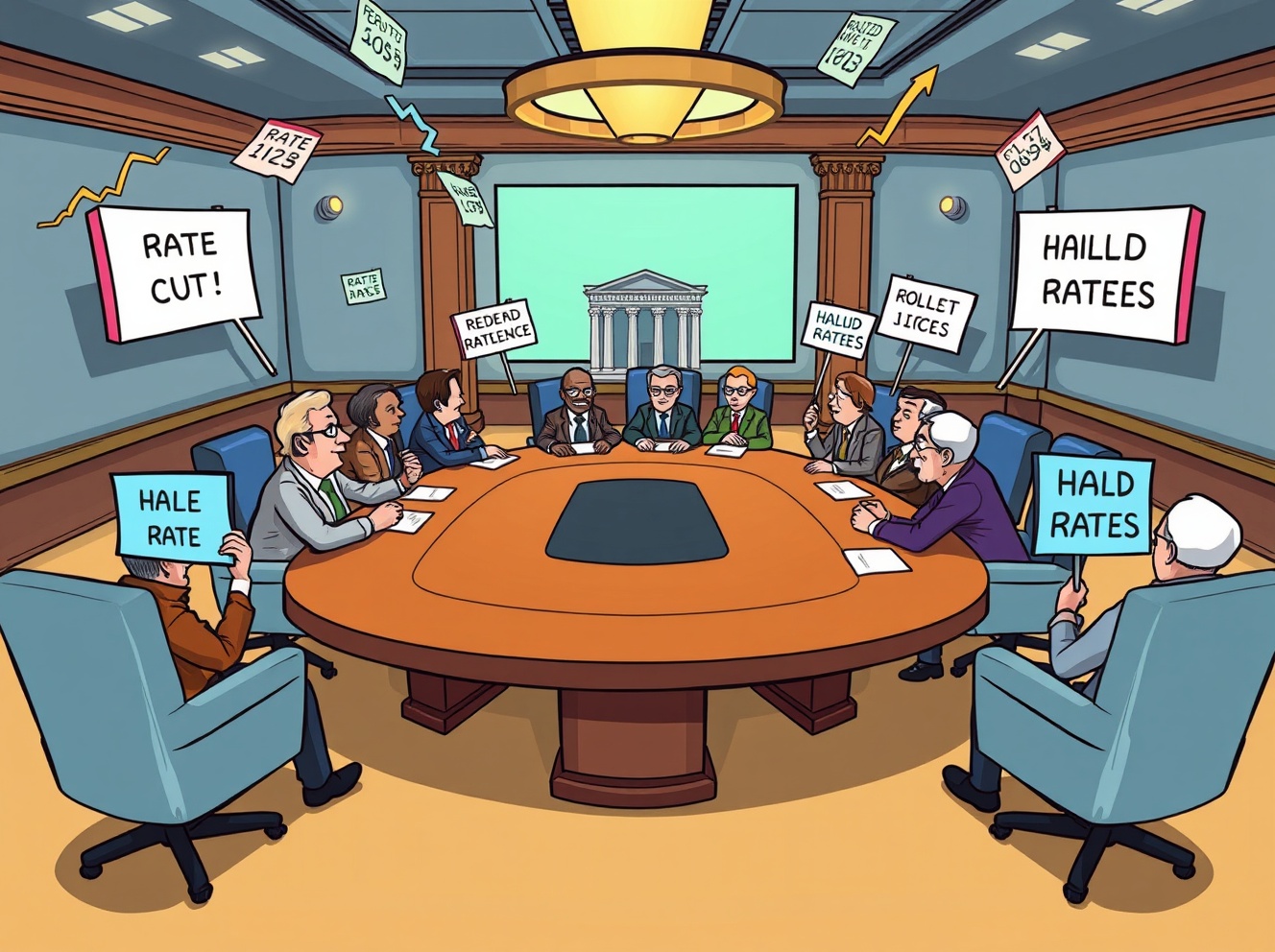
The latest FOMC minutes have sent shockwaves through financial markets, revealing deep divisions among Federal Reserve officials about the timing of interest rate cuts. For cryptocurrency investors, understanding these FOMC minutes is crucial for anticipating market movements and making informed decisions. What do the FOMC minutes reveal about rate cuts? The October FOMC minutes show a clear split among Federal Reserve members regarding monetary policy direction. Several officials strongly opposed implementing rate cuts, while others believed reductions should begin as early as December. This division within the FOMC minutes creates significant uncertainty for traders and investors across all asset classes, including cryptocurrencies. Most committee members agreed that policy would eventually become more accommodative. However, the timing remains highly contested. The debate captured in these FOMC minutes highlights the delicate balance the Fed must strike between controlling inflation and supporting economic growth. Why should crypto traders care about FOMC minutes? Cryptocurrency markets have become increasingly sensitive to Federal Reserve policy decisions. The FOMC minutes provide valuable insights into: Interest rate expectations that impact risk appetite Liquidity conditions affecting capital flows into crypto Market sentiment shifts that can trigger volatility Institutional positioning based on monetary policy outlook When analyzing FOMC minutes, crypto investors should pay particular attention to discussions about quantitative tightening and forward guidance. What was the consensus in the FOMC minutes? Despite disagreements on rate cuts, the FOMC minutes showed near-unanimous support for ending quantitative tightening by December 1st. This potential reduction in balance sheet runoff could provide additional liquidity to financial markets. The FOMC minutes indicate that most members anticipate a gradual shift toward more accommodative policy, though the exact timing remains uncertain. The division captured in these FOMC minutes reflects broader economic uncertainties. Some members expressed concern about moving too quickly with rate cuts, while others worried about maintaining restrictive policy for too long. How can investors use FOMC minutes for crypto strategy? Understanding FOMC minutes helps crypto traders develop more effective risk management strategies. Key takeaways from the latest FOMC minutes include: Monitor Fed communications for policy shift signals Prepare for volatility around FOMC meetings Diversify timing of entries and exits Watch bond markets for confirmation of Fed expectations The current FOMC minutes suggest that while rate cuts are coming, the path remains uncertain and potentially volatile. What’s next after these revealing FOMC minutes? The division highlighted in the FOMC minutes sets the stage for intense scrutiny of upcoming economic data. Future employment reports, inflation numbers, and growth indicators will likely determine which faction within the Fed prevails. For crypto markets, this means continued sensitivity to economic releases and Fed speaker comments. These FOMC minutes serve as a crucial reminder that central bank policy remains a primary driver of market sentiment. The lack of consensus suggests we may see significant market reactions to each new data point as traders attempt to anticipate the Fed’s next move. Frequently Asked Questions What are FOMC minutes? FOMC minutes are detailed records of Federal Open Market Committee meetings, released three weeks after each meeting. They provide insights into Fed officials’ discussions and policy considerations. How do FOMC minutes affect cryptocurrency prices? FOMC minutes influence crypto prices by shaping interest rate expectations, which affect risk appetite, dollar strength, and capital flows into digital assets. When are FOMC minutes released? FOMC minutes are typically released at 2: 00 PM ET, three weeks after each FOMC meeting. There are eight scheduled meetings per year. What was the key takeaway from October’s FOMC minutes? The key takeaway was significant division among Fed officials about the timing of rate cuts, with some supporting December reductions while others preferred maintaining current rates. How quickly do markets react to FOMC minutes? Markets typically react within minutes of FOMC minutes release, with volatility often persisting through the trading session as investors digest the information. Why do FOMC minutes matter for long-term crypto investors? FOMC minutes provide clues about future monetary policy that can influence macroeconomic conditions, regulatory environment, and institutional adoption of cryptocurrencies over extended periods. Found this analysis of the FOMC minutes helpful? to help them understand how Federal Reserve policy impacts digital asset markets! To learn more about the latest crypto market trends, explore our article on key developments shaping Bitcoin price action and institutional adoption.
https://bitcoinethereumnews.com/tech/critical-fomc-minutes-reveal-shocking-division-on-rate-cuts/

BlackRock Moves $815M in BTC and ETH amid ETF Outflows

BlackRock has moved nearly $1 billion in Bitcoin and Ethereum to Coinbase while the crypto ETF markets for these two assets face heavy outflows. The large transfers were captured on Arkham Intelligence, showing coordinated flows from BlackRock’s ETF-linked wallets into Coinbase Prime across two consecutive days. BlackRock’s BTC and ETH Transfers Exceed $1 Billion The latest deposits included 6, 735 BTC and 64, 706 ETH, representing one of BlackRock’s biggest on-chain moves this month. These transfers followed another round of activity from the previous day, when 3, 064 BTC and 64, 707 ETH (totaling almost $500 million) were deposited into Coinbase. Together, the two-day total crossed $1 billion, highlighting aggressive fund movement across BlackRock’s spot ETF products. It also means that it is the third successive day the firm would be making these transfers. On Monday, BlackRock deposited BTC and ETH worth millions into Coinbase. All assets were sent to Coinbase Prime since it is BlackRock’s core settlement and execution platform for its spot Bitcoin and Ethereum ETFs. Bitcoin and Ethereum ETFs Record Significant Outflows This activity comes during a tough period for ETF flows. According to SoSoValue data, U. S. Bitcoin Spot ETFs recorded a net outflow of about $373 million. The biggest withdrawals were from BlackRock’s IBIT, with over $523 million, in one day. Other issuers reported mixed results, but none matched the scale of BlackRock’s outflows. According to ETF analyst Eric Balchunas, this outflow was IBIT’s worst day. He further said that Bitcoin ETFs now have up to $13. 3 billion total outflows in the last month. This amount represents 3. 5% of their total assets under management. However, he emphasized that IBIT continues to dominate the industry with $25 billion year-to-date inflows, making it to rank sixth among all ETFs. Ethereum ETFs also struggled. BlackRock remains the most popular provider of ETFs despite experiencing outflows. IBIT is its most lucrative ETF and ETHA is the top Ethereum product among other Ether ETFs. These movements indicate how liquidity can shift quickly as institutional funds make moves in the markets. Macro Uncertainty Weighs on Crypto The timing is notable. Bitcoin is still experiencing pressure following recent losses, and Ethereum is still experiencing poor liquidity. There has also been a weakness in sentiment in the broader markets. The crypto market is currently facing macro uncertainty before the release of Nvidia’s report earnings, FOMC minutes, and America’s employment statistics. Despite the outflows, the large Coinbase deposits do not imply direct selling. The asset manager may be preparing the cryptocurrencies for ETF creation, redemption, or internal liquidity adjustments.
https://bitcoinethereumnews.com/bitcoin/blackrock-moves-815m-in-btc-and-eth-amid-etf-outflows/

Exit mobile version
Sitemap Index