
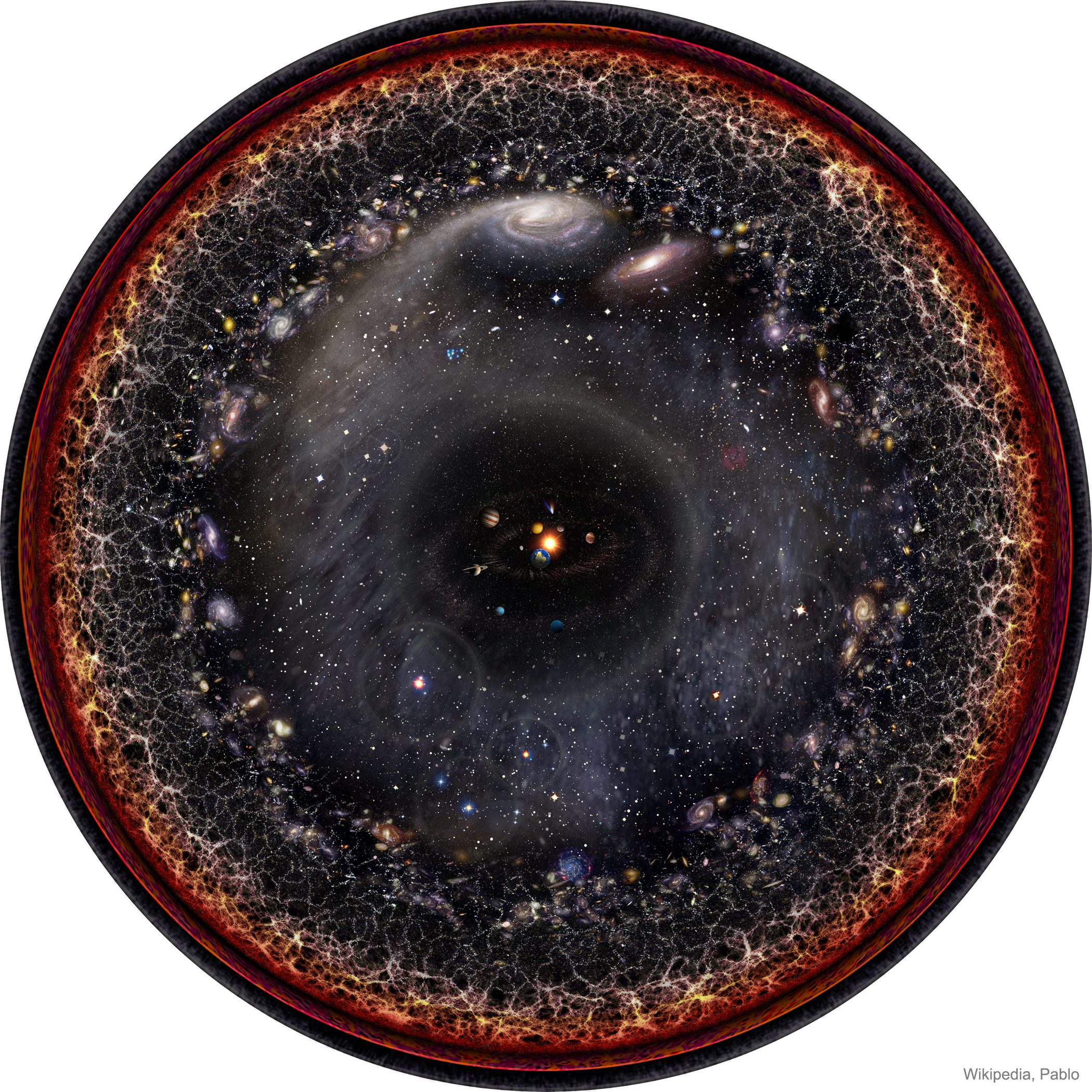
Astronomy Picture of the Day The Observable Universe NASA ^ | 23 Nov, 2025 | Illustration Credit & Licence: Wikipedia, Pablo Carlos Budassi Posted on by MtnClimber Explanation: How far can you see? Everything you can see, and everything you could possibly see, right now, assuming your eyes could detect all types of radiations around you — is the observable universe. In light, the farthest we can see comes from the cosmic microwave background, a time 13. 8 billion years ago when the universe was opaque like thick fog. Some neutrinos and gravitational waves that surround us come from even farther out, but humanity does not yet have the technology to detect them. The featured image illustrates the observable universe on an increasingly compact scale, with the Earth and Sun at the center surrounded by our Solar System, nearby stars, nearby galaxies, distant galaxies, filaments of early matter, and the cosmic microwave background. Cosmologists typically assume that our observable universe is just the nearby part of a greater entity known as “the universe” where the same physics applies. However, there are several lines of popular but speculative reasoning that assert that even our universe is part of a greater multiverse where either different physical constants occur, different physical laws apply, higher dimensions operate, or slightly different-by-chance versions of our standard universe exist. For more detail go to the link and click on the image for a high definition image. You can then move the magnifying glass cursor then click to zoom in and click again to zoom out. When zoomed in you can scan by moving the side bars on the bottom and right side of the image. 1 posted on by MtnClimber To: MtnClimber 2 posted on by MtnClimber (For photos of scenery, wildlife and climbing, click on my screen name for my FR home page.) To: 21stCenturion; 21twelve; 4everontheRight; A Navy Vet; A_perfect_lady; abb; AFB-XYZ; AFPhys; . Pinging the APOD list 🪐 🌟 🌌 🍔 3 posted on by MtnClimber (For photos of scenery, wildlife and climbing, click on my screen name for my FR home page.) Disclaimer: Opinions posted on Free Republic are those of the individual posters and do not necessarily represent the opinion of Free Republic or its management. All materials posted herein are protected by.
https://freerepublic.com/focus/f-chat/4354218/posts
Tag: gravitational

Tiny dwarf galaxies help solve a 40-year dark matter debate
For decades, scientists have puzzled over why galaxies spin faster than expected. The stars in their outer regions move so quickly that, by the laws of physics, they should fly apart. Something unseen—something massive—seems to be holding them together.
This invisible force has long been attributed to dark matter, a mysterious substance that makes up most of the universe’s mass but has never been directly detected. However, some physicists have argued that dark matter may not exist at all, suggesting instead that the laws of gravity themselves might need rewriting.
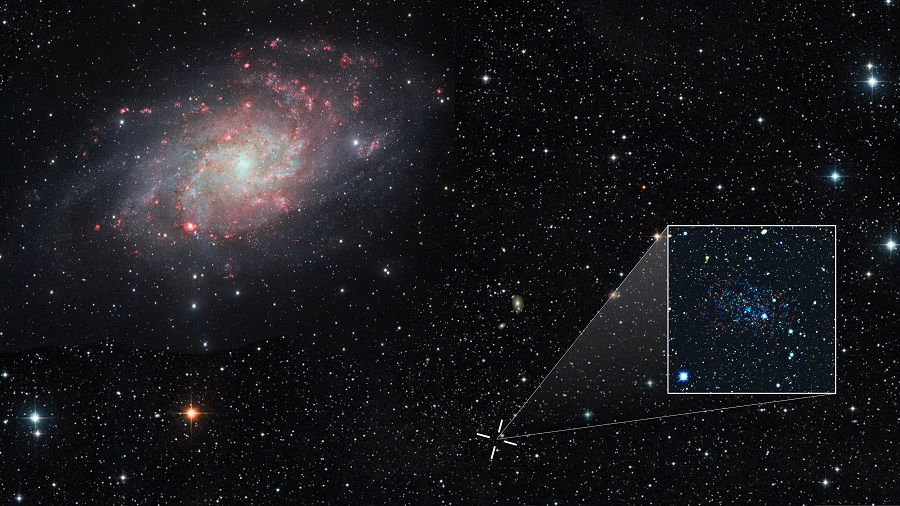
Now, new research led by the Leibniz Institute for Astrophysics Potsdam (AIP) has taken a major step toward resolving this debate. By studying the smallest and faintest galaxies in the universe—known as dwarf galaxies—the team has found strong evidence supporting the existence of dark matter over alternative theories of gravity.
Their findings, published in *Astronomy & Astrophysics*, suggest that even the tiniest galaxies contain vast halos of dark matter that govern their motion.
### International Collaboration and Methodology
The study was carried out by an international collaboration of scientists from institutions including the University of Surrey, the University of Bath, Nanjing University, the University of Porto, Leiden University, and Lund University.
The researchers focused on 12 dwarf galaxies and carefully mapped how fast their stars move at different distances from the center. Because dwarf galaxies are so small and faint, gathering such precise data was previously impossible. But thanks to new observations and powerful simulations, the team was able to measure their internal gravitational forces in unprecedented detail.
### Testing Modified Newtonian Dynamics (MOND)
One of the competing theories they tested is called Modified Newtonian Dynamics (MOND). First proposed in the 1980s, MOND suggests that the laws of gravity change under very weak conditions, eliminating the need for dark matter entirely.
Yet, when the team compared MOND’s predictions to the observed star motions, the numbers didn’t add up.
“Both the observations and our simulations show that the gravitational field cannot be explained by visible matter alone,” said Mariana Júlio, a PhD student at AIP and the study’s lead author. “This contradicts modified gravity predictions and reinforces the need for dark matter.”
### Simulations Confirm Dark Matter’s Role
To check their results, the team ran detailed computer simulations using the UK’s DiRAC National Supercomputer. Models that assumed the presence of dark matter produced far better matches to the observed data than those using MOND.
The simulations also revealed that dwarf galaxies behave differently from larger ones. While big galaxies follow a clear relationship between the amount of visible matter and their gravitational pull—known as the radial acceleration relation—this link breaks down in dwarf galaxies.
“Our results confirm that dwarf galaxies don’t behave like scaled-down versions of big galaxies,” explained Dr. Marcel Pawlowski, co-author of the study. “They show higher accelerations than expected, which means there’s more unseen mass—most likely dark matter.”
### Implications and Future Research
Professor Justin Read from the University of Surrey added that new data are allowing researchers to map the gravitational fields of galaxies in greater detail than ever before.
“We can’t explain what we see using only visible matter,” he said. “The simplest explanation is that these galaxies are surrounded by halos of dark matter, which encode the missing information. The modified gravity models just don’t fit.”
While the study doesn’t reveal what dark matter actually is, it narrows the range of possible explanations and strengthens the case for its existence. Future observations of even smaller and more distant galaxies may bring scientists closer to finally uncovering the true nature of the universe’s invisible matter.
https://knowridge.com/2025/11/tiny-dwarf-galaxies-help-solve-a-40-year-dark-matter-debate/

Dark matter obeys gravity just like ordinary matter, scientists discover
For decades, scientists have been trying to understand dark matter—the mysterious, invisible substance that makes up about 85% of all matter in the universe. It doesn’t emit or reflect light, making it impossible to see directly, and its nature remains one of the biggest puzzles in physics.
Now, a new study from researchers at the University of Geneva (UNIGE) and their international collaborators suggests that dark matter behaves much like ordinary matter when it comes to gravity.
The findings, published in *Nature Communications*, indicate that dark matter falls into gravitational wells—the regions of space distorted by the pull of massive objects—just as normal matter does. This discovery supports the idea that dark matter follows Einstein’s general theory of relativity and is not influenced by a mysterious “fifth force.”
However, the results still leave open the possibility that an undiscovered force could exist, albeit one much weaker than gravity.
Ordinary matter—the kind that makes up stars, planets, and humans—responds to four known forces: gravity, electromagnetism, and the strong and weak nuclear forces that operate inside atoms. But dark matter, which interacts very little with anything other than gravity, has long been suspected of possibly obeying an additional, unknown force.
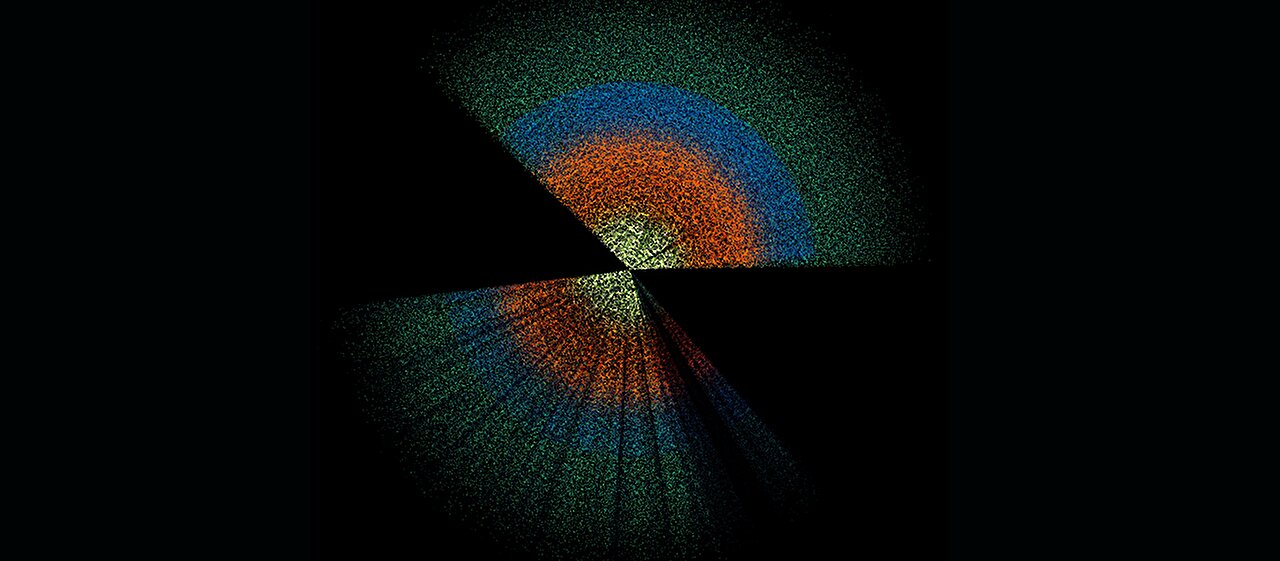
To test this, the UNIGE-led team examined the motion of galaxies across the universe. Because galaxies are mostly made of dark matter, their movements should reveal how dark matter behaves under the influence of gravity.
“We compared the velocities of galaxies with the depths of the gravitational wells they fall into,” explained Camille Bonvin, a theoretical physicist at UNIGE and co-author of the study.
If dark matter followed different rules than ordinary matter, galaxies would move in unexpected ways—falling faster or slower into these wells depending on whether another force was acting on them.
“Our results suggest that dark matter obeys the same equations that describe ordinary matter,” Bonvin said. Specifically, the researchers found that Euler’s equations, which describe how matter moves under gravity, still hold true for dark matter.
However, they caution that this does not fully eliminate the possibility of a new, extremely weak force. According to Nastassia Grimm, the study’s lead author, if such a fifth force exists, it would have to be less than 7% as strong as gravity, or it would have already been detected.
The team’s next goal is to push these limits even further. Future astronomical surveys—such as the Legacy Survey of Space and Time (LSST) and the Dark Energy Spectroscopic Instrument (DESI)—will collect even more precise data on galaxy motion. These new observations could detect forces as faint as 2% of gravity’s strength, offering deeper insight into dark matter’s true nature.
“This study marks an important step forward,” said Isaac Tutusaus, co-author and researcher at the University of Toulouse. “We now know dark matter doesn’t blatantly defy gravity—but the universe may still be hiding subtle forces we’ve yet to uncover.”
https://knowridge.com/2025/11/dark-matter-obeys-gravity-just-like-ordinary-matter-scientists-discover/