
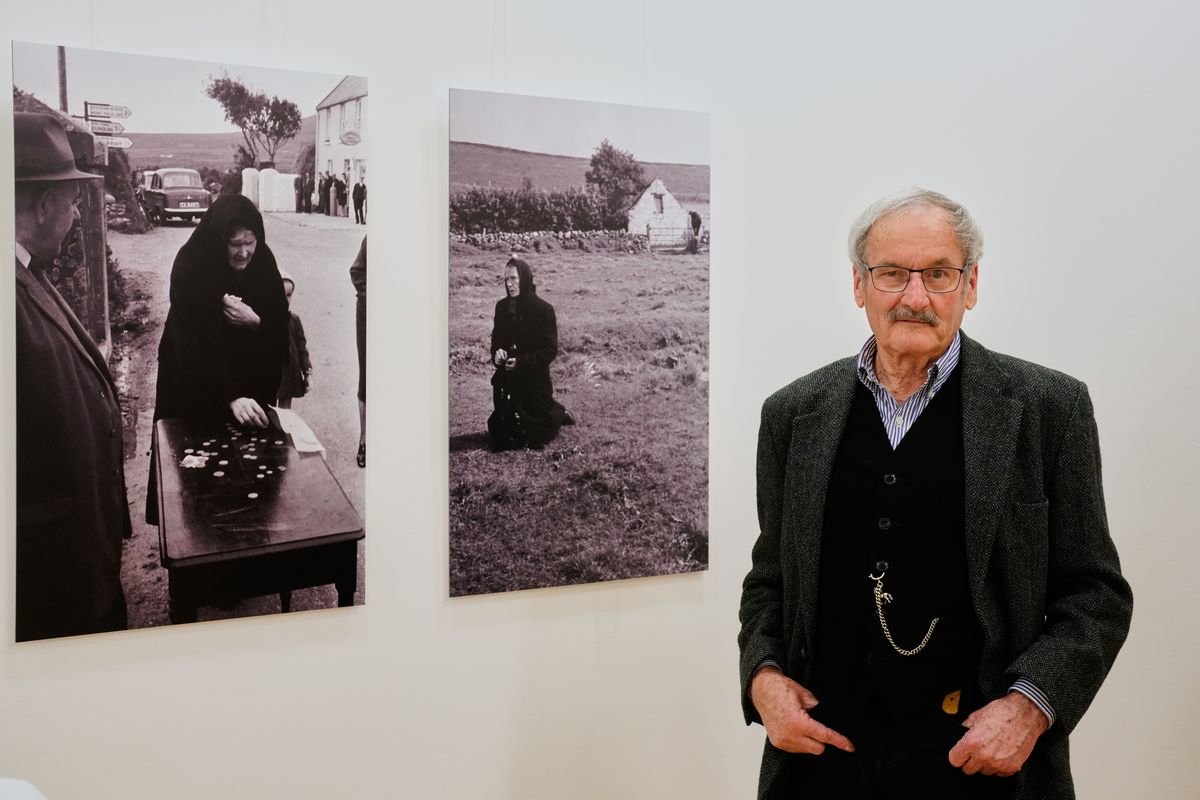
BERLIN (AP) Rare photographs of Ireland from 1963 show a world about to disappear, a country before it took its first steps toward modernity. Black and white images captured by a young German photographer, Diether Endlicher who later spent four decades covering the Olympics and major global events for The Associated Press are being shown at the Irish embassy in Berlin, where Endlicher, now 85, was honored last weekend for his role in documenting moments of Irish life from another era. The photos feature boatmen, fishermen, workmen, herders taking their animals to markets, women transporting milk by donkey cart, a funeral, devout worshippers praying to relics in stone-walled fields, ruined abbeys, dramatic landscapes, children looking at TVs through a shop window, an evocation of a time before modern conveniences arrived to convert all. The pictures lay unseen and forgotten in Endlicher’s attic until recently, when he rediscovered them after deciding to go through his archive. He scanned the now 62-year-old negatives and contacted the embassy to see if there was any interest. There was. Maeve Collins, the Irish ambassador to Germany, praised the photographs’ “beautiful detail” and historical importance. “They bring a vivid expression to the lived experience of people on the west coast of Ireland in the early 1960s,” she said. Photos are record of a road trip Endlicher was 22 when he traveled with a friend from Germany to the west coast of Ireland in a tiny Fiat 500, a two-door bubble car known as the “Bambino” that was not designed for road trips. He carried a Leica M2 and three lenses to places where few had seen cameras before. Once they got to Ireland’s west coast, they found a man transporting turf to Inishmaan, one of the Aran Islands in Galway Bay, in a large sailing vessel with no motor. They decided to go with him and Endlicher took photos as they went. “I thought we’d never arrive there because the wind was not so strong. The boat traveled very slow,” Endlicher told the AP. “It was an interesting trip there and then when we landed on Inishmaan, that was a different world.” He saw fishermen at work, and peasants threshing barley by beating stalks on stones. Their clothes were home-spun from tweed. Electricity hadn’t reached the island. Turf from the mainland was used for heating and cooking. Many of the locals made clear they didn’t want their photos taken. The Aran Islands are still part of the Gaeltacht, the Irish-speaking area, and on Inishmaan at the time, most did not speak any English. “Inishmaan was a different world, even from the mainland,” Endlicher said. “Europe was very different then and so the difference between Ireland and Europe, mainland European countries was not so big. The agriculture was about the same. Farmers worked with horses. The only thing that was different in Ireland was donkeys. There were many donkeys at the time.” Return to work for the AP Endlicher returned to Ireland in 1984 to cover U. S. President Roland Reagan’s visit for the AP. He worked for the news agency from 1965 to 2007. “I covered 29 Olympics altogether, Winter and Summer Olympics. I covered many Winter Olympics. As a Bavarian, I almost grew up on skis,” said Endlicher, who would ski the slopes before big races to find the best positions for photos. Endlicher was at the 1972 Olympics in Munich where 11 Israeli athletes and coaches were killed after being targeted by the Palestinian group Black September. He traveled to Israel for news assignments in the 1980s and 90s and did several stints in Gaza, where he saw the first intifada, a Palestinian uprising against Israel’s military occupation of the West Bank and Gaza. He remembers Israeli soldiers forcing him to hand over his film after he took photos of them beating a child who had been running with a Palestinian flag in Khan Younis, in Gaza. “I had no chance, I had to give them the film,” he said. Endlicher covered the changes unleashed by the fall of the Berlin Wall and the breakup of the Soviet Union, as well as uprisings in Georgia and Armenia. “I remember in Moscow, there was this uprising when the communists tried to occupy the parliament, that was after (former Russian President Boris) Yeltsin, there were a lot of shootings in Moscow,” he said. “I was undercover, under a truck, and next to me was a TV cameraman in a telephone cell, and they shot at the telephone cell and he was wounded.” Endlicher was also embedded with American troops during the Gulf War in 1991, and had been in Prague, Czechoslovakia for the Soviet invasion in 1968, when he relied on a taxi driver driving to and from Vienna, Austria to get his films out to be processed and transmitted. “He must have had some deal with the border police or the Russian army,” he said. Job presents dangers Reflecting on the dangers he faced over a 42-year career with the AP Endlicher also previously worked for German news agency DPA he said he believes there is a necessity to take pictures, to bear witness. “It’s necessary that some people are willing to take the risk. Like Anja Niedringhaus, she paid with her life,” he said of his former AP colleague who was killed in Afghanistan in 2014. “The thing is you have to be independent, I think. If you’re married and have kids, it’s a different story. If you are single and have no obligations . It’s also difficult to keep up friendships. I had also a time when the job was the most important thing to me. And I neglected some of my family life. It’s a conflict.” Endlicher’s son, Matthias, accompanied him to the embassy’s tribute on Saturday, and they were joined by his wife, Andrea, at the ambassador’s residence for dinner that evening. “I’m very happy that they saw the value of these pictures,” he said.
https://mymotherlode.com/news/world/10236594/former-ap-photographers-vintage-images-of-ireland-capture-a-world-before-it-disappeared.html
Tag: photographer

Letlive. and Taking Back Sunday in Las Vegas
This felt like a culmination of two separate worlds. Letlive. embodied the post-hardcore scene for the last twenty years and Taking Back Sunday the emo scene. Seeing them together on stage was truly a once in a lifetime experience. Both bands were stellar and delivered some of their best performances yet. Letlive. was, to no one’s surprise, stellar beyond belief. Jason Alan Butler has gained notoriety through all his bands as being one of the most captivating front man. He threw the bass drum, kicked over mic stands, and used his spilled water as a slip-n-slide across the stage. Every second of their set was captivating. Taking Back Sunday unveiled their new mega-lineup. This was the first time fans got to see both Fred Mascherino [from Where You Want To Be and Louder Now] and John Nolan [from the rest of their discography] play side-by-side. It felt like all eras of the seminal band colliding. They sounded fantastic and the new songs fit seamlessly next to their hits. We were fortunate enough to send our photographer @LiveOnToor out to capture the chaos. Please enjoy our gallery below. Letlive. Taking Back Sunday.
https://www.theaquarian.com/2025/11/18/letlive-and-taking-back-sunday-in-las-vegas/

Teen behind the Louvre heist ‘Fedora Man’ photo embraces his mystery moment
PARIS — When 15-year-old Pedro Elias Garzon Delvaux realized an Associated Press photo of him at the Louvre on the day of the crown jewels heist had drawn millions of views, his first instinct was not to rush online and unmask himself. Quite the opposite.
A fan of Sherlock Holmes and Hercule Poirot who lives with his parents and grandfather in Rambouillet, 30 kilometers (19 miles) from Paris, Pedro decided to play along with the world’s suspense. As theories swirled about the sharply dressed stranger in the “Fedora Man” shot — detective, insider, AI fake — he decided to stay silent and watch.
“I didn’t want to say immediately it was me,” he said. “With this photo there is a mystery, so you have to make it last.”
For his only in-person interview since that snap turned him into an international curiosity, he appeared for the AP cameras at his home much as he did that Sunday: in a fedora hat, Yves Saint Laurent waistcoat borrowed from his father, jacket chosen by his mother, neat tie, Tommy Hilfiger trousers and a restored, war-battered Russian watch. The fedora, angled just so, is his homage to French Resistance hero Jean Moulin.
In person, he is a bright, amused teenager who wandered, by accident, into a global story.
From Photo to Fame
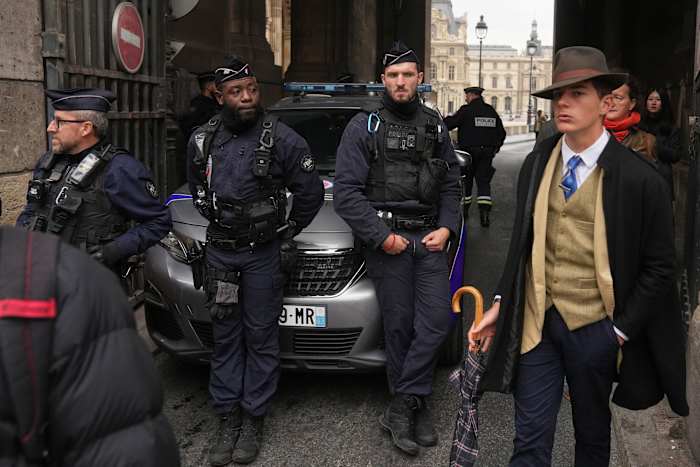
The image that made him famous was meant to document a crime scene. Three police officers lean on a silver car blocking a Louvre entrance, hours after thieves carried out a daylight raid on French crown jewels. To the right, a lone figure in a three-piece suit strides past — a flash of film noir in a modern-day manhunt.
The internet did the rest. “Fedora Man,” as users dubbed him, was cast as an old-school detective, an inside man, a Netflix pitch or not human at all. Many were convinced he was AI-generated.
Pedro understood why. “In the photo, I’m dressed more in the 1940s, and we are in 2025,” he said. “There is a contrast.” Even some relatives and friends hesitated until they spotted his mother in the background. Only then were they sure: The internet’s favorite fake detective was a real boy.
The Real Story
Pedro, his mother, and grandfather had come to visit the Louvre. “We wanted to go to the Louvre, but it was closed,” he said. “We didn’t know there was a heist.” They asked officers why the gates were shut. Seconds later, AP photographer Thibault Camus, documenting the security cordon, caught Pedro midstride.
“When the picture was taken, I didn’t know,” Pedro said. “I was just passing through.”
Four days later, an acquaintance messaged: Is that you? “She told me there were 5 million views,” he said. “I was a bit surprised.” Then his mother called to say he was famous.
“It’s not every day,” he said. Cousins in Colombia, friends in Austria, family friends and classmates followed with screenshots and calls.
“People said, ‘You’ve become a star,’” he said. “I was astonished that just with one photo you can become viral in a few days.”
An Inspired Style
The look that jolted tens of millions is not a costume whipped up for a museum trip. Pedro began dressing this way less than a year ago, inspired by 20th-century history and black-and-white images of suited statesmen and fictional detectives.
“I like to be chic,” he said. “I go to school like this.” In a sea of hoodies and sneakers, he shows up in a three-piece suit. And the hat? No, that’s its own ritual. The fedora is reserved for weekends, holidays and museum visits.
At his no-uniform school, his style has already started to spread. “One of my friends came this week with a tie,” he said.
He understands why people projected a whole sleuth character onto him: improbable heist, improbable detective. He loves Poirot — “very elegant” — and likes the idea that an unusual crime calls for someone who looks unusual.
“When something unusual happens, you don’t imagine a normal detective,” he said. “You imagine someone different.”
Life and Art
That instinct fits the world he comes from. His mother, Félicité Garzon Delvaux, grew up in an 18th-century museum-palace, daughter of a curator and an artist, and regularly takes her son to exhibits.
“Art and museums are living spaces,” she said. “Life without art is not life.” For Pedro, art and imagery were part of everyday life.
So when millions projected stories onto a single frame of him in a fedora beside armed police at the Louvre, he recognized the power of an image and let the myth breathe before stepping forward.
He stayed silent for several days, then switched his Instagram from private to public. “People had to try to find who I am,” he said. “Then journalists came, and I told them my age. They were extremely surprised.”
He is relaxed about whatever comes next. “I’m waiting for people to contact me for films,” he said, grinning. “That would be very funny.”
In a story of theft and security lapses, “Fedora Man” is a gentler counterpoint — a teenager who believes art, style and a good mystery belong to ordinary life.
One photo turned him into a symbol. Meeting him confirms he is, reassuringly, real.
“I’m a star,” he says, less brag than experiment, as if he’s trying on the words the way he tries on a hat. “I’ll keep dressing like this. It’s my style.”

Dave Hyde: A day for Diana Nyad, and a reunion of ‘two Fort Lauderdale girls’
**Diana Nyad Honored with Plaque at Fort Lauderdale Beach**
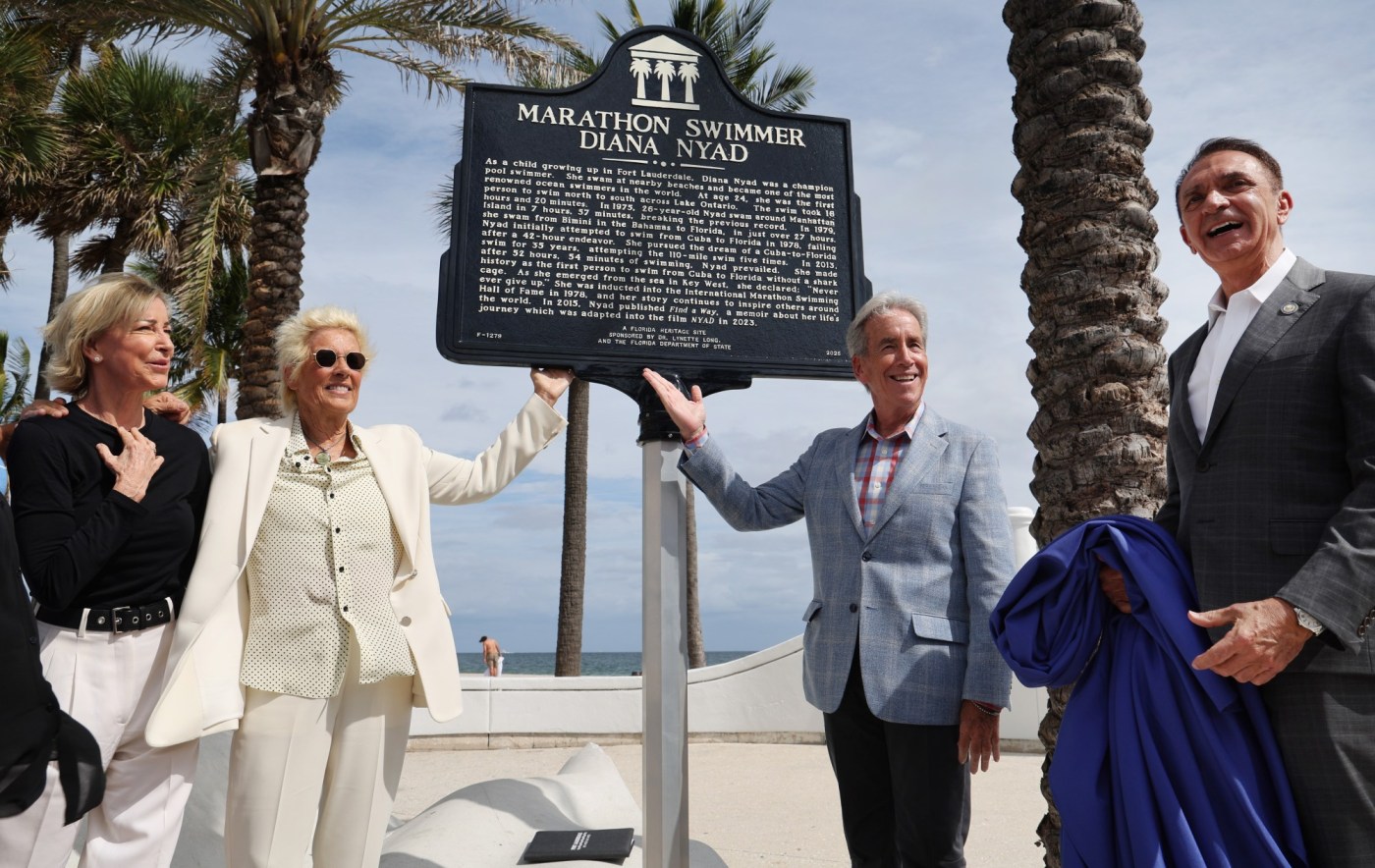
FORT LAUDERDALE — It was Diana Nyad’s day, her moment, and her stage as a plaque was unveiled honoring her life achievements at the very Fort Lauderdale beach where she played as a child.
Pointing up East Las Olas Boulevard to a bridge she’d walk over each day from her home on Desota Drive, Nyad, now 76, said, “This plaque is right where I’d come with my family from the time I was in second grade through high school.”
There was another girl who grew up just a few miles away — someone she met in Fort Lauderdale during the 1960s. They’d read about each other in the paper and often found themselves the only two girls at athletic awards banquets, so they would sit together.
“Chris, come in here for a picture,” Nyad called to Chris Evert, the tennis legend, as a photographer waited. The two friends have known each other for six decades, and now they smiled under the plaque that read, “Marathon Swimmer Diana Nyad.”
Nyad’s success is etched in history, from being the first to swim Lake Ontario north to south at age 24, to becoming the first person to swim from Cuba to Key West without a shark cage at age 64.
“I’m in absolute awe of her,” said Evert.
When told people say the same about her 18 Grand Slams, Evert responded, “I didn’t nearly die in those like she nearly did.”
Nyad nearly died after being stung by the highly venomous box jellyfish on one of her failed attempts to swim from Cuba. She failed three more times before finally succeeding. Those failures are all part of her achievement — the full journey that actresses Annette Bening and Jodie Foster brought to life in the 2023 movie, *Nyad*.
No one else who failed in attempting to cross the Florida Straits ever tried again — except Nyad.
It was that indomitable spirit that filled the ceremony with a few hundred family members, friends, politicians, and members of Nyad’s support team, who wore uniform T-shirts emblazoned with their motto: “Find A Way.”
Nyad continuously found her own way — from coming out as gay at 21 to swimming around Manhattan in a record seven hours and 58 minutes at age 26, a record for both men and women. She never felt hemmed in by what people thought — or later, by her age.
Swimming the 103 miles from Cuba to Key West in 52 hours, 54 minutes, and 11 seconds was impressive enough. But doing it at age 64? That was extraordinary.
“I faced challenges, but my challenges were within the line of the tennis court,” Evert said during a speech about Nyad. “You took on the ocean. The jellyfish. The sharks. The waves. The unpredictability of it all. And you did it with the belief that the human spirit can’t be held down at 64.”
Once role models for young Broward girls on how to excel as athletes, Nyad and Evert have gone on to be role models for how to age with courageous dignity — Nyad with that monumental swim, and Evert with her public battle against cancer in recent years.
Their story also highlights a broader issue. When Lynette Long conducted a study of Florida plaques in 2017, she found that just six of 950 honored women. Long has since pushed for ceremonies like Thursday’s honoring Nyad. Another ceremony is in the works for Evert.
“Two Fort Lauderdale girls,” said Evert, 70, at one point during the event.
Nyad attended Pine Crest School, while Evert went to St. Thomas Aquinas. Although Nyad was five years older, they forged a friendship in the way the best in any field do — occasionally crossing paths and supporting each other’s successes over the years.
Nyad visited Wimbledon twice and saw Evert there, even interviewing her for television after her final match in 1989. She also fondly remembers bumping into Evert at a Fort Lauderdale store years ago.
“Chris, Wimbledon!” Nyad exclaimed. “I saw your picture in the paper!”
Nyad punctuates the story by saying her picture was small compared to Evert’s larger headlines.
Evert laughs and admits she doesn’t remember the moment. But here they are, all these years later — two Fort Lauderdale girls standing under a plaque of achievement, getting their picture taken together.
“I love you,” Nyad said. “I’m so glad you came.”
“I wouldn’t have missed it,” Evert replied.
https://www.orlandosentinel.com/2025/11/06/dave-hyde-a-day-for-diana-nyad-and-a-reunion-of-two-fort-lauderdale-girls/


How the First Five Principles of Art and Design Can Make You a Better Photographer
Understanding the roles of the fundamental elements of art allows photographers to create compelling compositions. These elements are not merely aesthetic choices but essential tools for creating structure in your photography.
By mastering these basic components, you can guide the viewer’s eye, convey mood, and add depth to your images. Whether it’s line, shape, color, texture, or space, each element plays a crucial role in the overall impact of your photograph.
Incorporating these elements thoughtfully enables you to move beyond simple snapshots and craft photographs that tell a story and evoke emotion. Embrace these foundational principles to elevate your photography and create images that truly resonate.
https://petapixel.com/2025/10/25/how-the-first-five-principles-of-art-and-design-can-make-you-a-better-photographer/