
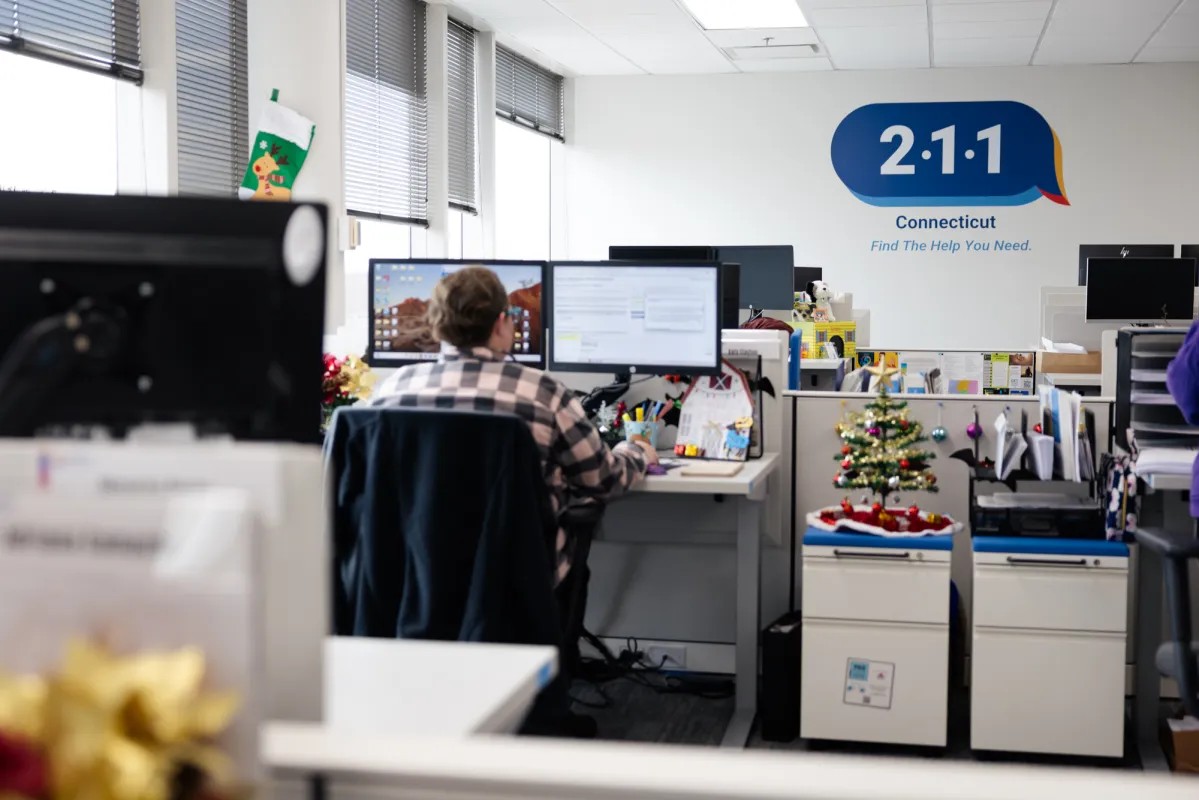
When Meg Slater found herself a single mom in her mid-20s, she feared she would have to quit her job as an office administrator at a Middletown engineering firm and move in with family in Georgia. Yet Connecticut’s 211 service, often called Infoline, steered her toward income-dependent housing and child care, as well as nutrition and energy assistance. Despite not receiving help from her daughter’s father, Slater kept her job, and within a few years with some help from family moved off assistance and met her future husband. But the United Way of Connecticut, which contracts with the state to run the 211 service, struggles to aid hundreds of thousands more residents now than it did when Slater sought help in the late 2000s. Further complicating matters, the 211 service, at first glance, is operating with the same state funding it received 15 years ago. But once those dollars are adjusted for inflation, a key part of Connecticut’s social safety net has lost nearly 30% of its resources. And officials fear vanishing federal aid for food, housing, heating and health care programs will push demand to unprecedented levels. “It’s important to me that if people find themselves in these situations, those solutions [still] exist,” said Slater, now 46 and a member of the United Way of Middlesex’s governing board for the past eight years and a regular donor to the nonprofit. “I don’t need them anymore, but I know there are literally thousands of people in our state struggling.” Inflation shrinks state aid even as demand swells The 211 service responded to more than 1. Annual state funding for the program, which covers more than nine out of 10 of these requests, is slightly less than $3. 7 million. But that funding barely has changed in a decade and a half, having stood at slightly more than $3. 5 million in 2010. Once adjusted for inflation, annual state support is down more than $1. 6 million. That’s the wrong trend for a service that must track hundreds of federal, state, municipal and private-sector human service programs, said Lisa Tepper Bates, president of the United Way in Connecticut. “We are the connector, providing for people the path to what they need . and we play that role for all of the resources that we represent in Connecticut,” she said. “We make sure that government investments and the investments of our friends in philanthropy actually hit their intended mark.” Whether the most complex state or federal benefit program changes its eligibility rules, or the smallest local clothing bank adjusts its hours, Infoline must maintain an up-to-date database, and staff must always be ready to give out detailed, accurate guidance. “Sometimes a food pantry has moved across town, and they just haven’t updated their address” on websites or fliers, Bates said. “The last thing you want to do for someone in need is send them to the wrong location, at hours that it’s not open.” Ronette Daniels of Stratford, an Infoline staffer for more than 10 years, said the job has become increasingly complex as a general sense of anxiety has grown among the public since 2020. “Post-COVID, I think there’s been a change in general,” she said, adding that staff have tried to respond with compassion. Front line staff, who generally earn between $50,000 and $62,000 per year, also undergo counseling training, not just updates on the latest changes to human services. The United Way’s 211 phone banks and central operations, housed in its office suite in Rocky Hill, include not only call centers and training areas but also rooms for staffers to decompress after particularly stressful calls. Though requests for help with household and shelter were the single-largest type of inquiry received last fiscal year about 36% of the more than $1. 7 million total mental health and addiction-related requests ranked second, representing more than 20%. Most callers require solutions that involve a combination of services, Bates said, adding that emotional strain or trauma often is a component. “The first thing they do is to validate how hard that must be, and to provide empathy and respect for the dignity of that person,” she added. When she approached 211 for help, Slater said, she was distraught at the prospect of moving to southeastern Georgia, where her daughter would have attended one of the lowest-rated public school systems in the nation. “The person on the other end of the phone was trained to make me feel comfortable and try and help me understand that, a), I wasn’t alone, and b), there were solutions.” Food-related inquiries, which approached 180, 000 or 10% last year, neared 117, 000 after only about four months this fiscal year, spurred on by the federal government shutdown that stalled Supplemental Nutrition Assistance Program benefits. Infoline staff also routinely coordinate aid involving employment, health care, utilities, legal issues, clothing, transportation, child care and education. CT officials expect many service providers to seek more funds The state has grown funding for some specialized programs under the 211 umbrella. A 988 Suicide and Crisis Lifeline, which didn’t exist 15 years ago, receives about $6. 8 million annually from the state. And youth and housing crisis response services that collectively received about $510,000 then now get more than $2. 9 million. But the volume of cases handled by those three programs represent roughly 7% of the inquiries whether they come in through email, phone or the website directed to the Infoline service, Bates said. And she added limitations set in contracts with the state bar United Way officials from shifting resources from one program to another. The core information and referral program, which had 32 front-line staff in 2010, now has just 17 and handles the remaining 93% of the inquiries. Starting in 2017, Infoline had to begin offering callers the ability to request a call back, rather than wait on the phone. About 7% of callers chose that option last fiscal year. The service also tries to prioritize calls from pregnant women and others with special needs. These trends sparked several appeals for more state funding from the United Way. And the General Assembly’s Appropriations Committee has endorsed funding increases in some recent years, but those hikes haven’t made it into the final budget adopted by the full legislature and Gov. Ned Lamont. And the entire $3. 7 million budget for the core 211 information and referral program represents a tiny fraction of state government’s finances about 1/65th of 1% of this year’s $24 billion General Fund and 1/5th of 1% of this fiscal year’s projected $1. 8 billion surplus. But Connecticut since 2017 has been following a series of aggressive budget caps that force large surpluses, which then have been used to build reserves and whittle down the state’s hefty pension debt. Still, Rep. Toni E. Walker, D-New Haven, and Sen. Cathy Osten, D-Sprague, co-chairwomen of the Appropriations Committee, both praised the operations of the 211 service. But while they didn’t rule out again recommending more funding, they also said their panel likely will face unprecedented calls for increased state dollars from across the spectrum of state, municipal, and private nonprofit social service providers. Those same cuts in federal funding on nutrition assistance, heating aid, health care and other programs that are straining Infoline are placing unprecedented pressure on other programs as well. “People are panicking,” Walker said. “It’s their food, their housing, their health care that are being attacked. I don’t know if we can cover 100%.” “I think we’re going to hear from everybody,” Osten added. Lamont’s budget spokesman, Chris Collibee, said only that the administration is reviewing funding requests from many human service providers. When Lamont recommends his budget for the 2026-27 fiscal year on Feb. 4 to the legislature, Collibee added, the package “will safeguard essential safety nets and fulfill his commitment to increasing affordability for all residents.” Slater, who began donating to support the 211 service even before she stopped needing public assistance programs, said state officials view the program as an economic investment, even if they don’t feel a moral obligation toward it. “It was important to me to put it back,” she said of her donations, adding it was done partly from gratitude and partly to challenge negative perceptions. “I think our society has really stigmatized being poor as bad choices that you make. You make bad choices, and that’s how you’re poor,” she said. But Slater added her experience with 211 showed her life simply presents difficult challenges at times and that she could be successful. “I just don’t think that people understand that life just happens. And you can try and make the best choices that are in front of you.” Keith M. Phaneuf is a reporter for the Connecticut Mirror. org).
https://www.courant.com/2025/11/20/cts-211-fielded-1-7-million-calls-for-help-last-year-its-had-the-same-state-funding-for-15-years/
Tag: administrator


Duffy warns air travel will slow to ‘a trickle’ during holiday season if govt. shutdown persists
**OAN Staff | Blake Wolf**
*2:17 PM Sunday, November 9, 2025*
Transportation Secretary Sean Duffy has warned that air travel will slow to “a trickle” as Thanksgiving approaches, due to the ongoing government shutdown negatively impacting the availability of air traffic controllers.
The Federal Aviation Administration (FAA) has notified airlines to reduce flights by 6% starting Tuesday, with a further reduction to 10% on November 14th if the shutdown continues.
“We are seeing signs of stress in the system, so we are proactively reducing the number of flights to make sure the American people continue to fly safely,” FAA Administrator Bryan Bedford said earlier this week.
Duffy also warned that flight reductions could increase to as much as 20% if the shutdown remains unresolved, which would significantly affect the public’s ability to travel during the holidays.
“It’s only going to get worse,” Duffy added, highlighting the growing concerns among travelers.
—
*Subscribe to get the latest updates directly to your inbox for free.*
*What do YOU think? Click here to jump to the comments!*
https://www.oann.com/newsroom/duffy-warns-air-travel-will-slow-to-a-trickle-during-holiday-season-if-govt-shutdown-persists/

Joe Minter, Renowned Birmingham Sculptor, to be Honored at City’s Classic Week ‘AWAKEN’ Event
The City of Birmingham will present its annual AWAKEN event in celebration of local changemakers who use creativity, advocacy, and service to advance social justice and community progress. This year’s program theme is **“Art as Resistance: Awakening Justice Through Creativity”** and will honor Joe Minter, a world-renowned sculptor, community historian, and founder of African Village in America. His visionary art chronicles the Black experience and the struggle for freedom, justice, and unity.
The event, orchestrated by the Division of Social Justice and Racial Equity, will take place on **Friday, Oct. 24, at 9 a.m.** at the Birmingham Museum of Art.
> “Art has always been a language of liberation,” said Mayor Randall L. Woodfin. “Through AWAKEN, we celebrate artists and advocates like Joe Minter who remind us that creativity is not only an act of expression, but also an act of resistance—a tool to awaken justice in all of us.”
Held annually during Magic City Classic Week, AWAKEN was created to spark meaningful dialogue, reflection, and education around Birmingham’s enduring legacy of activism and leadership. Each year, the event serves as a bridge between Birmingham’s historic civil rights struggle and the city’s modern movement for equity. It brings together artists, activists, and community leaders who continue to push for justice through creative expression.
As part of the program, Mayor Woodfin will present the **Putting People First Award** to Joe Minter, recognizing his vision that embodies Birmingham’s ongoing pursuit of equity and justice.
### About Joe Minter
Joe Minter is an artist and cultural historian living in the Titusville neighborhood, surrounded by his magnum opus — a sprawling didactic artwork he has dubbed the **African Village in America**. He recently exhibited at prestigious venues including the Royal Academy of Arts in London, Mana Contemporary, and the Minneapolis Institute of Art.
His work has been the subject of solo exhibitions at the Alabama Contemporary, Atlanta Contemporary, James Fuentes Gallery, and Tops Gallery. In 2019, he was featured in the Whitney Biennial, curated by Rujeko Hockley and Jane Panetta.
Minter’s artwork is included in the permanent collections of several major institutions, including:
– The Metropolitan Museum of Art, New York
– The Whitney Museum of American Art, New York
– The National Gallery of Art, Washington, D.C.
– The Smithsonian American Art Museum, Washington, D.C.
### Event Highlights
The program will also feature:
– A musical performance by trumpeter **Nathaniel Bagley**
– Poetry by Birmingham Poet Laureate **Salaam Green**
– Spoken word by **Quang Do**, president & CEO of Create Birmingham
Additionally, there will be a panel discussion on **“Art as Resistance”** featuring:
– Storyteller and craftivist **Wilhelmina Thomas**
– Visual artist **Willie E. Williams, Jr.**
– Arts administrator **John Fields**, senior director of UAB Abroms-Engel Institute for the Visual Arts
The conversation will be moderated by Gina Mallisham, executive director of the Jefferson County Memorial Project.
### Past Themes & Honorees
Since its inception, AWAKEN has honored Birmingham’s trailblazers who continue to shape the city’s story of resilience and reform. Past themes and honorees include:
– **2024:** Staying Woke in Voting Rights — Honoring Judge U. W. Clemon
– **2023:** Lifting Voices: Changing History — Honoring The Carlton Reese Memorial Unity Choir
– **2022:** Family Reunion: Stories Never Told — Honoring Dr. Shelley Stewart
– **2021:** Building the Beloved Community — Honoring Odessa Woolfolk
– **2019:** Hope for the World — Honoring Mayor Richard Arrington
The event is free to attend, but **registration is required**.
For more information and to register, please visit the City of Birmingham’s official website.
https://www.birminghamtimes.com/2025/10/the-city-of-birmingham-presents-awaken-art-as-resistance-awakening-justice-through-creativity/