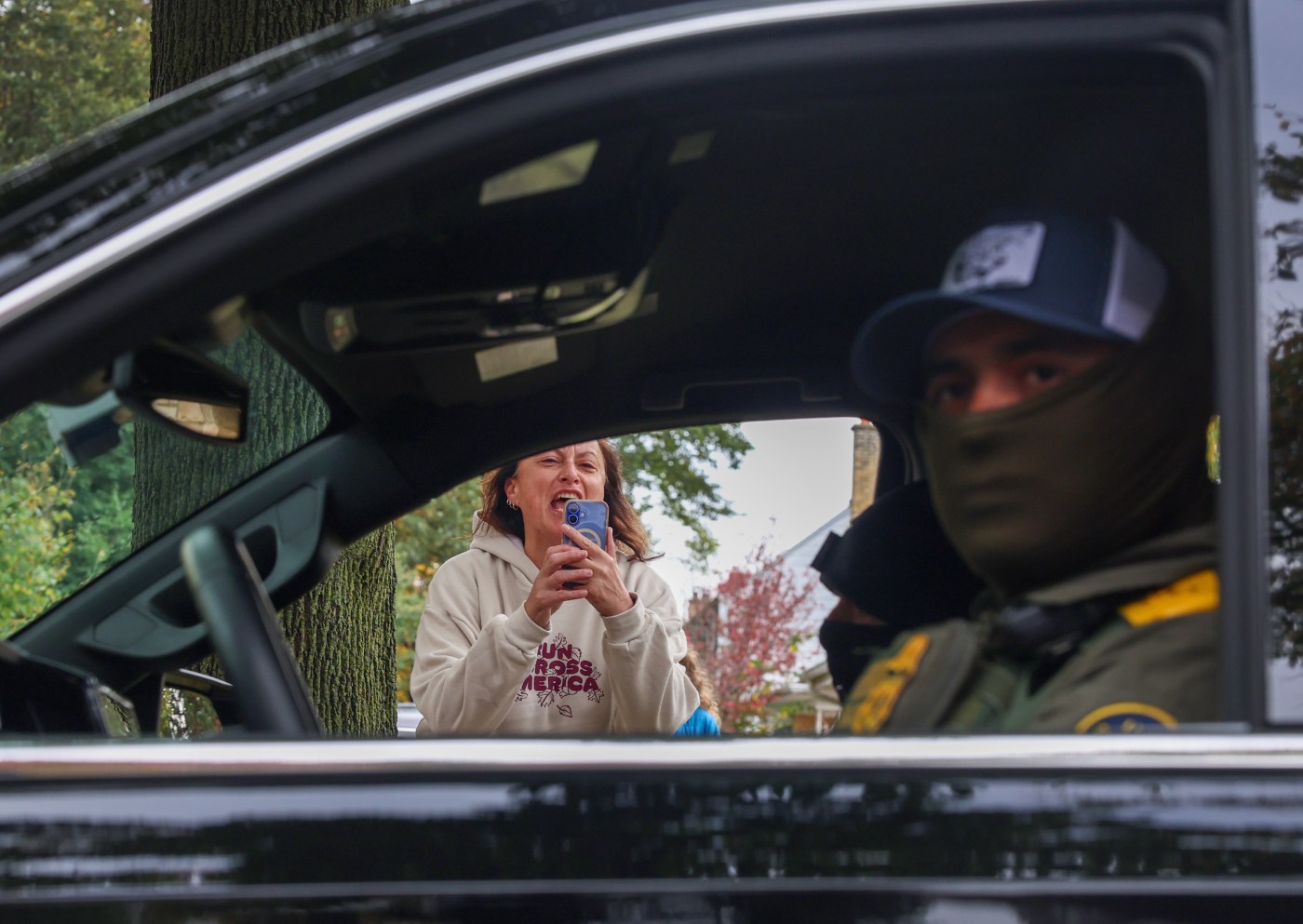
As the Trump administration’s mass deportation raids enter their second month, their impact has been felt across the Chicago region and the nation. Political tensions have deepened, hundreds have been detained or arrested, and thousands have protested—from a two-story brick U.S. Immigration and Customs Enforcement (ICE) facility in suburban Broadview to city street corners and suburban downtowns.
Throughout it all, activists, protesters, and journalists have faced tear gas and pepper ball rounds. President Donald Trump’s threats to send in the National Guard—first to quell crime in Chicago, then to assist ICE and Border Patrol agents—have, for the moment, not come to fruition.
Here’s what we know about federal immigration enforcement in and around Chicago, as well as other immigration-related stories and the National Guard deployment.
**Stay current with the latest news by subscribing to the Chicago Tribune and signing up for our free Immigration Bulletin newsletter.**
—
### How We Got Here
On September 8, President Donald Trump’s Department of Homeland Security announced a surge in immigration enforcement in Chicago, dubbing it “Operation Midway Blitz.” The operation targets what officials refer to as “criminal illegal aliens” who have allegedly benefited from the city and state’s sanctuary policies.
This announcement came more than two weeks after Trump said he planned to target Chicago due to its crime rates. In response, Democratic Governor J.B. Pritzker and Mayor Brandon Johnson warned residents about potential immigration sweeps.
“Let’s be clear, the terror and cruelty is the point, not the safety of anyone living here,” Pritzker said on September 2.
Trump had set the stage for the operation with a social media post showing military helicopters flying over Chicago’s lakefront skyline under the title “Chipocalypse Now.” “Chicago is about to find out why it’s called the Department of WAR,” Trump wrote, a day after signing an executive order renaming the Department of Defense to its pre-1949 title.
—
### ICE in and Around Chicago
Operation Midway Blitz has been visible throughout Chicago and its suburbs. Incidents have ranged from tear gas deployed in Logan Square and the detention of a mother and child at Millennium Park to a manhunt in suburban Mount Prospect and multiple arrests involving rideshare drivers at O’Hare International Airport.
A federal judge has ruled that all immigration enforcement agents must wear body cameras. The judge expressed particular concern over alleged violations during recent clashes, including an incident on Chicago’s East Side where agents used a controversial and potentially dangerous tactic to disable a fleeing vehicle before deploying tear gas during a tense gathering.
Tear gas usage by federal agents during immigration raids has escalated lately—from neighborhoods like Little Village to Lakeview and Irving Park.
On September 12, the operation took a violent turn when agents fatally shot a man in Franklin Park. The man, identified by federal officials as Silverio Villegas-Gonzalez, a 38-year-old Mexican citizen living illegally in the U.S., allegedly tried to flee a traffic stop and struck the officer with his vehicle.
On October 4, federal immigration authorities shot a Chicago woman in Brighton Park, after she allegedly tried to impede them. In the shooting’s aftermath, protesters gathered at the intersection to confront federal forces. Some threw water bottles as agents responded with tear gas and flash-bang grenades.
—
### Impact on Local Communities
Gig workers, street vendors, and day laborers have been caught up in the crackdown. Emotional arrests have unfolded in the region, including one where federal agents detained a man outside his Naperville apartment as his young sons watched and cried “Pa, te amo.”
In other cases, a Rogers Park man was fined $130 for not carrying his legal papers during questioning, and an Oak Park attorney arrested near a school described agents pointing guns at him and referencing a “Chiraq Team 2” group chat.
Federal immigration raids have also targeted local businesses and events:
– Swap-O-Rama on the Southwest Side was raided by federal agents.
– Videos of targeted raids in Carpentersville circulated online, including activity near the village hall.
– A flower vendor arrested during the launch of Operation Midway Blitz was deported to Mexico.
Waukegan’s mayor has even stepped in during a Border Patrol arrest to ensure the safety of residents.
—
### What’s Happening in Broadview?
The small suburb of Broadview has become a national spotlight due to confrontations between federal agents and protestors at the local ICE processing center. Since the launch of Operation Midway Blitz in early September, protesters have held near-daily demonstrations outside the facility.
Larger crowds—and subsequent arrests—often gather on Fridays and Sundays, sometimes violating Broadview Mayor Katrina Thompson’s order that protests only occur between 9 a.m. and 6 p.m.
A controversial 8-foot-high security fence erected by federal officials outside the facility was torn down on October 14 following a court order. Broadview officials pushed back, deeming the fence “illegally built,” and demanded the Department of Homeland Security remove it.
Residents remain fearful as the ICE center becomes a battleground amid the immigration blitz. Mayor Thompson, who is the first Black woman to lead Broadview, has refused to take “a position of fear” while navigating the national attention.
U.S. Homeland Security Secretary Kristi Noem recently indicated that ICE may expand operations in Broadview, stating, “we’re here to stay.”
—
### Chicago Takes Action
In Chicago, aldermen and residents are responding in various ways—leading street patrols, sounding whistles to alert communities of enforcement activity, and organizing protests.
“We’ll do everything in our power to make sure that ICE is out of Chicago,” Alderman Michael Rodriguez of Little Village told the Tribune on October 3.
Numerous U.S. citizens and others have reported being detained or questioned, including:
– A 44-year-old U.S. citizen zip-tied and questioned after work at a downtown bar.
– A Rogers Park man fined for not carrying his legal documents during questioning.
If stopped by ICE, here is what you should do to protect yourself.
Local clergy and faith leaders have publicly condemned the crackdown as “antithetical to the Gospel,” while cafes and restaurants across the city have posted signs barring immigration agents.
Community activism continues ward by ward, with faith leaders offering resources, moral support, and solidarity to those affected.
—
### The “No Kings” Protests
On October 18, the “Hands Off Chicago” protest at Butler Field in Grant Park drew a large crowd. The sound of whistles—an ominous warning signaling ICE activity in recent weeks—rang out as a sign of solidarity and resistance.
Mayor Brandon Johnson addressed the crowd:
“There are those in this country that have decided, at the behest of this president, to declare war on Chicago and American cities across this country,” Johnson said, eliciting boos from attendees.
“They have clearly decided that they want a rematch of the Civil War. But we are here to stand firm, to stay committed, that we will not bend, we will not bow, we will not cower, we will not submit.”
This demonstration was one of roughly 2,500 similar protests nationwide—another flashpoint in Trump’s ongoing immigration crackdown.
—
### Could the National Guard Be Next?
Governor J.B. Pritzker has repeatedly criticized the Trump administration’s plans to deploy the National Guard to Chicago, arguing that the stated purpose—combating violent crime—is a cover for militarizing Democratic-controlled cities as political payback.
Appearing on ABC’s *This Week* on October 13, Pritzker said the administration’s goal is to “militarize, especially blue cities and blue states.”
On October 17, the Trump administration asked the U.S. Supreme Court for permission to dispatch troops to the Chicago area while an appeal is pending.
However, a federal judge in Chicago extended a restraining order on October 22, barring President Trump from deploying the National Guard in Illinois as officials await a Supreme Court ruling that could decide the case.
Members of the Texas National Guard arrived in the Chicago area on October 7 as part of preparations.
Trump has discussed invoking the two-century-old Insurrection Act—a statutory exception to the Posse Comitatus Act—which would allow U.S. military involvement in law enforcement during a “rebellion” or when enforcing federal law is deemed “impractical.”
—
The situation remains fluid as Chicago and its suburbs grapple with the ongoing immigration enforcement surge, community resistance, and the looming possibility of National Guard deployment.
Stay informed with the Chicago Tribune for the latest updates on this critical issue.
https://www.chicagotribune.com/2025/10/27/chicago-immigration-enforcement-raids/