**Supreme Court to Decide Fate of Trump’s Emergency Tariffs**
WASHINGTON — Three lower courts have ruled illegal President Donald Trump’s use of emergency powers to impose worldwide tariffs. Now, the Supreme Court—featuring three justices appointed by Trump who are generally favorable toward expanded presidential power—will have the final say.
In roughly two dozen emergency appeals, the justices have largely sided with Trump, temporarily allowing parts of his aggressive second-term agenda to take effect while lawsuits play out. However, the case being argued Wednesday marks the first time the court will issue a definitive decision on a major Trump policy.
**Why This Case Matters**
The stakes are enormous, both politically and financially. Tariffs have been central to Trump’s economic and foreign policy strategy, and he has described a negative Supreme Court ruling as a potential “disaster.” The outcome will have broad implications for presidential powers and the economic future of the United States.
**Understanding Tariffs**
Tariffs are taxes on imports. They are paid by companies importing finished products or parts, with the added cost often passed on to consumers. Through September, the government reported collecting $195 billion in revenue from tariffs.
The Constitution gives Congress the authority to impose tariffs. However, Trump claimed extraordinary power to act without congressional approval by declaring national emergencies under the 1977 International Emergency Economic Powers Act (IEEPA).
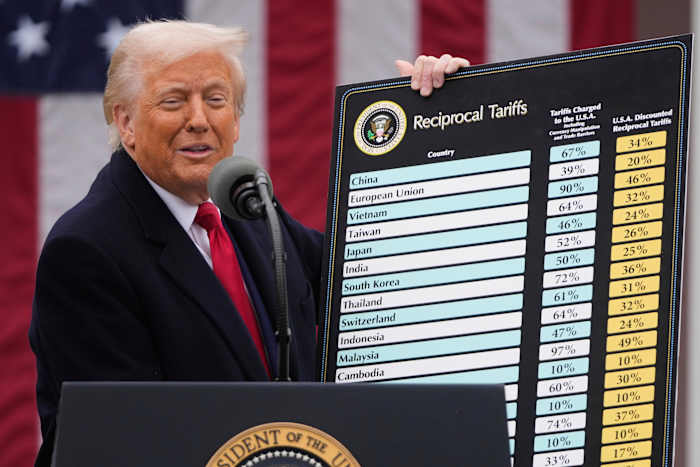
In February, he invoked IEEPA to impose tariffs on Canada, Mexico, and China, arguing that the illegal flow of immigrants and drugs across the U.S. border constituted a national emergency demanding further action from these countries. By April, Trump imposed worldwide tariffs after declaring America’s longstanding trade deficits “a national emergency.”
**Legal Challenges**
Libertarian-backed businesses and several states challenged Trump’s tariffs in federal court. They secured favorable rulings from:
– A specialized trade court
– A district judge in Washington, D.C.
– A business-focused appeals court also in the nation’s capital
These courts found that Trump could not justify the tariffs under the emergency powers law, which doesn’t mention tariffs. However, the courts allowed the tariffs to remain in place while the legal process continued.
**The ‘Major Questions’ Doctrine**
The appeals court relied on the “major questions” legal doctrine, created by the Supreme Court. This doctrine requires Congress to clearly address matters of “vast economic and political significance.” It previously doomed several Biden administration policies, including:
– The eviction moratorium during the coronavirus pandemic
– A vaccine mandate for large businesses
– Student loan forgiveness totaling $500 billion over 10 years
In comparison, the stakes in the Trump tariff case are even higher—tax revenues from these tariffs are estimated to reach $3 trillion over ten years. Challengers to the tariffs have cited writings by Trump appointees Amy Coney Barrett, Neil Gorsuch, and Brett Kavanaugh, urging the court to apply similar limitations to Trump’s signature policy.
For example, Barrett compared ambiguous congressional instructions to a babysitter’s vague directive to “make sure the kids have fun,” noting that such instructions could be interpreted in dramatically different ways. Kavanaugh, however, has suggested that the court should avoid imposing such limiting standards in foreign policy and national security contexts.
A dissenting appellate judge also argued that Congress intentionally gave presidents more leeway under the emergency powers law.
**A Renewed Nondelegation Challenge**
Some businesses challenging the tariffs have also raised a separate constitutional argument, claiming Congress cannot delegate its taxing power to the president. The so-called “nondelegation principle” hasn’t been used by the Supreme Court in 90 years, since striking down parts of the New Deal. Justice Gorsuch, joined by Justices Alito and Thomas, recently authored a dissent advocating for stricter limits on congressional delegations of power.
**Expedited Supreme Court Review**
The Supreme Court agreed to hear the tariff case in September and scheduled arguments less than two months later—a rapid turnaround by its standards. This likely means the justices will act swiftly. While most high-profile cases take half a year or more to resolve, the court has demonstrated an ability to decide quickly when necessary.
For example, the justices recently issued a unanimous ruling only a week after hearing arguments in the TikTok case, upholding a law requiring the popular social media app to be banned unless sold by its Chinese parent company. Trump has frequently intervened to keep laws like these from taking effect while negotiations continue.
**What’s Next?**
The Supreme Court’s upcoming decision on Trump’s emergency tariffs will shape both the balance of power between Congress and the presidency and the economic landscape for years to come. Observers across the political and business spectrum are watching closely as the justices prepare to weigh in on this landmark case.
https://www.clickorlando.com/business/2025/11/05/what-to-know-about-the-supreme-court-arguments-over-trumps-tariffs/