

Imagine storms fiercer than the strongest hurricanes on Earth, blowing nonstop all the way around an entire planet. This is exactly what happens on Venus, where winds at the cloud tops race around the planet at speeds of more than 100 metres per second. Even more astonishing is that Venus itself rotates very slowly so slowly that one full day on Venus lasts about 243 Earth days. Yet its atmosphere completes a full trip around the planet in just four Earth days. This extreme mismatch is called “superrotation,” and for years scientists have struggled to fully explain it. Now, new research has revealed an important clue: a daily rhythm in Venus’s atmosphere, driven by the heat of the Sun, may be a major force behind these extraordinary winds. The study, led by Lai and colleagues and published in AGU Advances, provides fresh insight into the hidden mechanics of Venus’s atmosphere. Unlike Earth, where the atmosphere generally moves at roughly the same speed as the planet’s surface, Venus’s atmosphere behaves more like a separate, fast-moving system. Researchers suspected that different types of atmospheric waves and circulation patterns were helping drive the superrotation, but it was unclear which ones were most important. To investigate, the research team examined data collected over 16 years by two spacecraft: the European Space Agency’s Venus Express and Japan’s Akatsuki satellite. These spacecraft studied Venus’s atmosphere by measuring how radio waves bent as they passed through its thick clouds, revealing details about temperature, pressure, and motion. In addition, the scientists used a computer model to simulate how Venus’s atmosphere behaves under these extreme conditions. The team focused on something called “thermal tides.” These are large-scale movements of air caused by uneven solar heating. When sunlight warms the dayside of Venus, the heated air rises and sets off waves that travel around the planet. There are two main types of thermal tides on Venus. Diurnal tides follow a once-per-day cycle, while semidiurnal tides repeat twice per day. Past studies suggested the semidiurnal, or twice-daily, tides were mainly responsible for helping push the atmosphere into superrotation. However, this new research paints a different picture. By including data from the planet’s southern hemisphere for the first time, the scientists found that the diurnal, or once-per-day, tides play a much bigger role than previously believed. These diurnal tides help move energy and momentum upward, toward the tops of Venus’s thick cloud layers. This transfer of momentum acts like a global engine, constantly pushing the atmosphere forward and keeping the winds racing around the planet at extreme speeds. Although more research is still needed to fully understand every detail, this discovery significantly changes scientists’ understanding of Venus. It also offers valuable lessons for studying other planets that rotate slowly or orbit close to their stars. Understanding Venus’s atmosphere could even help astronomers interpret weather patterns on distant, Earth-like worlds in other solar systems. Venus may be our closest planetary neighbor, but with its scorching temperatures and furious winds, it remains one of the most mysterious worlds we know. This new finding brings us one important step closer to understanding its alien climate.
https://knowridge.com/2025/11/scientists-discover-what-really-powers-venuss-wild-planet-encircling-winds/
Tag: extraordinary

Mike Johnson just downplayed Republican election losses with a take that has Democrats laughing
Speaker Mike Johnson Attempts to Downplay Republican Losses Amid Election Setbacks
Republicans faced notable losses in Tuesday’s elections, with Democrats securing major victories in Virginia, New Jersey, and New York City. These were the first significant elections since President Trump began his second term, occurring alongside an ongoing government shutdown that has now stretched unprecedentedly long.
Democrats Interpret Wins as Positive Momentum for 2026
The Democratic Party views these wins as strong indicators of their chances in the 2026 midterm elections, which will determine whether Republicans retain control of the House and Senate. In contrast, Speaker Mike Johnson remains unconcerned about the implications for his party.
Johnson’s Response: “No Surprises” and Historical Context
Speaking to reporters, Johnson said, “there were no surprises” the night before the elections. He attributed the results to expected voting patterns, stating that “blue states and blue cities voted blue.” Johnson urged the public not to read too much into the outcomes, suggesting that “off-year results don’t really tell us much about what will happen later,” a lesson he believes history has taught.
Democrats Unconvinced by Johnson’s Reasoning
Despite Johnson’s attempts to downplay the losses, Democrats remain unconvinced. Johnson also claimed the defeat “was any reflection about Republicans at all,” instead pointing to widespread voter frustration. “I think people are frustrated and angry as we are. I am. The president is, and we express that in different ways,” he explained.
Impact of Government Shutdown on Election Outcomes
President Trump also weighed in, suggesting the ongoing government shutdown likely hurt Republicans at the polls. By Wednesday, the shutdown had lasted 36 days, setting a new record. The Senate has made 14 attempts to pass a Republican plan to reopen the government, all unsuccessful.
Despite Polls, Johnson Remains Optimistic
Johnson has previously dismissed polling data that suggests Americans blame Republicans for the shutdown, warning there would be consequences for Democrats. He remained optimistic about future elections, telling reporters, “We’re looking forward to a great election running on our record, and we’re going to get all of our incumbents reelected and we’re going to add to the number here.”
Assigning Blame and Looking Ahead
Johnson placed responsibility for the shutdown squarely on the Democrats, criticizing them for refusing to support the Republican funding plan. “It’s very clear who’s responsible for this,” he said. “And I think that when we go into next year, in the midterms, we’re very bullish about the outcome. We have an extraordinary record to run on.”
Democrats See the Election as Validation of Their Strategy
On the other hand, Democrats interpret Tuesday’s victories as proof their approach is effective, especially given they occurred during a shutdown Republicans struggle to resolve. The New York City win was particularly significant, coming after Johnson had made bold predictions about the party’s future in the city.
The Road Ahead: Uncertain Outcomes in 2026
Only time will tell if Johnson’s confidence in the 2026 midterms is well-founded or if these recent election results serve as warning signs for the Republican Party.
https://attackofthefanboy.com/news/mike-johnson-just-downplayed-republican-election-losses-with-a-take-that-has-democrats-laughing/

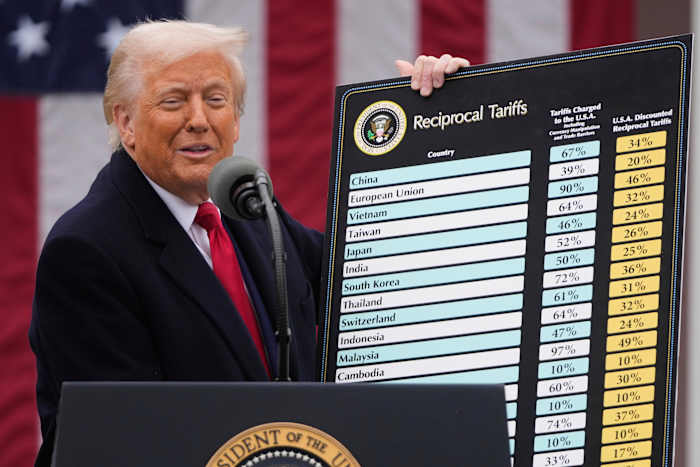
What to know about the Supreme Court arguments over Trump’s tariffs
**Supreme Court to Decide Fate of Trump’s Emergency Tariffs**
WASHINGTON — Three lower courts have ruled illegal President Donald Trump’s use of emergency powers to impose worldwide tariffs. Now, the Supreme Court—featuring three justices appointed by Trump who are generally favorable toward expanded presidential power—will have the final say.
In roughly two dozen emergency appeals, the justices have largely sided with Trump, temporarily allowing parts of his aggressive second-term agenda to take effect while lawsuits play out. However, the case being argued Wednesday marks the first time the court will issue a definitive decision on a major Trump policy.
**Why This Case Matters**
The stakes are enormous, both politically and financially. Tariffs have been central to Trump’s economic and foreign policy strategy, and he has described a negative Supreme Court ruling as a potential “disaster.” The outcome will have broad implications for presidential powers and the economic future of the United States.
**Understanding Tariffs**
Tariffs are taxes on imports. They are paid by companies importing finished products or parts, with the added cost often passed on to consumers. Through September, the government reported collecting $195 billion in revenue from tariffs.
The Constitution gives Congress the authority to impose tariffs. However, Trump claimed extraordinary power to act without congressional approval by declaring national emergencies under the 1977 International Emergency Economic Powers Act (IEEPA).
In February, he invoked IEEPA to impose tariffs on Canada, Mexico, and China, arguing that the illegal flow of immigrants and drugs across the U.S. border constituted a national emergency demanding further action from these countries. By April, Trump imposed worldwide tariffs after declaring America’s longstanding trade deficits “a national emergency.”
**Legal Challenges**
Libertarian-backed businesses and several states challenged Trump’s tariffs in federal court. They secured favorable rulings from:
– A specialized trade court
– A district judge in Washington, D.C.
– A business-focused appeals court also in the nation’s capital
These courts found that Trump could not justify the tariffs under the emergency powers law, which doesn’t mention tariffs. However, the courts allowed the tariffs to remain in place while the legal process continued.
**The ‘Major Questions’ Doctrine**
The appeals court relied on the “major questions” legal doctrine, created by the Supreme Court. This doctrine requires Congress to clearly address matters of “vast economic and political significance.” It previously doomed several Biden administration policies, including:
– The eviction moratorium during the coronavirus pandemic
– A vaccine mandate for large businesses
– Student loan forgiveness totaling $500 billion over 10 years
In comparison, the stakes in the Trump tariff case are even higher—tax revenues from these tariffs are estimated to reach $3 trillion over ten years. Challengers to the tariffs have cited writings by Trump appointees Amy Coney Barrett, Neil Gorsuch, and Brett Kavanaugh, urging the court to apply similar limitations to Trump’s signature policy.
For example, Barrett compared ambiguous congressional instructions to a babysitter’s vague directive to “make sure the kids have fun,” noting that such instructions could be interpreted in dramatically different ways. Kavanaugh, however, has suggested that the court should avoid imposing such limiting standards in foreign policy and national security contexts.
A dissenting appellate judge also argued that Congress intentionally gave presidents more leeway under the emergency powers law.
**A Renewed Nondelegation Challenge**
Some businesses challenging the tariffs have also raised a separate constitutional argument, claiming Congress cannot delegate its taxing power to the president. The so-called “nondelegation principle” hasn’t been used by the Supreme Court in 90 years, since striking down parts of the New Deal. Justice Gorsuch, joined by Justices Alito and Thomas, recently authored a dissent advocating for stricter limits on congressional delegations of power.
**Expedited Supreme Court Review**
The Supreme Court agreed to hear the tariff case in September and scheduled arguments less than two months later—a rapid turnaround by its standards. This likely means the justices will act swiftly. While most high-profile cases take half a year or more to resolve, the court has demonstrated an ability to decide quickly when necessary.
For example, the justices recently issued a unanimous ruling only a week after hearing arguments in the TikTok case, upholding a law requiring the popular social media app to be banned unless sold by its Chinese parent company. Trump has frequently intervened to keep laws like these from taking effect while negotiations continue.
**What’s Next?**
The Supreme Court’s upcoming decision on Trump’s emergency tariffs will shape both the balance of power between Congress and the presidency and the economic landscape for years to come. Observers across the political and business spectrum are watching closely as the justices prepare to weigh in on this landmark case.
https://www.clickorlando.com/business/2025/11/05/what-to-know-about-the-supreme-court-arguments-over-trumps-tariffs/

India’s Ahmedabad to host 2030 Commonwealth Games: Presenting key details
**India’s Ahmedabad to Host 2030 Commonwealth Games: Key Details**
*By Rajdeep Saha | Oct 15, 2025, 9:30 PM*
India has been recommended as the host nation for the 2030 Commonwealth Games, with Ahmedabad proposed as the primary venue. This recommendation came from the executive board of Commonwealth Sport during their meeting on Wednesday. The final approval for Ahmedabad’s candidacy will be confirmed by Commonwealth Sport’s full membership at the General Assembly in Glasgow, Scotland, on November 26.
**Previous Experience**
India last hosted the Commonwealth Games in 2010. However, that event was overshadowed by issues related to poor planning, infrastructure delays, and corruption allegations. Despite this, PT Usha, President of the Indian Olympic Association (IOA), described hosting the centenary games as an “extraordinary honor” for the country. She emphasized that the 2030 Games will not only showcase India’s sporting prowess but will also support its broader vision of becoming a developed nation by 2047.
**Strategic Move**
Ahmedabad and Abuja were the only two cities bidding to host the 2030 Commonwealth Games. India’s selection of Ahmedabad aligns with a strategic plan to strengthen its bid for the 2036 Olympics. An IOA official noted that hosting the 2030 Games will be an opportunity to demonstrate India as a “reliable destination” for major international sporting events.
**Venue Preparations**
The newly inaugurated Naranpura Sports Complex in Ahmedabad, which hosted the Commonwealth Weightlifting Championship and Asian Swimming Championship earlier this year, is expected to be a central venue for the Games. Constructed at a cost of ₹825 crore, this state-of-the-art facility is a significant asset.
Other proposed venues include the Sardar Vallabhbhai Patel Enclave and the Narendra Modi Stadium. Unlike the planned multi-city hosting format for the 2036 Olympics, the 2030 Commonwealth Games will primarily take place in Ahmedabad, with possible events in nearby Gandhinagar.
**Evaluation Criteria**
The decision to recommend Ahmedabad was reached after a rigorous assessment by the Commonwealth Sport Evaluation Committee. Candidate cities were evaluated on parameters such as technical delivery, athlete experience, infrastructure quality, governance, and adherence to Commonwealth Sport values.
India’s strong sporting history and impressive performance at the Birmingham 2022 Commonwealth Games—where it finished fourth in the medal tally—were also highlighted as key factors in the recommendation.
**Reactions**
The announcement has been met with enthusiasm across India’s sporting community, signaling a new era for Indian sports on the international stage. Further updates, including official confirmation at the November General Assembly, are eagerly awaited.
https://www.newsbytesapp.com/news/sports/commonwealth-games-2030-to-be-held-in-india-s-ahmedabad/story