XRP Whale Sell-Off Signals Potential Downside Near $2.2 Support Zone

**XRP Whales Offload 900,000 Tokens in Five Days, Fueling Bearish Market Sentiment**

XRP whales have recently intensified selling pressure by offloading approximately 900,000 tokens over the past five days. This significant sell-off has coincided with weakening on-chain metrics and technical indicators, driving a bearish sentiment in the market and pushing prices toward critical support levels between $2.20 and $2.30.

At the same time, Open Interest has dropped 15.73% to $3.52 billion, signaling reduced leverage and heightened risk aversion among traders. Liquidation heatmaps reveal dense clusters at $2.20 and $2.30, highlighting key volatility triggers with over $100 million in potential liquidations.

### What Is Driving the Recent XRP Whale Selling Pressure?

Large investors, or whales, have become the dominant force behind the recent XRP sell-off, distributing around 900,000 tokens in just five days. This surge in selling activity reflects growing caution among market participants amid broader volatility.

The sell-off aligns with a 12% decrease in large holder accumulation over the past week, according to on-chain data from Santiment. Together with technical weaknesses, this selling pressure underscores a market environment marked by caution and increased short-term bearish risks.

### How Are Technical Indicators Reflecting XRP’s Current Market Position?

Technical analysis shows a clear bearish tilt in XRP’s price action:

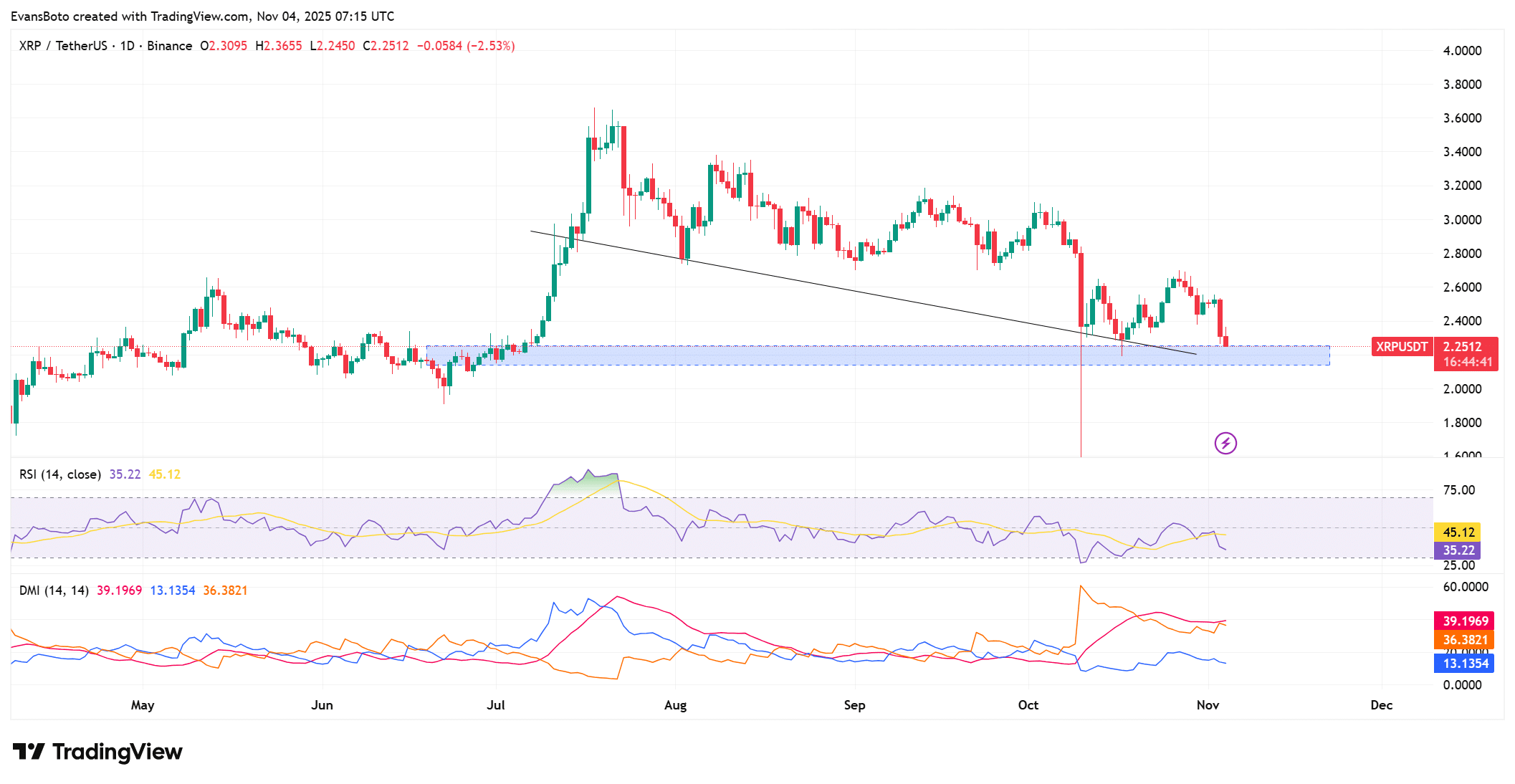
– **Relative Strength Index (RSI):** Currently at 35.22, approaching oversold territory, suggesting the possibility of buying interest emerging soon.
– **Directional Movement Index (DMI):** The negative directional indicator (-DI) stands at 36.38, overpowering the positive directional indicator (+DI) of 13.13.
– **Average Directional Index (ADX):** At 39.19, confirming strong downward trend momentum.

Price action has formed lower highs and repeatedly faces rejection by a descending resistance trendline, limiting any upward breakout attempts. XRP is consolidating within the $2.20–$2.30 demand zone, a historically significant area known for accumulation and potential price rebounds.

### Open Interest and Derivatives Market Contraction

The derivatives market for XRP has seen a notable pullback, with Open Interest falling by 15.73% to $3.52 billion. This decline reflects a broad reduction in trader participation, typically associated with periods of uncertainty and risk aversion.

According to Coinglass data, such retrenchment in leverage often leads to more stable price movements but also points to diminished speculative enthusiasm. Glassnode analysts note that Open Interest drops of over 15% frequently precede consolidation phases lasting several weeks.

Despite the current slowdown in derivatives activity, XRP’s long-term outlook remains underpinned by ongoing ripple ecosystem advancements, including cross-border payment integrations. Traders should watch for rebounds in Open Interest as a potential signal of renewed market confidence and possible whale accumulation resuming.

### The Role of Liquidation Zones in XRP’s Price Volatility

Liquidation zones are pivotal in shaping XRP’s current price risks. Coinglass heatmaps highlight concentrated liquidation clusters around $2.30 and $2.20, where more than $100 million in leveraged positions could be liquidated.

These zones act as magnets for price action—breaching them can trigger cascading forced liquidations, potentially amplifying price swings. For example:

– A breakdown below $2.20 may initiate a chain reaction of sell-offs.
– Holding above $2.20 could prompt short-covering, leading to a relief rally.

Binance futures data supports this vulnerability, showing a 20% spike in 24-hour liquidation volumes in recent sessions.

CryptoQuant analysts emphasize the influence of such liquidity pockets on short-term price direction, advising leveraged traders to exercise caution. Recent price tests near the upper boundary of this range confirm the need for sustained trading volume to validate a bullish reversal.

### Frequently Asked Questions

**What factors are contributing to XRP whale selling pressure in 2025?**

XRP whale selling pressure is primarily driven by profit-taking following recent gains, coupled with macroeconomic uncertainties and ongoing regulatory developments surrounding Ripple’s legal challenges. Over five days, approximately 900,000 XRP tokens were distributed, increasing market supply and exerting downward price pressure. While this intensifies short-term bearish risks, it does not diminish XRP’s long-term utility in cross-border payments.

**Will XRP hold the $2.20 support level amid current volatility?**

The $2.20 support is a critical technical level for XRP, historically acting as a strong floor during corrections. Current technical readings—including an RSI near oversold and consolidation within a key demand zone—suggest bulls could defend this level if accompanied by an uptick in volume. However, failure to hold $2.20 may expose lower support zones around $2.00, emphasizing the need for traders to prepare for potential volatility.

### Key Takeaways

– **Whale Offloads Signal Caution:** The sell-off of 900,000 XRP tokens by large holders has increased bearish sentiment, pressing prices toward crucial support levels.
– **Open Interest Contraction:** A 15.73% drop to $3.52 billion reflects reduced leverage in the market, which may stabilize prices but limit short-term upside momentum.
– **Liquidation Zones at the Forefront:** Traders should focus on the $2.20–$2.30 range as key zones for price volatility and potential directional shifts.

### Conclusion

XRP’s current market environment is characterized by intensified whale selling pressure, declining Open Interest, and concentrated liquidation clusters, fostering cautious trading sentiment. Prices are testing a vital demand zone between $2.20 and $2.30, with bearish technicals dominating. However, oversold signals do provide some hope for a rebound if buyers mount strong defenses.

As the Ripple network continues to expand its real-world applications, investors should closely monitor on-chain metrics and technical signals. Staying informed and prepared can offer strategic advantages in navigating this evolving landscape.
https://bitcoinethereumnews.com/tech/xrp-whale-sell-off-signals-potential-downside-near-2-2-support-zone/

Branching in a Sapling Monorepo

Sapling: Solving Branching Challenges for Meta’s Monorepo

Sapling is a scalable, user-friendly, and open-source source control system that powers Meta’s monorepo. At the GitMerge 2024 conference, we discussed the complexities of designing and implementing branching workflows for large monorepos. These workflows involve challenging tradeoffs between scalability and the developer experience.

Following the conference, we designed, implemented, and open sourced our monorepo branching solution within Sapling. While the code is already open source, this article shares valuable learnings on:

– How we resolved scalability and developer experience tradeoffs in the design and implementation.
– The problems this solution addresses.
– Feedback we received from other developers at Meta.

The key technical insight is that two workflows — non-mergeable full-repo branching and mergeable directory branching — solved all branching-related problems for the wide and diverse set of products built at Meta. We hope Sapling’s open-source code and the insights shared here will benefit the wider industry and open source communities.

### How Source Control Is Handled at Meta

At Meta, engineering teams work within a large monorepo with a single main branch. This approach enables:

– Unified dependency management
– Large-scale refactoring
– Easier collaboration
– Code reuse across projects

However, managing multiple versions of code within this setup presents challenges.

In multi-repo environments, teams typically rely on repository branches to manage different versions. Source control tools like cherry-pick and merge help manage differences between versions effectively.

In contrast, in a monorepo, repository branches are less effective. Branches affect the whole repository, so creating a branch means unrelated projects and dependencies remain frozen and quickly become stale. We refer to this approach as *full-repo branching.*

For workflows that do not require merging back to the main branch — such as product releases where the branch ceases to exist after release — full-repo branching works well. Sapling supports this workflow with the `sl bookmark` family of commands.

However, for product development workflows that require merging back to the main branch, full-repo branching is not scalable. This is because full-repo merges create merge commits with multiple parents, producing a wide (high branching factor) and non-linear commit graph.

In large monorepos, this non-linear history causes performance problems for operations like `sl log` and `sl blame`. Maintaining a mostly linear commit graph, where most commits have a single parent, is crucial for keeping these operations fast for all monorepo users, including those not using branches.

The core limitation is that full-repo branches are all-or-nothing. You cannot create a branch limited to the part of the codebase you own. If you need to patch legacy code or maintain a custom variant for a project, branching forks the entire repository, which is inefficient and cumbersome.

A common workaround was for teams to copy their code into multiple directories. However, this causes loss of standard developer tooling for branch management, resulting in duplicated effort and error-prone manual patching between directories.

### Directory Branching: Sapling’s Monorepo Branching Solution

To address these challenges, we introduced a new set of source control tools in Sapling to implement *directory branching*. This approach bridges the gap between multiple repository branches and maintaining code copies in separate directories.

With directory branching, you can treat directories within the monorepo much like traditional repository branches. You:

– Create branches by copying the code
– Maintain the code by cherry-picking and merging changes between directories
– View history for each directory, including all copies and merges

Crucially, while directory branches support merging between directories, at the repository commit graph level they appear as linear commits. This resolves scalability challenges associated with repo-level merge commits while still providing merging workflows at the directory level.

### How Directory Branching Is Implemented in Sapling

Directory branching in Sapling relies on a series of operations centered around the `sl subtree` command.

– To branch a directory, you use `sl subtree copy` to copy a directory or file — either at the current version or from any historical revision — to a new location in the repository.
– Sapling records metadata in the commit to track the source directory, source revision, and copy relationship, allowing complete recovery of the file histories in the new branch.
– If the code you want to branch is not yet in the monorepo, you can use `sl subtree import` to create a directory branch from an external repository.

Once you have a directory branch, you can use:

– `sl subtree graft` and
– `sl subtree merge`

to cherry-pick or merge changes between directory branches. These commands use the stored metadata to reconstruct directory relationships and perform three-way merges scoped to specific directory content.

The merge algorithm locates the common ancestor of the two directory branches (using the copy metadata) and applies a standard three-way merge as done for traditional repository merges, but limited to the directory content.

### Build System and Developer Tooling Integration

One major advantage of directory branching is that the latest versions of all directory branches are visible simultaneously. This means continuous integration (CI) can test against multiple branches with a single checkout, and teams can be confident no hidden old branches are unexpectedly still in use.

At Meta, we use Buck2 as our build system. When a component depends on another component using directory branching, we use Buck config modifiers (i.e., running `buck build` with the `-m` flag) to select the branch being built.

A downside of directory branching is that code searches may return multiple hits across branches. While it is important to recognize the searched-for code appears in multiple places, this can complicate browsing if results from multiple branches intermix. Advanced code search systems capable of ranking results can mitigate this issue.

### User Feedback on Directory Branching

Directory branching has been widely adopted within Meta by diverse engineering teams to help manage multiple versions of code effectively.

Some teams even combine full-repo branching and directory branching by freezing most of the monorepo on an old commit for stability, while using directory branching to merge changes for specific projects.

We identified three common reasons teams choose directory branching:

1. **Reducing CI costs or avoiding disruption:** Teams separate development and production versions of code, enabling better control over when changes deploy to production.

2. **Collaborative experimental changes:** Large groups collaborate over months on changes that might disrupt production. Directory branching offers better scalability than handling many stacked diffs to simulate a branch.

3. **Migrating from Git:** During migration, teams need equivalents of Git branches within the monorepo to complete consolidation. Directory branching provides this functionality without needing to consolidate all Git branches pre-migration.

Despite these exceptions, having a single version of code remains the monorepo’s default assumption. However, when one of the above scenarios applies, directory branching offers extensive branching workflows without sacrificing monorepo benefits.

### Future Work with Directory Branching

We are exploring leveraging directory branching to improve integration of Git repositories into the Sapling monorepo. Specifically, we plan a lightweight repository migration mechanism:

– Instead of committing all Git repository commits irreversibly into the monorepo history, we create a *soft link* to the external Git repository.
– Sapling can then load Git history on demand, lowering the barrier to entry for Git repositories joining the monorepo.
– This approach facilitates preliminary integrations without committing to migrating full history upfront.

This functionality will be available as an option with the `sl subtree import` command when working with external Git repositories.

Stay tuned — we will publish a dedicated article once we have more insights to share on this exciting advancement.

### Acknowledgements

Many contributors across Meta’s Source Control, Developer Experience, and Open Source teams helped design and implement directory branching in Sapling. We would like to thank:

Chris Cooper, George Giorgidze, Mark Juggurnauth-Thomas, Jon Janzen, Pingchuan Liu, Muir Manders, Mark Mendoza, Jun Wu, and Zhaolong Zhu.

To learn more about Meta Open Source, please visit our [website](https://opensource.fb.com).
https://engineering.fb.com/2025/10/16/developer-tools/branching-in-a-sapling-monorepo/

Exit mobile version
Sitemap Index