Humboldt County Office of Education, Tribal Partners Launch California’s First State-Sponsored Native American Studies Curriculum

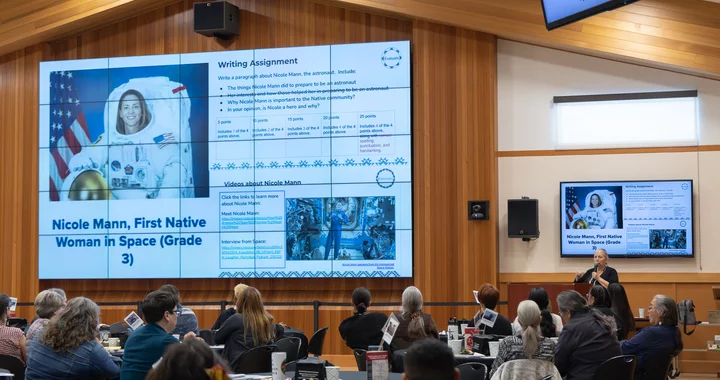
On November 8, 2025, the Humboldt County Office of Education (HCOE) hosted **Carrying Our Stories Forward: Celebrating the Launch of the Native American Studies Model Curriculum (NASMC)**, a landmark event honoring California’s first state-sponsored curriculum designed to center and uplift Native American voices, histories, and perspectives in public education.

The event brought together Tribal leaders, educators, youth, and community members for a day of celebration, dialogue, traditional foods, and professional learning. This historic milestone was made possible by $30,000 in community donations supporting the initiative.

### A Message from the Keynote Speaker

The event’s keynote speaker, Dr. Cutcha Risling Baldy (Hupa, Yurok, Karuk), a Guiding Leader of the NASMC development, spoke from the heart. She encouraged educators to embrace the curriculum even when the content feels new or challenging. Dr. Baldy reminded participants that learning Native American Studies is an ongoing process, and the NASMC was intentionally designed to support that journey.

> “You don’t have to redesign your entire curriculum overnight,” she shared. “Start small by integrating one lesson, one unit, or one Indigenous author—and build over time. Use this curriculum as an opportunity to model what learning looks like for students: enthusiasm, reflection, and growth.”

### A Movement Toward Educational Justice

Michael Davies-Hughes, Superintendent of the Humboldt County Office of Education, emphasized the significance of the curriculum:

> “The NASMC represents far more than a new curriculum, it’s a movement toward truth, healing, and educational justice. We are honored to stand with California’s Tribes, educators, and students to ensure Native voices are not only represented but centered in our classrooms.”

### About the Native American Studies Model Curriculum

Developed by the Humboldt County Office of Education in partnership with the San Diego County Office of Education and California Tribal partners, the NASMC is one of four new Model Curricula funded by the state under Education Code §51226.9. The curriculum is available on the *We Are California* website hosted by UC Davis.

The NASMC includes:

– Hundreds of standards-aligned lesson plans and primary source materials
– Commissioned and licensed Native art, poetry, and oral histories
– Planning guides and culturally grounded professional development resources

Created by and with Native educators, youth-serving organizations, and cultural knowledge keepers, the NASMC ensures accuracy, respect, and authenticity.

### Supporting Native Students and Communities

By reflecting Native students’ cultures and worldviews in the classroom, the curriculum supports positive identity development, mental health, and a sense of belonging. It also guides all students to build empathy, awareness, and a deeper understanding of our shared environment.

Humboldt County’s participation in the NASMC project reflects its deep commitment to educational equity and community partnership. With 8.8% of Humboldt County students identifying as Native American or Alaska Native—and chronic absenteeism among Native students more than double the countywide rate—HCOE recognized the urgent need to create learning environments that affirm Native identity and strengthen school engagement.

### Expanding the Work

HCOE’s Native American Studies Model Curriculum Learning Specialist, Maggie Peters, continues to lead this work by facilitating monthly professional development sessions for educators across the state. These sessions offer lesson deep dives, collaborative learning spaces, and Cal Poly Humboldt course credit to deepen teacher capacity in implementing the NASMC.

> “This moment is an affirmation of truth, resilience, and shared commitment to the future,” said Peters. “The NASMC shows what’s possible when Tribes, educators, and communities work together to restore balance through education.”

Educator and curriculum writer Cheryl Tuttle (Yurok/Karuk), who was honored at the event for her contributions, shared her impressions:

> “I was astounded at the breadth of the NASMC project. It really hit me at the event—the variety, the age differences, the different mediums, and the complexity involved!”

### Carrying This Work Forward

As the NASMC takes root statewide, organizers invite the public to honor Indigenous communities and strengthen relationships with Tribes and Indigenous-led networks to uphold culture, tradition, and sovereignty.

Supporting the First Peoples of Humboldt County and California means affirming Native identities through accountability, curiosity, and respect for community and place. This effort also calls for integrating Native perspectives into education and policy by moving from consultation to true collaboration with Tribes and Indigenous-led networks to ensure accurate representation and co-created approaches.

Most importantly, advocates are encouraged to ensure this first step becomes a foundation, not a finish line. Continued funding is essential so that the NASMC can grow into a comprehensive curriculum representing all Tribes and reaching every school in California.

We all share the responsibility—and have the opportunity—to grow, unlearn, and reimagine how we understand history, place, and belonging.

This event marked not only a celebration of what has been achieved but also a call to sustain and expand this work. Together, we can ensure that Native American Studies remains a living, evolving part of California’s classrooms for generations to come.
https://lostcoastoutpost.com/2025/nov/14/humboldt-county-office-education-tribal-partners-l/


Dozens of Whitman-Hanson teachers could face layoffs due to $1.3 million budget deficit

**Whitman-Hanson School Committee Delays Layoff Notices Amid Budget Deficit Concerns**

*WHITMAN, MASS. (WHDH)* – Teachers, families, and members of the Whitman-Hanson School Committee gathered for an emergency business meeting Thursday night, expressing outrage over dozens of potential staff layoffs and what they described as a “lack of transparency.”

Originally, notifications of 25 layoffs were scheduled to be sent out Friday morning. However, following a vote by the school committee board, the distribution of these notices has now been postponed by 30 school days.

The school committee members stated that the decision to issue layoffs came as a surprise to them and was presented on short notice for the district as a whole. The delay was intended to allow time for exploring alternative options.

“The impact of these shifts two months into the school year is catastrophic,” said one committee member.

Superintendent Jeffrey Szymaniak explained that about two weeks ago, a business manager contracted from outside the district discovered a budget deficit of more than $1.3 million for the upcoming school year.

“The outside firm looked at our budget, looked at our numbers, and recommended an $800,000 plus cut immediately to sustain where we are to make sure we were not in deficit at the end of the FY26 year,” said Szymaniak.

As a result, the proposed budget cuts meant that 25 employees were slated to receive layoff notices Friday morning, with an additional five positions lost due to resignations or retirements left unfilled.

“There are still unanswered questions regarding the situation and how we got here as a district. Cuts were made to our units with minimal cuts to the rest of the district,” stated a woman representing the Teachers Union.

Szymaniak also expressed concern about the timing of the delayed notices, noting the upcoming holiday season. “That concerns me, because I don’t have answers right now,” he said.

Parents voiced worries about the potential impact of the layoffs on their children. Amy Gavin, a parent, shared her frustration: “I am so upset and frustrated that they’re even considering reducing staff, especially our special-ed staff. You cannot have children build a rapport for the first two months of school and rip that caring adult out of their life.”

The business manager responsible for discovering the deficit was not present at Thursday’s meeting. As a result, Szymaniak said he cannot comment on how the district arrived at this financial situation. However, he added that the business manager will attend the next meeting scheduled for Wednesday.

*Stay tuned for updates as the Whitman-Hanson Regional School District continues to navigate this challenging budget situation.*
https://whdh.com/news/dozens-of-whitman-hanson-teachers-could-face-layoffs-due-to-1-3-million-budget-deficit/

Canada Fast-Tracks Stablecoin Rules Ahead of November 4 Budget

Canada’s Crypto Scene Heats Up as Government Moves to Regulate Stablecoins

Canada’s cryptocurrency landscape is rapidly evolving, with the government taking a proactive role in shaping the future of digital assets. Ottawa is moving swiftly to introduce stablecoin regulations, with detailed proposals expected to be unveiled in the upcoming federal budget on November 4. This development comes just days after a record-breaking $126 million fine was levied against a crypto company for anti-money laundering violations. Here’s what you need to know.

Stablecoin Rules Finally on the Way

According to Bloomberg, Canadian officials have spent the past few weeks engaged in intensive discussions with regulators and industry leaders to finalize the framework for stablecoin governance. These talks are anticipated to culminate in clear regulatory proposals when Finance Minister François-Philippe Champagne presents the new budget next week.

Stablecoins play a crucial role as a bridge between digital assets and mainstream finance. However, until now, regulatory treatment of stablecoins in Canada has been unclear. Currently, regulators classify stablecoins as securities or derivatives, creating uncertainty for companies and investors alike.

Meanwhile, the United States has already taken significant steps forward. The Genius Act, enacted in July, empowers US regulators to supervise stablecoin issuers and establish reserve requirements. This legislation categorizes compliant stablecoins as payment instruments, a move that has been widely welcomed by the crypto industry.

Experts Warn of Capital Flight

Industry leaders are urging the Canadian government to act swiftly or risk falling behind in the global crypto race. John Ruffolo, founder of Maverix Private Equity, cautioned that without timely regulations, Canadian investors might increasingly turn to US stablecoins. This shift could dampen demand for Canadian bonds and weaken local financial autonomy.

“Every Canadian who transacts in a US stablecoin funds American debt, enriches American institutions and exports our financial data south,” Ruffolo remarked earlier this month.

The call for a national regulatory framework is echoed by prominent institutions. Both the Bank of Canada and the Office of the Superintendent of Financial Institutions (OSFI) have emphasized the need to close regulatory gaps. Former deputy governor Carolyn Wilkins highlighted the importance of rules that promote “trust, security, stability and competitiveness” within the payments ecosystem.

Crackdown Sets the Tone for Enforcement

The urgency for stronger regulations was underscored last week when FINTRAC, Canada’s financial watchdog, imposed a historic $126 million fine on Cryptomus (Xeltox Enterprises Ltd) for an unprecedented 2,593 anti-money laundering violations—the largest fine ever issued in Canada’s crypto sector.

Investigations revealed the company failed to report suspicious transactions linked to serious crimes including child abuse, ransomware attacks, and Iran-related transfers. These operations were traced back to Uzbekistan and Spain.

FINTRAC criticized the company’s inadequate systems, stating they “significantly impair transparency and accountability.” The agency warned that Canada’s crypto sector still contains significant vulnerabilities that criminals can exploit.

What’s Next for Canada’s Crypto Regulations?

With regulatory clarity on stablecoins expected soon, Canadian crypto firms and investors are watching closely. Effective rules could bolster trust and foster innovation in the digital asset space, while lax oversight risks capital flight and reputational damage.

As the federal budget approaches, all eyes are on Ottawa to deliver a balanced framework that supports growth while safeguarding the financial system.

Also Read: Crypto Regulations in Canada 2025
https://coinpedia.org/news/canada-fast-tracks-stablecoin-rules-ahead-of-november-4-budget/

.
Privacy Policy Data
Exit mobile version