

A hawkish litigation strategy in Alameda County has led to costly courtroom battles that have stretched on for years, racking up millions of dollars in attorneys’ fees and incurring multimillion-dollar settlements for which taxpayers have footed the bill. There are many such expensive examples, according to numerous lawyers who’ve sued the county. In May 2023, for example, Alameda County’s lawyers sought a new trial for two sheriff’s deputies who were found to have illegally detained Aasylei Loggervale and her two daughters, who had fallen asleep in their car in Castro Valley in 2019. The officers were searching for two male suspects who had burgled cars in the area, but they detained the Loggervales and demanded the mother provide her ID. A jury awarded the Loggervale family $8. 25 million for their unlawful detention four years later, but the county’s attorney for the case, Kevin Gilbert, made a motion for a new trial, claiming senior U. S. district judge William Alsup had advocated for the plaintiffs, permitted incorrect statements on the record, and that the “totality of circumstances in the case is troubling and problematic.” But Alsup was having none of it. “I wish I could believe you. When I go through the list, you’ll see why I don’t trust almost anything you say,” Alsup said in a back-and-forth with Gilbert. The following appeal cost the county and its taxpayers an additional $3 million for a total settlement of $11. 26 million. According to the Loggervales’ lawyer, Joseph May, the initial settlement offer was approximately $750,000. In recent years, county-hired lawyers have pursued a similar litigation strategy in multiple cases, even when the outcome appeared to obviously disfavor the county’s case, according to lawyers who’ve sued the county. Cases that could have been settled quickly for a fraction of the ultimate cost have instead become years-long courtroom battles, driving millions of dollars in attorneys’ fees and million-dollar settlements with the plaintiffs, May and other attorneys said. Gilbert and the county’s legal team “took an extremely aggressive approach,” May said. “Later on, once the facts started becoming clear, (Gilbert) just kept doubling down.” Gilbert did not respond to a request for comment. In Alameda County, County Counsel Donna Ziegler and the Risk Management Unit decide how to respond to cases filed against the county, varying from alleged violations of labor laws to the Americans with Disabilities Act and the Fourth Amendment. With a case’s assigned lawyer, they face a choice: fight the allegation or settle. In case after case, plaintiffs’ attorneys interviewed for this story describe the county’s legal strategy as “sophomoric and unfortunately blind to obvious risk.” Inquiries to County Counsel Donna Ziegler and the Risk Management Unit did not receive a response. In another case, in 2015, Daniel Ridge, a morgue employee at Alameda Health System, was working seven days a week while the hospital sought to fill a vacant attendant role. The consequences of this demanding role caused Ridge’s mental health to suffer, his attorney, Lawrance Bohm, said. When he sought treatment for “work stress,” his doctor with Kaiser diagnosed him with generalized anxiety disorder, depression and PTSD, according to court documents. Ridge eventually went on medical leave to participate in an Intensive Outpatient Program. It was during this period in late 2015 that the health system fired Ridge for failure to show up for work, despite a doctor’s note excusing him in violation of California labor law. The mortician’s mental health deteriorated further; he became estranged from his family and was homeless as he pursued the lawsuit. Alameda County “could not have had Daniel Ridge in more of a leveraged position, being in litigation for eight years, homeless, disabled, financially destitute,” Bohm said. “And they couldn’t get this case resolved, mainly because they didn’t try. Instead, they took a ‘pounds for defense, pennies for resolution’ approach.” Bohm said he had offered to settle the lawsuit for $550,000 in 2018, but county counsel sought a jury trial. And in March 2025, a jury found the hospital system had violated California labor law by firing Ridge and ordered it to pay $2. 4 million in addition to $5 million to $7 million for attorneys fees that are still being accounted for, according to Bohm to Ridge’s family, as his lawyers had told the court he could not be located. The hospital system then appealed the jury’s verdict, stating, the “plaintiff’s allegations were not supported by fact” and that “Alameda Health System defended itself from litigation in this case because it was and is the right thing to do.” But doing the right thing, in Bohm’s opinion, requires accountability. The county’s defense team instead “dug in its heels” for five years and used odd interpretations of the law to avoid taking responsibility, he said. The county “lost this case on every issue, required a federal injunction to issue, and subjected taxpayers to over $1. 2 million in avoidable legal expenses, not including the money spent on the County’s private losing defense firm,” Bohm said. “The Board of Supervisors and citizens should be outraged at this overly litigious mishandling of a meritorious civil rights issue.” But there may be more to the county’s litigation strategy, according to UC Berkeley law professor and former San Francisco District Attorney Chesa Boudin. “There is a long-term strategy that many big entities, government and private, . “Sometimes it is worth paying lawyers more than it would cost us to settle a case to fight and deter future copycat litigation.” Last month, Alameda County settled a lawsuit with Lisamaria Martinez, a Union City resident who is blind and had sued Alameda County twice for failing to accommodate her disability as required by law. While Martinez’s first lawsuit against Alameda County was adjudicated within months of filing it in 2013, her second lawsuit took nearly six years to settle. Martinez had sought to establish a business name in 2019 and asked the county’s Clerk and Recorder’s Office staff to help her sign the document, but they refused and said that only the business owner could fill out the form, according to court documents. Martinez then sued the county to force it to change its policies to be more accessible, and the county once again fought Martinez’s allegations that staff had violated the Americans with Disabilities Act. Five years later, a federal jury in San Francisco ruled that Alameda County had discriminated against Martinez and her request for reasonable accommodation, awarding her $1. 2 million nearly all of which was for legal fees. Her attorney, Tim Elder, said the county counsel’s “overly litigious mishandling” of a foundational civil rights case should outrage the public. “Plaintiff Lisamaria Martinez was willing to resolve this case five years ago for no damages, minimal legal fees and the County of Alameda agreeing to change its policy,” Elder said. “The county refused to work with us.” In commenting on the Loggervale case, Judge Alsup emphasized how the county’s legal approach had cost the county. “In my view, the reason it’s a large verdict is the way Mr. Gilbert tried the case and not because of what actually happened. It’s quite clear to me that it was the way in which this case was tried that led to this big verdict,” Alsup said. “When I finally do this order, I want your boss to read it, because there are so many things you said in your brief that turned out to be false.”.
https://www.eastbaytimes.com/2025/11/24/how-alameda-countys-stonewalling-legal-approach-has-cost-taxpayers-millions/
Tag: back-and-forth


Want to know what high school football is all about? Talk to coaches after a tough playoff loss.
If you’re ever looking to hear some tough men share their feelings, talk to high school football coaches after their teams have lost a hard-fought playoff game. You’ll probably hear a lot about joy, gratitude, pride and love. The Bangor area had three teams in particular that shined on the gridiron this fall, and all three fell just short of their respective state title games over the weekend. The Bangor Rams lost to defending state champion Portland in Class A, the Hermon Hawks missed out on their second straight Class C championship game appearance with a loss against Leavitt, and the John Bapst Crusaders had an otherwise perfect campaign stall against Winslow in Class D. Longtime John Bapst head coach Dan O’Connell paused for a moment after Saturday’s game when he was asked what it was like to lead a senior-laden Crusaders team that put together such a fantastic season. “I’m just lucky,” O’Connell responded. “I’m so thankful that I get to be around this great game with great kids, great families.” Hermon coach Kyle Gallant, a former assistant and player under O’Connell, had a similar answer when asked about the Hawks’ 8-2 season coming to a close. “Like I said to my guys, 48 minutes of football doesn’t define who we were this season. I’m super proud of them,” Gallant said. “You know, they’re just a joy to coach.” Both of Hermon’s losses this year came against Leavitt. “I just find myself trying to figure out what to do at night without football practice and being around those guys, because I love them that much,” Gallant added, “Unfortunately the season didn’t end the way we wanted it to, but it didn’t take away what those guys were able to do.” Bangor coach David Morris said his Rams players would be the first to tell you that they didn’t want to have their season end in the state semifinal against Portland for the second year in a row. But most importantly, he said his players could look themselves in the mirror and be proud of who they are. The Rams battled it out with top-seeded Portland in a back-and-forth contest for the ages, but came up just short against reigning Gatorade Player of the year Cordell Jones and the Bulldogs. “That’s the biggest thing really proud about what kind of people these guys are,” Morris added about his Bangor team. He was also proud of their commitment to Bangor High School in general. “Not to get sentimental, but one of our mottos was, ‘LEO,’ which means love each other,” Morris explained. “And yeah, they exemplified that to the fullest.” All three of these Bangor-area teams had an impactful group of seniors who played their final high school football game over the weekend. “They came to work every day, especially the seniors,” Gallant said about his group of five seniors in Hermon. “The senior leadership was amazing. The sad part about it being over was it was so fun to be with them every day.” That made his job as coach an easy one. “I’m just so honored to have been able to coach them, especially those seniors, for the last four years,” Gallant added. Morris shared similar sentiments about Bangor’s 15 seniors, who he said have “tremendous character” after weathering difficult seasons in their early high school careers and seeing the rewards later down the road. “They’re really a coach’s dream in terms of just the commitment that they made, not just in football, but in the offseason,” Morris said. He couldn’t recall any of the seniors missing practice at all this season. “Each of them have their own story, as to what they not only contributed to football, but what they brought to Bangor High School,” Morris added. The Rams, like the Hawks and Crusaders, fell just short of the state championship game. Things didn’t work out quite like these three talented teams had hoped. “But that’s what’s so great about this great game of football, is that it teaches you so much about life,” O’Connell said Saturday when reflecting on the John Bapst season. “For these kids, this is a hard lesson. But sometimes in life, you can work as hard as you can, you can put the time in, you can want something so bad. And sometimes, you just don’t get what you want.” That’s not where the story ends, however. “You’ll be measured by how you come back from that,” O’Connell continued. “And I have zero doubt that these kids will rally from this, because they’re great people they’re great football players, but they’re great people, and we’re awful proud of them.”.
https://www.bangordailynews.com/2025/11/18/sports/high-school-football/maine-high-school-football-coaches-after-playoff-loss-joam40zk0w/


Essay: AI will shape the future of art — it’s time for the public to see
When we were already making art, the digital world was still a novelty. Questions abounded on whether and how to incorporate this new tool into making art—something beyond the ordinary, something that would stand alongside traditional practices and materials. We were just beginning to see how computers could be a canvas.
Over the last two decades, we’ve watched this digital landscape evolve, embracing software and digital hardware as our tools. Now, here we are at another crossroads, faced with a technology that feels both familiar and entirely new: artificial intelligence.
The word “AI” brings up a lot of baggage. For many, it’s a source of fear—fear of replacement, of a loss of authenticity, of art becoming sterile and soulless. We’ve heard the critiques: AI art is plastic, predictable, and devoid of genuine emotion. Type a prompt, and presto, an image appears—lacking the sweat, the struggle, the slow, intentional dance of creation.
We acknowledge this critique because, on the surface, some of it feels true. There is a lot of formulaic, overly polished imagery out there. But to dismiss AI art is to miss the point entirely. It’s like rejecting photography because it’s not a painting or looking down on a lithograph because it’s not a sculpture. A new tool doesn’t erase the old ones; it simply gives us more ways to express ourselves.
For us and other artists, the images we generate with AI aren’t the final destination. They are a new kind of raw material. We think of them as a starting point—a piece of clay that needs to be shaped, a sketch that needs to be refined.
The most exciting part of this partnership is the surprise, the unexpected, the so-called “hallucinations” that AI produces. Where a programmer sees a bug, an artist sees an opportunity. In our work, we’ve always been drawn to the unseen, the surreal, and the beautifully strange. We’re not trying to capture reality in a factual sense; we’re working with fiction, with the world as it could be. And in this space, the illogical, distorted outputs of AI are a gift. They are seeds of new ideas.
We fold them into a partnering process, layering them with our photographs, drawings, and digital manipulations. It’s a slow, iterative dance—a back-and-forth between human intent and artificial ingenuity.
Consider the portrait. It has been explored extensively in digital space. With AI, that exploration can be deepened. The technology has become a collaborator, helping us push the boundaries of what a portrait can be. The final images aren’t just pixels; they are a conversation between the past and the present, the tangible and the intangible.
They hold the ghost of a photograph, the texture of a painting, and the otherworldly essence of something created by a machine.
The creative process has always been fluid. We rarely consider a piece truly “finished,” as there are always more possibilities, more variations to explore. AI only amplifies this, turning a single idea into a multitude of paths. We use it as a brainstorming partner, a “what if” machine that helps us flesh out new ideas.
Ultimately, we remain the authors—the ones making the choices, shaping the noise into a specific, intentional vision.
So, it’s time for a public exhibit to open minds and hearts to this new conversation. We invite you to contemplate these works as you would any other art—a watercolor, a sculpture, a photograph. Look at them not as the product of an algorithm, but as the result of a partnership, a collaboration between human passion and technological possibility.
Ask yourself the same questions you would of any other piece: Do they provoke something within you? Do they have emotional depth and intellectual appeal?
Our “Emergence” exhibit is not just a show about AI art; it’s a statement about the nature of art itself. It’s a reminder that artists have always used the resources available to them to push boundaries and create something new. This is simply the next step in that journey.
We believe the future of art lies not in a competition between humans and machines, but in the beautiful, strange, and wondrous space where they meet.
Consider a visit to “Emergence.” The exhibit will be at the Escondido Arts Partnership Expressions Gallery from Dec. 13 to Jan. 2. For more information, contact the gallery at 760-480-4101.
Joe Nalven and Jill Rowe are San Diego-based digital artists.
https://timesofsandiego.com/opinion/2025/10/25/ai-will-shape-future-of-art-time-public-to-see/
Dodgers Sweep Brewers to Win NLCS, Advance to Back-to-Back World Series: Shop Championship Gear
The Los Angeles Dodgers are heading back to the World Series. Behind dominant pitching, timely hitting, and another standout performance from Shohei Ohtani, the Dodgers defeated the Milwaukee Brewers in four games to win the National League Championship Series, capturing their second straight NL pennant.
After a back-and-forth regular season, Los Angeles caught fire in October, sweeping through the NLCS with poise and power. The Dodgers outscored the Brewers 24-10 across the four-game set, closing the series with a convincing 6-2 win at Dodger Stadium on Wednesday night.
Shohei Ohtani once again proved why he’s baseball’s biggest two-way star. In the clinching Game 4, Ohtani belted three home runs and struck out 10, becoming the first player in MLB history to accomplish both feats in a postseason game. His dominance set the tone early, while Freddie Freeman and Mookie Betts added crucial insurance runs late to seal the victory.
The Dodgers’ pitching staff also delivered, holding one of baseball’s best offenses in check. Walker Buehler and Tyler Glasnow combined for three wins in the series, while the bullpen allowed just three earned runs over 12 innings.
With the sweep, Los Angeles now heads to its second consecutive World Series, looking to defend last year’s title and continue its modern dynasty under manager Dave Roberts.
### Celebrate the Dodgers’ NLCS Championship
Dodgers fans can now celebrate another pennant win in style. Fanatics has dropped an exclusive line of NLCS and World Series gear, including championship T-shirts, hats, and hoodies.
Click the links below to purchase your gear and see the full Dodgers NLCS and World Series Collection:
– [Shop: Los Angeles Dodgers 2025 NLCS Championship Gear](#)
– [Shop: Los Angeles Dodgers 2025 World Series Gear](#)
Get your official Dodgers gear and show your support as the team heads to the World Series!
https://www.newsweek.com/dodgers-sweep-brewers-to-win-nlcs-advance-to-back-to-back-world-series-shop-championship-gear-10899499

CPS gets $522 million boost from Mayor Brandon Johnson’s budget proposal
Mayor Brandon Johnson’s new budget proposal recommends that the city declare a historic surplus of funds from special taxing districts, shoring up the finances of Chicago Public Schools (CPS) for the academic year.
The draft budget, unveiled Thursday, calls for the city to draw $1 billion from its Tax Increment Financing districts, or TIFs. More than half of that money is slated for CPS, covering the $379 million the district already anticipated and a controversial $175 million municipal pension payment.
This move marks a rare victory for CPS, allowing school officials to maintain their August spending plan—which relied heavily on TIF money—and spare classrooms from deeper cuts.
### Understanding TIF Funds and Surplus
The pooled funds from TIF districts—taxing areas drawn around the city—are intended for local development projects. However, when the TIFs expire or are declared to have a surplus, meaning there is an excess of funds not obligated to specific projects, the money is disbursed across local government bodies. CPS receives roughly 52% of the cut, while the city receives 23%. This year, that amounts to a potential $522 million for the district.
Before the Chicago Board of Education passed the district’s $10.25 billion budget in late August, school officials said they had received assurances from City Council that a declared TIF surplus would allocate at least $379 million to CPS. But questions remained over whether that record surplus would actually materialize, and the district lacked a clear backup plan.
CPS had also pledged to help the city cover the $175 million municipal pension payment for nonteaching employees—but only “contingent on additional revenue.” This payment had become a major point of contention. More than half of the recipients of the Municipal Employees’ Annuity and Benefit Fund are district staff. Up until 2020, the city footed the bill as required by state law. However, Johnson and his predecessor, former Mayor Lori Lightfoot, shifted the responsibility to CPS.
### Political Fallout and Budget Impact
The political back-and-forth over the pension payment contributed to the resignation of the entire school board last year and the subsequent firing of former CPS CEO Pedro Martinez. Johnson’s Thursday budget proposal offers some closure to this protracted debate—at least for now. It remains unclear who will assume liability in future budget seasons.
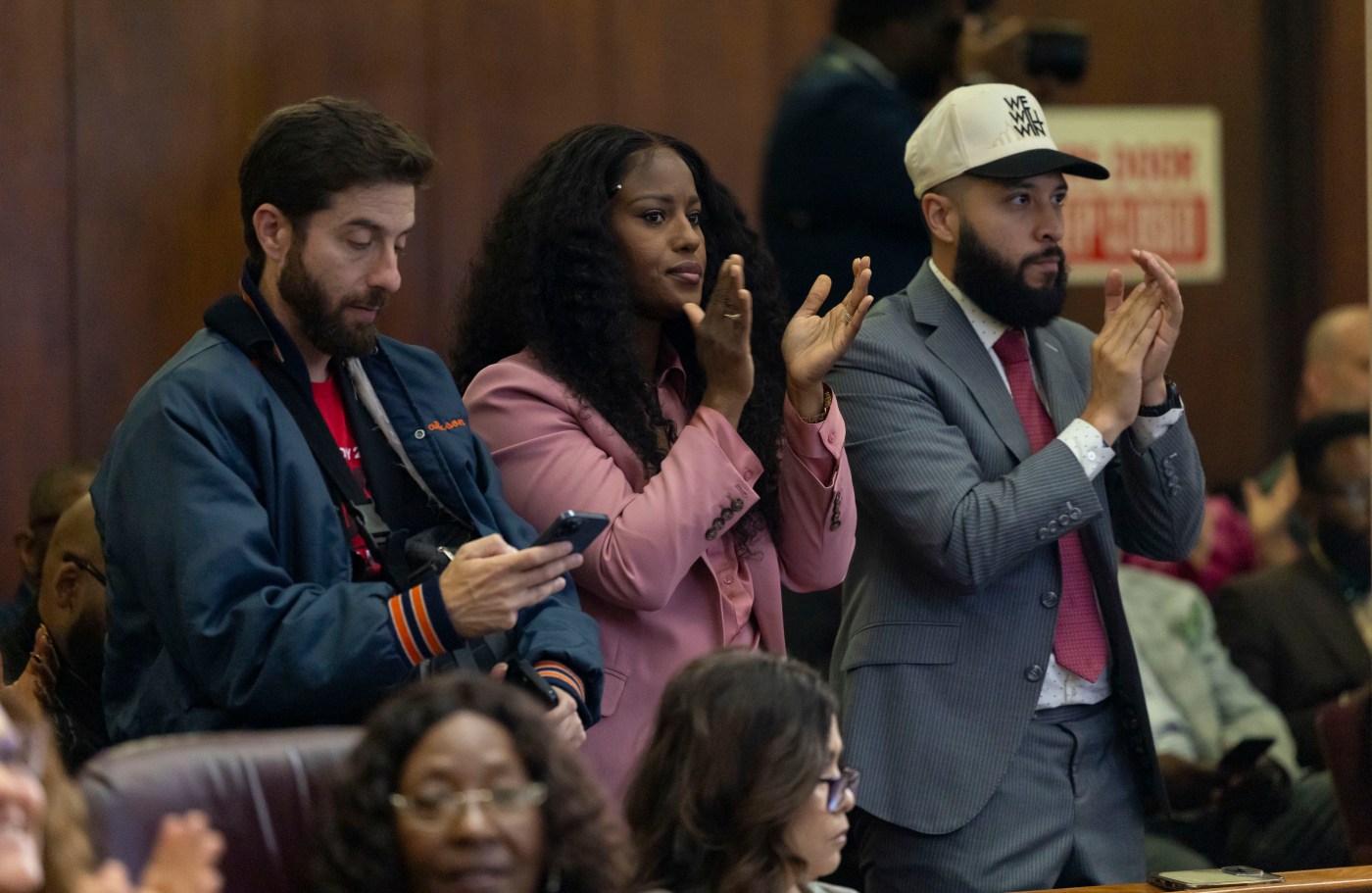
Chicago Board of Education member Michilla Blaise lauded the move at a Thursday morning press conference, noting it came from direct negotiations between some board members and the mayor’s office.
“The CPS budget passed in August was built on hope and balanced on paper, but not in reality,” Blaise said. “This commitment prevents any mid-year cuts and allows us to maintain stability in our classrooms. It also provides essential support for the pensions of CPS non-teaching personnel—the front line staff who clean our buildings, who feed our children and support our students who have the greatest needs.”
### Covering Additional Funding Gaps
The potential TIF revenue would also cover a canceled $8 million federal grant. Last month, the U.S. Department of Education’s Office for Civil Rights announced it would withhold the funds after CPS refused to end its Black Student Success Program, which Trump administration officials claimed violates federal antidiscrimination laws.
Blaise said the extra revenue helps maintain those inclusivity programs facing government criticism. “Despite pressure from the White House, this agreement is essentially Trump-proofing the CPS budget,” she said.
### Next Steps and Reactions
City Council must approve Johnson’s budget by December 31. Aldermen could still object to declaring such a large TIF surplus, as the funds are intended to drive redevelopment in their wards. However, in August, the majority signed a letter committing to a substantial surplus to help CPS.
Educational nonprofit Kids First Chicago applauded the city yesterday for the potential bump in funding but also advocated that the district not sign any intergovernmental agreement committing funds to Chicago before the TIF surplus amount is decided on or a budget is passed.
Though the prospective funds are a win, the city’s final budget is not yet set in stone, Kids First Chicago’s Chief of Policy Hal Woods told the Tribune ahead of Thursday’s meeting. “It’s going to take negotiations to see how much TIF surplus is ultimately swept. But certainly, we’re celebrating today,” Woods said Wednesday afternoon.
Some budget watchdogs, such as the Civic Federation, argue that relying on TIF surplus money is an unsustainable solution that could exacerbate the city’s structural deficit. Still, recent Chicago mayors have declared increasingly large surpluses to plug budget gaps.
In 2014, the city declared a TIF surplus of $65 million, with CPS receiving a $36 million cut. By 2025, the total surplus amount topped a record $712 million. CPS received $379 million of those funds, which accounted for 4% of its budget.
### CPS’s Continuing Fiscal Challenges
The district continues to grapple with fiscal woes after years of borrowing to cover current expenses and outstanding debt. CPS has about $9.1 billion in long-term debt and $450 million of short-term debt to be paid down over time. Its bond rating is considered “junk” by three of four rating agencies, making borrowing more expensive.
Expenses will only grow as CPS funds the Chicago Teachers Union’s new contract, set to cost $1.5 billion over four years.
—
Chicago Tribune’s A.D. Quig contributed to this report.
https://www.chicagotribune.com/2025/10/16/proposed-mayor-johnson-budget-cps/