‘Lanterns’ co-creator Damon Lindelof apologizes for ‘dumb joke’ that upset DC fans and a comics icon

**Damon Lindelof Sets the Record Straight on “Lanterns”: “Green is f- awesome”**

Damon Lindelof, co-creator and executive producer of the upcoming HBO Max superhero drama *Lanterns*, is addressing the backlash following his previous comments about the show’s title. In a heartfelt apology posted to Instagram on Monday, the prolific TV writer—known for his work on *Lost*—clarified his stance and expressed his genuine admiration for the Green Lantern legacy.

“I made a dumb joke on a comedy podcast,” Lindelof wrote alongside a photo of himself wearing a very green T-shirt emblazoned with the Green Lantern symbol at his first Comic-Con appearance. “I’m not going to bob and weave about context, the joke was dumb, the fandom is not. I owe them an explanation and a genuine reflection of my actual feelings.”

The joke that sparked controversy originated from Lindelof’s appearance on a 2024 episode of *Pod Save America* co-host Jon Lovett’s podcast, *Lovett or Leave It*. When asked about the show’s title, Lindelof said, “It’s called ‘Lanterns’ because we all agreed that the ‘Green’ was stupid.”

These remarks resurfaced recently after the release of the first *Lanterns* teaser earlier this month, during which some fans noticed an apparent lack of green. The resulting uproar caught the attention of comic book legend Grant Morrison, who penned a direct response in a Sunday Substack post. Morrison questioned Lindelof’s involvement with the project, writing:

“Why does a writer attach himself to this kind of narrative if he thinks it’s fundamentally ‘stupid’? What is this jockish dismissal of superhero conventions intended to prove anyway? Does Lindelof imagine it makes him seem less nerdy? The only people who give a [f-] about the ‘Lanterns’ TV series are Green Lantern fans. Why alienate them at the start? That feels more like ‘stupid.’”

Lindelof acknowledged Morrison’s criticism and took responsibility for his remarks. He also shared a personal reflection on what the Green Lantern character Hal Jordan meant to him growing up:

“For a quiet, uncoordinated kid, there was nothing cooler than a hero whose superpower was his imagination,” Lindelof wrote. “And green is not stupid, it is my lifelong favorite color and I have a questionnaire that I filled out in third grade to prove it.”

He went on to emphasize his pride in being part of the *Lanterns* creative team:

“More importantly, it would be a betrayal to everyone I worked for and alongside to say anything other than I was absolutely honored to be a part of the team that manifested the incredible construct that is *Lanterns*, because it was,” Lindelof added. “I was sloppy and careless with my words, ironic considering I care so much about Hal, John and the entire Corps. I can and will do better to be worthy of the oath. Until then, I’ll let the show speak for itself and I can’t wait for you all to hear what it has to say.”

Support soon followed in the comments section of Lindelof’s Instagram post. Among those sending encouragement were *Superman* actor Nathan Fillion—whose Green Lantern Corps member Guy Gardner will appear in *Lanterns*—and DC Studios president James Gunn.

“The joke was funny. No harm, no foul! Keep up the great work, we appreciate you!” Fillion wrote, including a green glove emoji. Gunn expressed his support more succinctly, sharing a single green heart emoji.

With the apology and positive reinforcement from notable figures in the DC fandom, Lindelof looks to move forward confidently as *Lanterns* gears up for its highly anticipated debut.
https://www.latimes.com/entertainment-arts/tv/story/2026-03-17/green-lanterns-damon-lindelof-apology

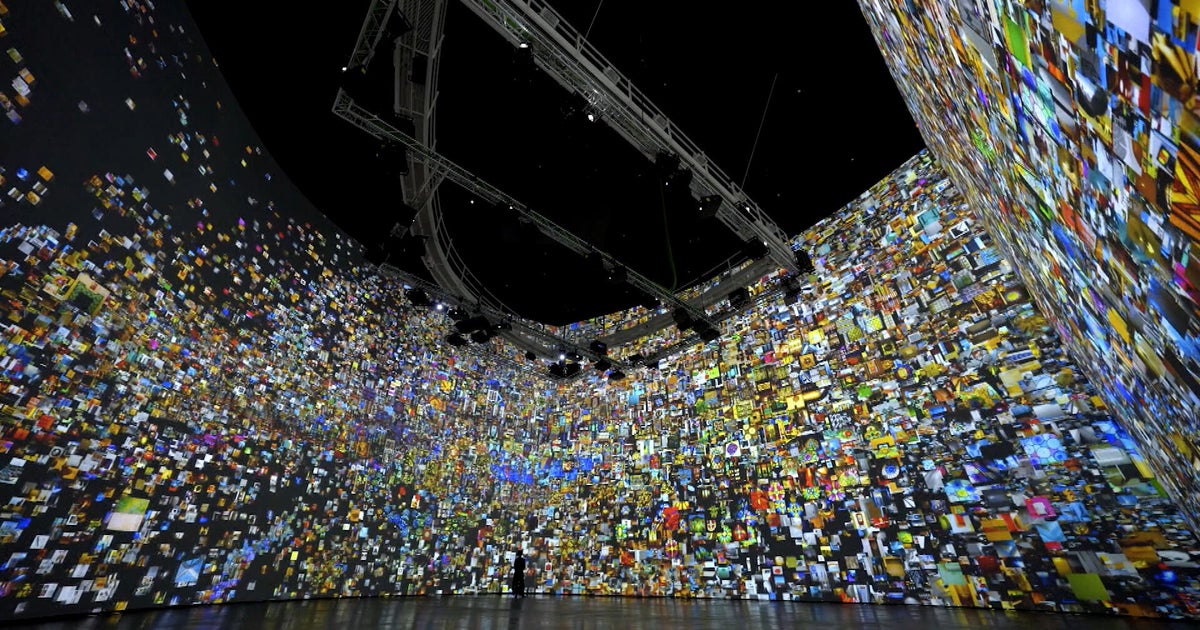
When AI becomes a paintbrush, is it art?

This week on 60 Minutes, correspondent Sharyn Alfonsi stepped into a new frontier of artistic expression: the rapidly evolving world of artificial intelligence-generated art. She profiled Refik Anadol, the 40-year-old Turkish American artist widely regarded as a pioneer of this emerging form. Anadol doesn’t mix acrylics or sculpt with stone. Instead, he paints with data. For one recent work, he fed an artificial intelligence model 200 million photographs of Earth, drawing heavily from archives provided by NASA. The result is a sweeping, immersive digital installation a living canvas of color and motion that feels at once cosmic and intimate. “When I think about data as a pigment,” Anadol told correspondent Sharyn Alfonsi, “I think it doesn’t need to dry. It can move in any shape, in any form, any color, and texture.” It’s a poetic description of a process rooted in code. His installations, projected across walls and ceilings, envelop viewers in constantly shifting landscapes generated by machine learning systems trained on vast image libraries. The effect can feel, as Alfonsi put it, “a little trippy. It is trippy,” Anadol replied. “Because I think as artists we ask what is beyond reality.” The critics weigh in Anadol’s work has appeared in some of the world’s most prestigious museums. But as A. I. art moves from tech labs to galleries, the art world is grappling with a bigger question: How do these creations stack up? Jerry Saltz, the Pulitzer Prize-winning critic for New York Magazine, is both skeptical and curious. “Right now, AI art seems to be an average of averages,” Saltz told Alfonsi. Algorithms are trained on vast datasets of existing images, themselves products of countless influences. The result, he argues, risks becoming “vaster, and more average,” rather than more profound. For Saltz, great art emerges from something machines fundamentally lack: lived experience. “I want the algorithm to experience death,” he said. “I want the algorithm to know the feeling of feeling like you have a fat neck, or bad hair. I want to train the algorithm to experience carnality.” Without sex and death, Saltz suggests, there is no art. And yet, he doesn’t dismiss the technology. “I like to think of it as a material,” Saltz said. “Artists use materials. A digital file is a material.” To reject A. I. outright, he argued, would be like rejecting oil paint or the novel before engaging with them. “I wish it well. And I would never, ever ignore it.” Fear, replacement, and ethics Part of the anxiety surrounding A. I. art is existential. Artists, like professionals in many industries, fear replacement, Saltz said. “We all have a latent fear of being replaced by AI,” Saltz acknowledged. “I guess I think that we will be on some level.” His prescription isn’t retreat it’s reinvention. Artists must become “better, or more useful, or more unique at what we do in order to keep our jobs.” The ethical questions are thornier. Is it fair or legal to train an algorithm on the work of other artists? Saltz thinks so. Artists have always borrowed, referenced, and reinterpreted what came before them. “There are no laws in art,” Saltz said bluntly. “All art comes from other art.” Is it art? Last year, artist Refik Anadol brought his vision to the Guggenheim Museum Bilbao in Spain. For that exhibition, he built a custom A. I. model trained on open-access photographs, sketches, and blueprints from the archive of Frank Gehry, the legendary architect who designed the museum itself. The system processed Gehry’s architectural legacy and reimagined it as a fluid, morphing, digital spectacle. Saltz once dismissed a similar installation at New York’s Museum of Modern Art as a “glorified lava lamp,” dazzling but ultimately decorative. Which raises the central question of this cultural moment: When a machine recombines humanity’s visual history into something new, is that art? Photos & Video courtesy of Refik Anadol Studio, Guggenheim Museum Bilbao, Tom Ross & Getty Images. The video above was edited by Scott Rosann.
https://www.cbsnews.com/news/when-ai-becomes-a-paintbrush-is-it-art/

Gold sinks below $4K: What does it mean for Bitcoin price?

**Bitcoin ETFs See $839 Million Inflows While Gold ETFs Lose $4.1 Billion: What’s Next?**

Gold’s shine is fading fast just as its “digital” rival, Bitcoin (BTC), recovers lost ground.

Just a week after reaching a record high above $4,381, gold has retreated by over 10.6%, sinking as low as $3,915 on Thursday—marking its steepest seven-day drop since April. This correction in gold coincides with a nearly 6.7% jump in Bitcoin’s price, highlighting a sharp divergence amid improving trade relations between the US and China.

### Trade Deal Boosts Risk Appetite

The shift followed Donald Trump’s remarks about an “amazing meeting” with Xi Jinping, during which the two leaders agreed to reduce fentanyl tariffs from 20% to 10%, effective immediately. With risk appetite improving and crypto markets heating up, traders may be rotating away from gold and back into Bitcoin in the months ahead.

### Bitcoin ETFs Attract $839 Million Amid Gold’s Plunge

US-listed Bitcoin ETFs have absorbed $839 million in net inflows since gold hit its record high on October 20, according to data from Farside Investors. Bitcoin ETF holdings have increased consecutively in the last four sessions, signaling growing investor interest.

In contrast, gold-backed ETFs experienced significant outflows, totaling about 1.064 million ounces (nearly $4.1 billion) since October 22, Bloomberg data shows. This includes the largest one-day withdrawal in over six months on Monday, when investors pulled out 0.448 million ounces of gold exposure.

### BTC Technicals Indicate Strong Support With Bullish Outlook

Bitcoin’s technical indicators now reveal a strong floor near $101,790, aligning with the 20-week exponential moving average (20-week EMA) and the 1.0 Fibonacci retracement level. Holding above this support confluence increases the chances of Bitcoin reaching $150,000 by the end of the year.

JPMorgan analysts are even more bullish, expecting BTC to hit $165,000 in 2025. They argue that Bitcoin remains undervalued relative to gold, underscoring its growing appeal as a digital store of value.

### Gold’s Bull Run Remains Intact, Analysts Say

Despite the recent correction, gold is still up around 50% year-to-date, supported by record central-bank purchases, persistent fiscal imbalances, and the ongoing “debasement trade,” where investors seek protection against ballooning government debt and weakening fiat currencies.

Metal trader David Bateman points out that gold’s bull run remains fundamentally intact. Technicals show that gold is still in a bull market correction, holding firm above its 50-day exponential moving average (50-day EMA). Historically, gold has bounced from this support every time in the past two years, leading to rebounds between 4% and 33%.

### Historical Patterns Suggest Gold Rebound Ahead

Over the past three decades, gold’s 10% corrections have consistently resulted in sharp rebounds within days, indicating these steep dips are more likely short-term bottoms than signs of deeper declines.

Data highlighted by Sabu Trades shows that the previous ten instances of such steep drops all produced positive two-month returns, averaging an 8.3% recovery. If this pattern holds, gold could revisit the $4,200-$4,250 zone by December, effectively retesting its record highs and reaffirming the metal’s broader uptrend.

Looking further ahead, gold could reach HSBC’s $5,000 target in 2026, as long as it maintains support above the 50-day EMA.

**Disclaimer:** This article does not contain investment advice or recommendations. Every investment and trading move involves risk, and readers should conduct their own research when making a decision.
https://cointelegraph.com/news/gold-below-4k-what-does-it-mean-for-bitcoin-price?utm_source=rss_feed&utm_medium=editors_pick_rss&utm_campaign=rss_partner_inbound

Exit mobile version
Sitemap Index