
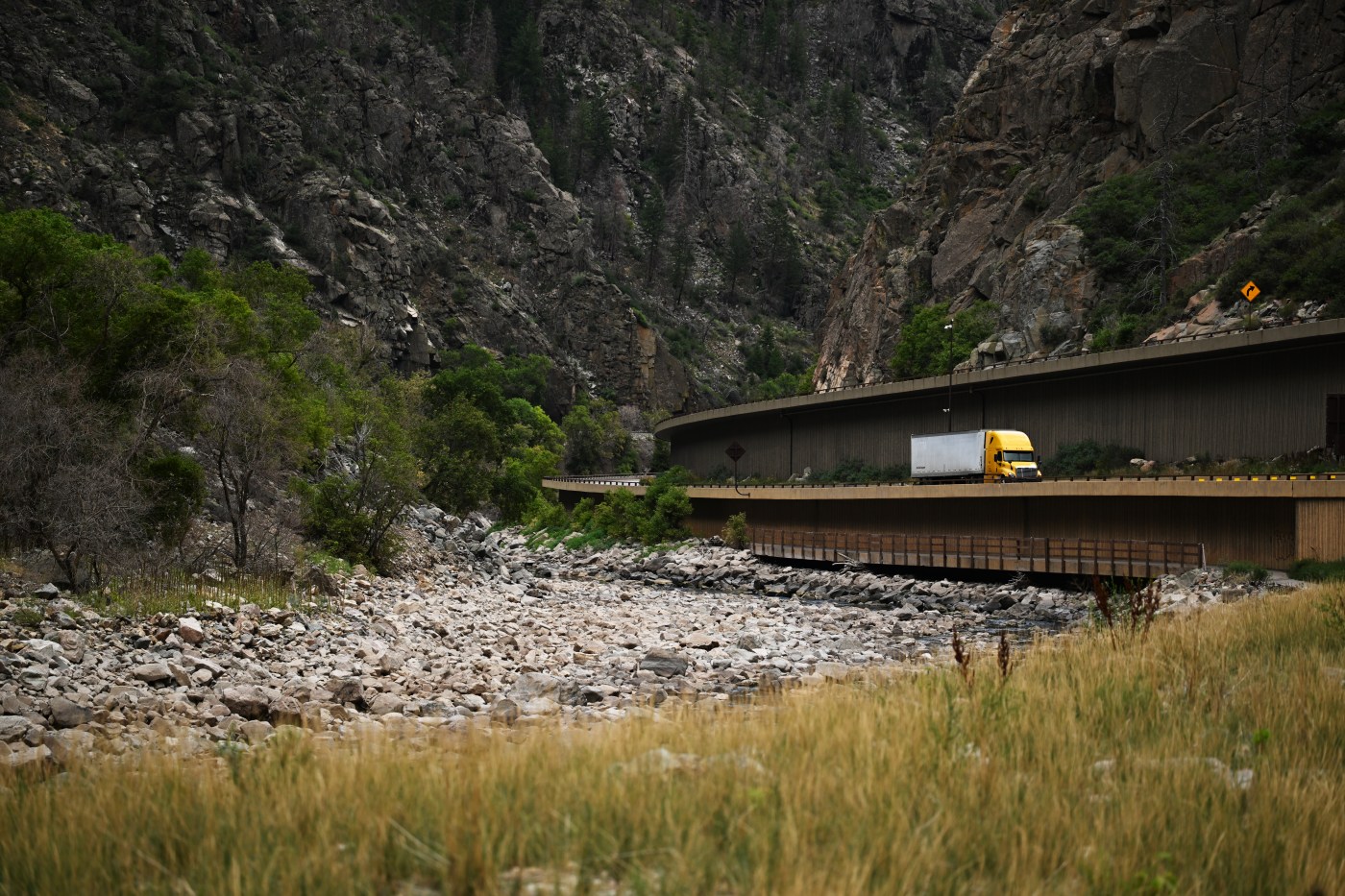
A yearslong effort to purchase two of the most powerful water rights on the Colorado River has cleared another hurdle after the state water board agreed to manage the rights alongside Western Slope water officials. The Colorado Water Conservation Board voted unanimously Wednesday night to accept the two water rights tied to the Shoshone Power Plant into its environmental flow program. The approval is a critical piece in the Colorado River District’s $99 million deal with the owner of the aging plant in Glenwood Canyon Xcel Energy but the deal has faced pushback from Front Range water providers that fear the change could impact their supplies. Backers of the deal aim to make sure the water now used by the small hydroelectric plant and then put back in the river will always flow westward. “The importance of today’s vote cannot be overstated as a legacy decision for Colorado water and the Western Slope,” Andy Mueller, general manager of the Colorado River District, said in a news release. “It secures an essential foundation for the health of the Colorado River and the communities it sustains.” Colorado water officials hailed the decision as a monumental achievement for the state that will help protect the river and its ecosystem. The state’s instream flow program allows the Water Conservation Board to manage dedicated water rights for the health of rivers, streams and lakes. “Acquiring the Shoshone water rights for instream flow use is a once-in-a-lifetime opportunity to preserve and improve the natural environment of the Colorado River,” Dan Gibbs, the executive director of the Colorado Department of Natural Resources, said in a news release. One of the main sticking points during the hourslong meeting Wednesday was whether the board should manage the water rights with the River District. That would include decisions on how and when to require upstream users like Front Range utilities to send more water downstream. Generally, the board is the sole manager of water rights in its instream flow program, which the Shoshone rights are now a part of. Several Western Slope entities said they would withdraw their financial support from the purchase if the Colorado River District was not allowed to co-manage the right with the board. Local governments and other organizations across the Western Slope promised more than $16 million toward the purchase. Front Range water providers argued that the statewide board is the sole authority that can manage such rights and should have final decision-making power. The water board instead approved the co-management strategy, which means that the two authorities will decide together how to act when there is not enough water to meet the right’s obligations. The Colorado River District a taxpayer-funded agency that works to protect Western Slope water wants to purchase the Shoshone rights to ensure that water will continue to flow west past the plant and downstream to the towns, farms and others who rely on the Colorado River, even if the century-old power plant were decommissioned. A stream of Western Slope elected officials, water managers and conservation groups testified in support of the deal and the rare opportunity it presented. “The Shoshone call is one of the great stabilizing forces on the river a heartbeat that has kept our valley farms alive, our communities whole and our economies steady even in lean years,” Mesa County Commissioner Bobbie Daniel said, urging the board to approve the plan. The meeting on Wednesday came after weeks of extensive mediation between the River District and Front Range entities. However, the representatives from opposite sides of the Continental Divide could not come to a consensus on a way forward. Representatives from Front Range utilities have said repeatedly that they supported the purchase as a whole, but they stated concerns about the purchase changing the status quo on the river. The water rights connected to the plant are the oldest major water rights on the main stem of the Colorado River, which means that they must be fulfilled before any rights established afterward. Those include more junior rights held by Front Range utilities to divert water from the river and bring it under the Continental Divide to their customers. The plant’s rights can command up to 1, 408 cubic feet of water per second year-round, or about 1 million acre-feet a year enough water for 2 million to 3 million households’ annual use. The Water Conservation Board’s approval is one of several that must be acquired by the River District. The deal now must go through the state’s water court and its Public Utilities Commission. Along with the $16 million coming from Western Slope entities, the district will pay $20 million and the Water Conservation Board allocated another $20 million. The financial plan also includes $40 million awarded under the federal Inflation Reduction Act by the Biden administration, but that money remains frozen as part of the Trump administration’s broad halt to spending by the previous president.
https://www.denverpost.com/2025/11/20/colorado-river-shoshone-water-rights-vote/
Category: general


Kim Kardashian reclaims her late father’s gift to O.J. Simpson through NFL legend’s auction
During O. J. Simpson’s murder trial in the 1990s, Kim Kardashian’s father, Robert Kardashian, was part of the defense of the controversial NFL legend.
https://www.sportskeeda.com/nfl/news-kim-kardashian-reclaims-late-father-s-gift-o-j-simpson-nfl-legend-s-auction


Crypto Exchange Ripio Reveals $100M Crypto Treasury, Second Largest in Latin America
Crypto Exchange Ripio Reveals $100M Crypto Treasury, Second Largest in Latin America The company’s holdings, which include bitcoin and ether, have been managed through trading and hedging strategies since 2017. By Francisco Rodrigues|Edited by Stephen Alpher Nov 20, 2025, 6: 19 p. m. What to know : Ripio, a Latin American cryptocurrency exchange, has a cryptocurrency treasury valued at over $100 million. The company’s holdings, which include bitcoin and ether, have been managed through trading and hedging strategies since 2017. Ripio’s treasury is the second-largest publicly known in Latin America, behind OranjeBTC’s $335 million and ahead of Méliuz’s $54 million and Mercado Libre’s $51 million. Latin American cryptocurrency exchange Ripio has revealed it holds a crypto treasury valued at over $100 million, making it the second-largest publicly known such firm in Latin America behind OranjeBTC. The company’s CEO Sebastian Serrano confirmed the figure in an interview with CoinDesk during DevConnect 2025 in Buenos Aires, noting that it began acquiring bitcoin and ether in 2017. Since then, Ripio has managed its holdings through trading and hedging strategies, though it didn’t specify the breakdown or performance of its assets. .. In addition to holding crypto, Ripio said it has acted as a seed investor in other crypto-focused companies, including Polygon and ZKSync. OranjeBTC, which earlier this year became Brazil’s largest publicly-traded crypto treasury firm, currently holds 3, 713 BTC worth more than $335 million, making it the largest digital asset treasury company in Latin America. Méliuz, the region’s third-largest DAT, currently holds around $54 million worth of bitcoin, while Latin American e-commerce giant Mercado Libre holds $51 million of BTC. More For You Protocol Research: GoPlus Security By CoinDesk Research Nov 14, 2025 Commissioned byGoPlus What to know : As of October 2025, GoPlus has generated $4. 7M in total revenue across its product lines. The GoPlus App is the primary revenue driver, contributing $2. 5M (approx. 53%), followed by the SafeToken Protocol at $1. 7M. GoPlus Intelligence’s Token Security API averaged 717 million monthly calls year-to-date in 2025 with a peak of nearly 1 billion calls in February 2025. Total blockchain-level requests, including transaction simulations, averaged an additional 350 million per month. Since its January 2025 launch the PS token has registered over $5B in total spot volume and $10B in derivatives volume in 2025. Monthly spot volume peaked in March 2025 at over $1. 1B while derivatives volume peaked the same month at over $4B.
https://www.coindesk.com/business/2025/11/20/crypto-exchange-ripio-reveals-usd100m-crypto-treasury-second-largest-in-latin-america

“This is what the media told us Arch Manning would be”: CFB fans react after Urban Meyer gets entranced by Fernando Mendoza
Indiana quarterback Fernando Mendoza is enjoying a fabulous season and is in contention for the Heisman Trophy.
https://www.sportskeeda.com/college-football/news-this-media-told-us-arch-manning-be-cfb-fans-react-urban-meyer-gets-entranced-fernando-mendoza
Average US long-term mortgage rate rises to 6.26%, the third straight increase
Just three weeks ago, the average rate was at 6.17%.
https://www.pressdemocrat.com/2025/11/20/mortgage-rates-nov-20/

Rubio casts doubt on pro-Russian Ukraine peace plan, touts ‘realistic ideas’ to end war
Secretary of State Marco Rubio appeared to deny that the US had decided to push a Moscow-friendly peace plan on Ukraine, becoming the first Trump administration official to publicly temper expectations on a reported deal that would gut Kyiv’s defense force and give up land to Russia. “Ending a complex and deadly war such as the one in Ukraine requires an extensive exchange of serious and realistic ideas. And achieving a durable peace will require both sides to agree to difficult but necessary concessions,” he wrote in a cryptic post to X on Thursday night. “That is why we are and will continue to develop a list of potential ideas for ending this war based on input from both sides of this conflict.” The comment came after Axios on Tuesday reported a deal had been reached, citing Putin henchman Kirill Dmitriev, who claimed he worked on the plan with US Special Envoy Steve Witkoff. On Wednesday, The Post revealed details of the 28-point framework, which called for Ukraine to shrink its Army to 2. 5 times smaller than it is now; force Kyiv to turn over long-range missiles “or any kind that can reach Moscow or St. Petersburg”; and ban any international brigades within Ukraine which has long been considered the best way to ensure a halt to Russia’s assault would remain in place, according to sources familiar with the details. Financial Times also reported the deal would include the entirety of Ukraine’s Donbas region including portions of the territory that Russia has been unable to capture in more than 11 years of war there. Politico later reported that a senior White House official said the proposed framework could be agreed to “as soon as this week,” despite including terms experts say were unreasonable to expect of Ukraine, amounting to the near-abandonment of its sovereignty. “Giving up the remainder of the Donbas would enable the Russians to make a run on Kyiv as the territory is flat and reducing the size of the Ukrainianian military, giving up weapons and no international security force would make that an even more likely outcome,” said the Atlantic Council’s Alex Plitsas. “If the plan as described is accurate, it would put $200 billion in US military assistance and aid to Ukraine at risk. Any peace plan needs to protect US taxpayer investments and this proposal is deeply unserious,” he added. While Ukrainian officials confirmed the plan was presented to Kyiv, Rubio’s comments appear to convey that the deal was not set in stone. The White House and State Department did not immediately respond to requests for comment.
https://nypost.com/2025/11/20/world-news/rubio-shares-unease-over-reports-of-pro-russian-ukraine-peace-deal/

Former AEW star Saraya (fka Paige) provides massive update on her in-ring return amid extended break
Former AEW star Saraya was recently asked about her return to the ring, and her response has left the wrestling world abuzz. Ad Saraya Bevis is one of the most popular wrestling personalities today. The Anti-Diva has built a reputation for being a resilient talent, overcoming a career-threatening neck injury that doctors said would prevent her from wrestling again. Despite this setback, Saraya returned to the ring in AEW after leaving WWE, where the erstwhile Paige was mainly seen in a backstage or managerial role during her later days with the company. The former AEW Women’s World Champion departed from Tony Khan’s promotion in March this year to focus on her podcast and other ventures. Now, after over a year of hiatus, the Anti-Diva has finally provided an update on her in-ring future. Ad Trending In a conversation with the Toronto Sun, Saraya stated that her drive to wrestle again is slowly returning. “I’m gonna get into training in January and we’ll see where that takes me, you know. Because I feel like I do-if I was to ever come back, you know, not saying I am, but if I was to ever come back, I want to be at the top of my game and be wrestling better than I was wrestling back when I was in NXT, you know. So that’s my goal. So I miss it. I love it. I think the percentage of me going back is a lot higher now, you know. But we’ll see where it goes. We’ll see where it goes. Who knows what will happen?” [H/T: ringsidenews] Ad Check out her comments in the video below: Ad Former AEW star Saraya recently announced some positive personal news. A few days ago, Saraya shared a personal update with her fans about her father, who had to be hospitalized due to health complications. However, the situation improved in the following days, and the Anti-Diva confirmed last night that her ‘daddio’ will be released from the hospital next Monday. “Just a quick one to say that my daddio gets to go home on Monday. He’s doing very well, you guys. Thank you, everybody, for checking in and messaging me about him, but he is doing so well. And yeah, he gets to come home,” she said. (00: 00 00: 14) Ad Check out her post on X here. It will be interesting to see when Saraya returns to the ring and whether it will be in WWE, as the rumors indicate. × Feedback Why did you not like this content? Clickbait / Misleading Factually Incorrect Hateful or Abusive Baseless Opinion Too Many Ads Other Was this article helpful? Thank You for feedback Edited by Karan Raj.
https://www.sportskeeda.com/aew/news-former-aew-star-saraya-fka-paige-provides-massive-update-in-ring-return-amid-extended-break

Who is eligible for payment in the $2.5B Amazon settlement? Here’s how to get a cut
It’s payback time for these conned customers. Amazon has begun sending automatic refunds to millions of eligible Prime customers as a result of the company’s $2. 5 billion settlement with the Federal Trade Commission, the agency confirmed. The FTC accused Amazon of deceiving customers into signing up for Prime subscriptions while intentionally making it difficult to cancel. The settlement consists of $1 billion in civil penalties and $1. 5 billion going directly to eligible Prime subscribers, capped at $51 per person. The first wave of payments, which started being sent on Nov. 12, will be automatic and will be sent out through Dec. 24. The FTC said that customers should accept their refunds within 15 days of receiving them. As part of the agreement, Amazon must now provide customers with clear disclosures, get explicit consent for subscriptions, and require an easy cancellation process. “The Trump-Vance FTC made history and secured a record-breaking, monumental win for the millions of Americans who are tired of deceptive subscriptions that feel impossible to cancel,” FTC chair Andrew Ferguson said in a statement in September. “Amazon and our executives have always followed the law, and this settlement allows us to move forward and focus on innovating for customers,” Amazon spokesperson Mark Blafkin said in a statement at the time. “We work incredibly hard to make it clear and simple for customers to both sign up or cancel their Prime membership, and to offer substantial value for our many millions of loyal Prime members around the world.” Who qualifies for a refund in the Amazon settlement? Subscribers must have signed up for Prime between June 23, 2019, and June 23, 2025, to be eligible for a refund. Refunds will be issued in two waves. The first wave of refunds consists of subscribers who signed up for a Prime subscription through a “challenged enrollment flow” and haven’t used more than three Prime benefits, “the member would not have received if they were not a Prime member.” Challenged enrollment flows include “any version of the Universal Prime Decision Page, the Shipping Option Select Page, Prime Video enrollment flow, or the Single Page Checkout.” These customers do not need to submit claims and will receive a payment of $51 maximum, “the total amount of membership fees paid” during a subscription. The second wave of customers will have to fill out a form after the automatic payment period ends on Dec. 24 to receive payment. Amazon will send out a form to those eligible to make a claim, and they will have up to 180 days after receiving the form to submit it. Amazon will have up to 30 days to review the claims submitted and will then pay those with valid claims the total amount of Amazon Prime membership fees, up to $51. This group includes customers who signed up through a challenged enrollment flow or unsuccessfully attempted to cancel their memberships during the five-year period, and haven’t used more than 10 benefits during any 12 months of enrollment. An attempt to cancel is defined as “entering, but failing to complete, the online cancellation process” or “taking a Save Offer during the online cancellation process.” How to receive your refund Subscribers eligible for an automatic refund will receive an email about it and can collect the money through PayPal or Venmo. “Once you do not claim the PayPal or Venmo payment, Amazon will mail you a check to your default shipping address listed on your Prime subscription,” the agency explained, adding that customers should cash their checks within 60 days. The FTC said that those who are eligible but did not get an automatic refund should wait for further guidance in 2026. “In 2026, Amazon will begin its claims process for eligible Prime customers who didn’t get an automatic refund between November and December 2025.”.
https://nypost.com/2025/11/20/tech/how-to-get-a-cut-of-the-2-5b-amazon-settlement/


Why gardening mishaps are a (sometimes painful) part of the process
By Jessica Damiano | The Associated Press I’ll be the first to admit there have been a few frights in my garden over the years, starting with the English ivy and pea-gravel mulch I inherited when I moved into the house and ending with the mint I foolishly planted directly in the ground many years ago, when I didn’t realize it would still be around to haunt me today. Did I say “ending with?” Who am I kidding? I’m still causing all sorts of mayhem in my beds and borders. Recently, I had to hire a landscaper to remove the creeping Liriope I mistook for the clumping type. The poor guy toiled with a pickaxe for more than three hours. I’m just glad he didn’t come after me with it. In the process, I lost many of the weedy groundcover’s mature perennial and bulb neighbors, and it will be years before the new plantings mature and the border returns to its former abundant glory. Plenty of blame Some ghastly garden scenarios, like my mint mishap, are clearly our own fault, but the blame for others can fall squarely on outsiders, like the nurseries that mislabel plants or the squirrels that “plant” invasive species among our natives. Either way, the cleanup falls to us. Nobody knows this better than John and Mary Richardson of Port Jefferson Station, New York, who wrote to tell me about that one time they were advised to apply cayenne pepper around their vegetable plants to repel the critters that were wreaking havoc on their harvests. “We happily and liberally sprinkled it in every bed in the garden,” they told me, adding that they took care to repeat the application after every rainfall to ensure “the protection would continue.” Before long, the couple said, pepper plants were taking over all their vegetable and flower beds. “It had never occurred to us to use ground cayenne and not pepper flakes, which are seeds,” they admitted. Speaking of seeds reminds me of a tale recounted years ago by a reader who was perplexed by the weekly disappearances of tomatoes from his vines. After checking to assess the ripeness of one particularly plump heirloom beauty, he decided to hold off on harvesting for one more day, when he planned to enjoy a tomato-sandwich lunch. But when the salivating sower went out to pick it, that tomato, too, was nowhere to be found. It was lawn-mowing day, he said, and it didn’t take long for him to discover “the landscapers had tomato seeds in their teeth.” I also once heard from a desperate reader who was battling the running bamboo that had been planted by his next-door neighbor. The viciously invasive, iron-rooted plant had grown under the fence dividing their properties and was poking up through his swimming pool liner. I wonder if he had to move. ‘The ultimate rookie mistake’ Then there’s Alyssa Sirek from Granbury, Texas: “With years of horticulture experience, I made the ultimate rookie mistake,” she admitted. “I put a bird feeder directly over our freshly landscaped rockscape and forgot that bird seed is, in fact, seed. “Between the birds flinging seeds like confetti and a few solid Texas rainstorms, our clean rockscape transformed into accidental chaos,” she said. Committed to avoiding pesticides, Sirek spent hours “hand-pulling surprise sprouts, collecting ant bites, knee scrapes, and a bruised ego along the way.” Months later, she said, stray seedlings still pop up from time to time, particularly after storms. Hoping for a fun project to do with her kids, she ordered ladybug larvae by mail. “I released them onto my zucchini plants, later to find out they were actually squash beetles,” she said. “They decimated all of my plants.” And sometimes, it comes with the job. Alice Raimondo says she sees a lot of strange things working as a horticultural lab coordinator at the Cornell Cooperative Extension’s diagnostic clinic in Riverhead, New York, where homeowners bring diseased plants and creepy insects for identification. Once, a woman brought in a wreath she was making out of cones that she’d collected, Raimondo remembers. “She liked the way the cones looked, but after working with a few of them, (she noticed) they wriggled,” she said. “Turns out, they were bagworms,” destructive pests that wrap themselves in “bags” that they construct from leaves and other plant parts. The woman “was pretty grossed out,” Raimondo said. As these brave gardeners can attest, one simple mistake can turn into a gruesome cautionary tale. ___ Jessica Damiano writes weekly gardening columns for the AP and publishes the award-winning Weekly Dirt Newsletter.
https://www.pasadenastarnews.com/2025/11/20/from-errant-birdseed-to-mint-mishaps-gardening-can-be-as-scary-as-any-halloween-night/
Securitize to Launch Institutional Assets on Plume’s Nest Protocol
Plume a blockchain focused on real-world asset finance (RWAfi) with $159 million in total value locked announced Thursday that tokenization platform Securitize will deploy institutional-grade assets on its Nest staking protocol. Nest currently holds over $39. 5 million in distributed assets, down nearly 30% over the past month, according to RWAxyz. The upcoming deployment will connect Securitize’s tokenized assets with Plume’s network of roughly 280, 000 RWA investors, according to a press release viewed by The Defiant. Securitize also tokenized BlackRock’s BUIDL fund the largest RWA product with over $2. 5 billion in assets. The deployment onto Nest will start with Hamilton Lane funds and expand throughout 2026 to include additional issuers and asset classes. The fund is targeting $100 million in capital, the release noted. The move highlights how RWA and decentralized finance (DeFi) projects are increasingly exploring compliant ways to bring traditional assets on-chain for trading, staking, and other DeFi use cases. As part of the initiative, Solv Protocol, a Bitcoin finance platform with over $2. 8 billion in assets, will invest up to $10 million in Plume’s RWA vaults. Users can trade and stake these assets on Plume, which is backed by Apollo Global Management, while keeping them under Securitize’s regulated framework. “Bitcoin’s role is becoming the foundation for real, yield-bearing capital markets,” said Ryan Chow, co-founder and CEO of Solv Protocol. “As regulated on-chain markets emerge, Bitcoin will underpin a new generation of yield, credit, and liquidity infrastructure, where demand for yield-bearing Bitcoin with RWA-backed yields replaces passive treasuries as the next phase of institutional adoption.” The deployment will also utilize Bluprynt’s Know-Your-Issuer (KYI) system to verify assets and issuers. The move comes a little over a month after Plume announced it would be acquiring Dinero, the developer of a liquid staking protocol on Ethereum. The deal added institutional staking products for Ethereum (ETH), Solana (SOL), and Bitcoin (BTC) to Plume’s platform, The Defiant previously reported. Earlier this year, Plume also partnered with World Liberty Financial (WLFI), a DeFi project with ties to President Donald Trump, to make USD1 the official reserve asset for its native stablecoin, pUSD. Plume’s native token (PLUME) is down 5% in the past day, per CoinGecko data.
https://bitcoinethereumnews.com/tech/securitize-to-launch-institutional-assets-on-plumes-nest-protocol/