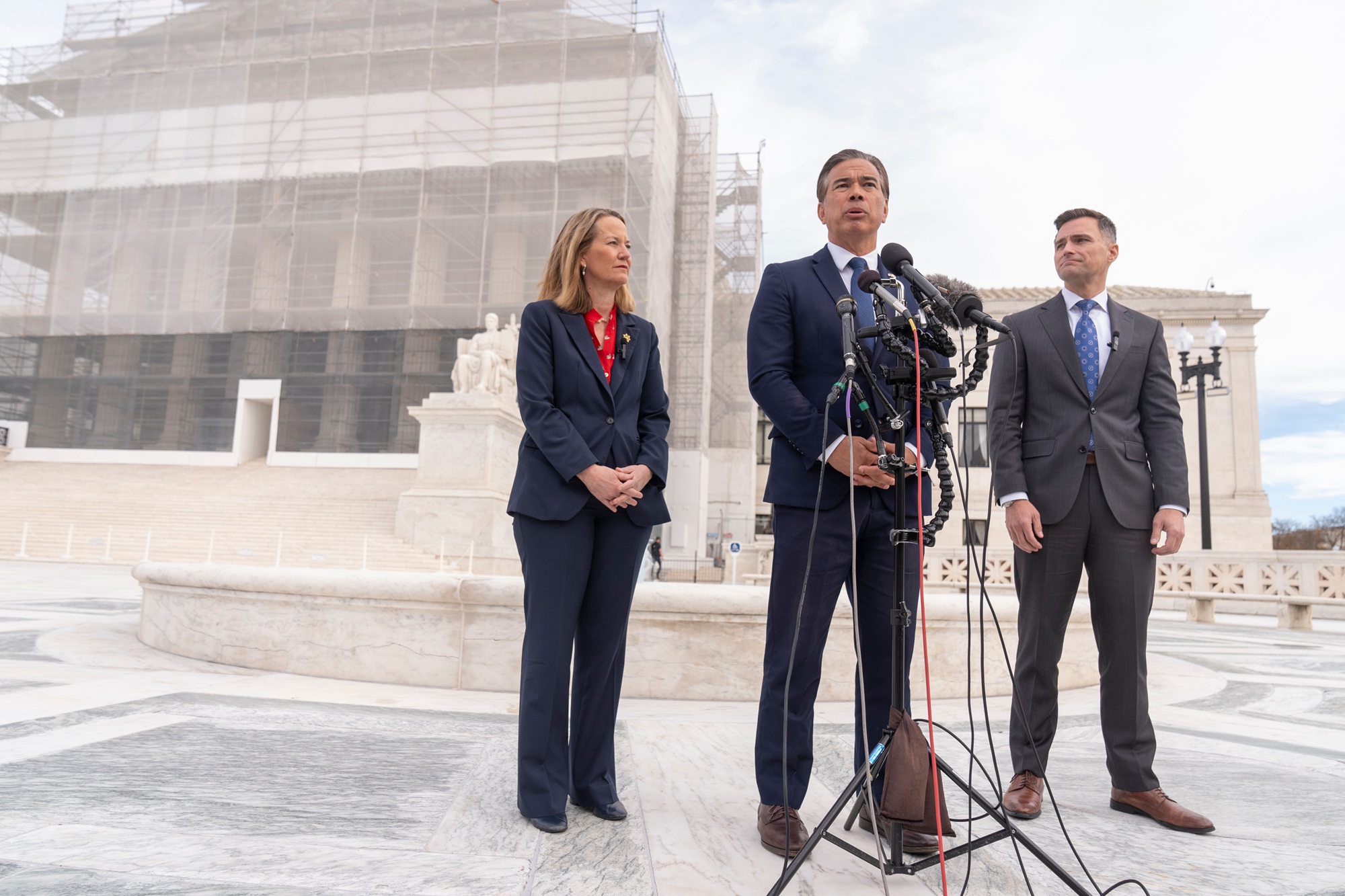
Newsom’s Prop 50 Redistricting Measure Faces New Lawsuit from DOJ

The Justice Department on Thursday filed a lawsuit to block California’s newly approved congressional districts, escalating a legal battle that could impact which party controls the U.S. House of Representatives in 2026.

The lawsuit, filed in federal court in California, targets the redistricting map advanced by Democratic Governor Gavin Newsom. This move comes after Republicans pursued a similar redistricting effort in Texas, which was backed by former President Donald Trump.

This case sets up a high-stakes clash between the GOP-led administration and Governor Newsom, a Democrat widely viewed as a potential presidential candidate in 2028.

This is a breaking news story. Updates will follow.
https://www.newsweek.com/newsom-prop-50-california-doj-lawsuit-trump-congress-redistricting-11043732

HKES holds entertaining competition in “Survivor”-themed fall banquet

Dozens of people gathered in the Mandela Room on Sunday for an entertaining Hong Kong Exchange Square (HKES) banquet themed “Survivors.”

Founded in 1994 at Binghamton University, the HKES aims to bring people together to foster a better understanding of Hong Kong culture through social and cultural events. Sunday evening was filled with engaging challenges, audience participation, performances, food, and auctions.

The room was festively decorated with red, blue, and green banners, and many attendees took photos in front of the “HKES Survivor EST. 1994” backdrop. Fake leaves and flames adorned each table to replicate the “Survivor” theme, complemented by creatively designed brochures available to guests.

Energy simmered as guests mingled, enjoying food catered by Mein Bowl, which offered made-to-order Asian cuisine. Attendees eagerly anticipated a game where contestants would “outwit, outplay, and outlast” their opponents—an homage to the famous “Survivor” tagline.

Katty Ho Fang, vice president of HKES and a junior majoring in accounting, explained how the “Survivor” theme reflects the organization’s values. “The fall banquet stands as our most important tradition, and this year’s ‘HKES Survivor’ theme demonstrates teamwork and resilience combined with entertaining competition,” Fang said via email. “The event aims to provide enjoyment for all attendees through performances, games, and a lively atmosphere. It highlights the hard work of our E-Board members, who crafted a night focused on community pride. The event fosters family bonds and friendships while creating shared memories.”

This year’s game featured six contestants competing in various challenges. Leo Chung, fundraising chair and a sophomore majoring in computer engineering, and Izzy Young, a fall representative and freshman majoring in business administration, hosted the event.

Challenges included quick games like telephone charades, “What’s in the Box,” and a blindfolded eating contest. After each contest, the winners prevailed while the others faced dramatic voting rounds, where one contestant was “voted out” by their peers, echoing the “Survivor” experience.

The first game, telephone charades, emphasized teamwork. The six contestants split into two groups, each aided by two audience members. A prompt was acted out by one person and then passed down the line, with the last person guessing the original prompt.

The second challenge, “What’s in the Box,” tested individual skill. Contestants reached blindly into a box for ten seconds, guessing the item inside—ranging from cold sausage to aluminum foil. The contestant with the most correct guesses earned immunity from the following voting round.

Between games, the E-Board members performed a variety of dances, including a women’s hip hop dance, a cultural dance, and an all-men’s routine. Chung and Katherine Chan, social chair and a sophomore majoring in biology, performed a duet, while Iris Lin, a sophomore majoring in chemistry, played the piano.

The dances were lighthearted, with many guests laughing at the unexpected explicit moves in the boys’ routine, while the girls’ dance impressed with synchronized hair flips. Lin’s piano performance featured beautiful adaptations of Cantonese folk songs that captured the essence of Hong Kong’s cultural beauty. Guests joined together, illuminating the room with phone flashlights as they swayed to the music.

Fang discussed the extensive preparation behind the event’s seamless transitions between activities. Starting planning in June, the E-Board held multiple rehearsals to coordinate lighting, sound, prop changes, and performance cues. “The smooth operation depends on various hidden elements, including stage setup, game timing, and clear roles for participants and spectators,” Fang noted. “Our members’ success demonstrates their ability to work effectively as a team.”

After the blindfolded eating contest, freshman mechanical engineering major Irene Li emerged as the final victor. Li shared her winning strategy during intermission, explaining she aimed to befriend as many fellow contestants as possible to stay safe during voting rounds. However, she acknowledged that betrayal was inevitable in the game’s competitive spirit, where only one survivor prevails.

An auction towards the evening’s end, along with continued voting, kept the audience engaged through performances and contests. Guests held onto raffle tickets received at the start of the night, cheering as their numbers were called by the hosts. Prizes were generously sponsored by Moshi, CHICHA San Chen, LAFCO New York, and Uncle Lou.

The final voting round allowed the audience to select the ultimate winner from the three remaining contestants via a Google Form. The night concluded with a heartfelt speech from Christopher Chin, HKES president and a senior majoring in business administration. He thanked attendees and praised the E-Board’s efforts in organizing this year’s unique fall banquet.

With warmth and gratitude, the E-Board exchanged flowers and the audience applauded the performers, organizers, and the victorious survivors. Chin expressed hope to “continue to be blown away” by the E-Board’s dedication and creativity.

“To my amazing E-Board, you guys are the HEART and SOUL of HKES,” Chin wrote in the event brochure. “Through countless days of decorating, you not only pulled through but made every minute more fun than the last. I cannot express how appreciative I am that you spent your weekends creating something so exciting!”

The “Survivors” banquet was a memorable celebration of teamwork, culture, and community spirit, leaving lasting impressions on all who attended.
https://www.bupipedream.com/ac/hkes-holds-entertaining-competition-in-survivor-themed-fall-banquet/172964/

‘Is that a hint?’ Epstein helped top Trump advisor attack Brett Kavanaugh’s accuser

One of the emails from convicted sex offender Jeffrey Epstein recently released by the House Oversight Committee reportedly shows correspondence with Steve Bannon, one of President Donald Trump’s longtime advisors, about getting Trump’s embattled second Supreme Court nominee through a major controversy.

On Wednesday, journalist Sean Morrow of More Perfect Union posted a September 2018 email exchange between Epstein and Bannon. In the exchange, the two discuss a potential line of attack on Dr. Christine Blasey Ford, who accused then-Supreme Court nominee Brett Kavanaugh of assaulting her at a high school party.

According to the emails, Epstein suggested that Kavanaugh’s attorneys press Ford about medications she may have been using, which can sometimes cause memory loss. Epstein wrote from a personal Gmail account, “I delayed my trip a day. So I’m still around.” Bannon responded, “Tell [Kavanaugh attorney Bill Burck] they should make sure they ask Ford about her medications, what type and for how long. My guess is that [Ford lawyer Debra Katz] won’t let her answer.”

Epstein then sent Bannon a link to a 2015 Pharmacy Times article entitled “8 Medications That May Cause Memory Loss.” Bannon replied, “Is this a hint,” to which Epstein responded, “Duh.”

The convicted child predator followed up with another email containing a link to a 2017 University of São Paulo study titled “False Memories in Social Anxiety Disorder.” Bannon later wrote back, “She couldn’t recall if the lie detector was given the same day as her mother’s funeral or the next day? MEDS. Oh I get it now.”

Although Bannon was no longer Trump’s White House chief strategist after August 2017, The Washington Post reported several months after his firing that Bannon and Trump kept in regular contact through phone calls, with Trump usually initiating them. According to the Post, Bannon continued to address Trump as “sir,” despite no longer being an administration employee.
https://www.alternet.org/epstein-trump-kavanaugh/

Are American workers being replaced? Inside the H-1B visa controversy

**Understanding the Controversy Surrounding H-1B Visas**

Following months of controversy, President Donald Trump issued a proclamation in September decrying the systemic abuse of the H-1B visa program. He argued that the program is fueling the “large-scale replacement of American workers” and has “undermined both our economic and national security.”

To address this, Trump instituted a $100,000 fee for companies seeking to obtain an H-1B visa, a move that has been widely criticized by business leaders, especially in the tech industry. The debate over the program has split both the American public and the GOP, with one side asserting that visa holders are poaching American jobs, while the other emphasizes the program’s importance to U.S. competitiveness.

So, what exactly are H-1B visas, and why have they become such a political flashpoint?

### What is an H-1B Visa?

An H-1B visa is a non-immigrant work visa that allows U.S. companies to hire highly-skilled foreign workers in specialty occupations. These visas are issued for an initial period of three years and can be extended up to six years.

According to the U.S. Citizenship and Immigration Services (USCIS), the visas are meant for individuals of “exceptional merit and ability.” To qualify, candidates must have at least a bachelor’s degree in a relevant field.

### Which Industries Use H-1B Visas Most?

By far, the tech industry is the largest user of H-1B visas, accounting for roughly 60 to 70 percent of all new applications in recent years. Other prominent sectors include consulting and professional services, engineering and manufacturing, healthcare and medical research, and higher education.

### How Many Foreign Workers Hold These Visas?

There is no official figure for the number of people currently holding H-1B visas. However, there is a yearly cap of 65,000 visas, with an additional 20,000 reserved for individuals holding master’s degrees or higher.

Most universities and non-profit research organizations are exempt from this cap, which further increases the number of people approved each year. The Pew Research Center estimated that about 400,000 H-1B visa applications were approved last year under the Biden administration.

### Where Do Visa Holders Come From?

Nearly three out of every four — 73 percent — of H-1B visa holders come from India, according to Pew. China ranks second, with 12 percent, while the remaining 15 percent come from various other countries, none exceeding a 2 percent share.

### Who Is Against H-1B Visas?

Criticism of the H-1B visa program comes from both sides of the political aisle, including former President Trump and Senator Bernie Sanders (I-Vt.).

Critics contend that the program has strayed from its original purpose — attracting top global talent — and is now being exploited by employers to import cheaper foreign labor, suppress wages, and displace American workers.

In response, Senate Democratic Whip Dick Durbin (D-Ill.) and Senate Judiciary Chair Chuck Grassley (R-Iowa) reintroduced bipartisan legislation in September aimed at reforming the program, closing loopholes, protecting American workers, and preventing outsourcing of jobs.

On the state level, Florida Republican Governor Ron DeSantis issued guidelines in October to combat what he called a university loophole. He directed the Florida Board of Governors to require universities to prioritize American graduates and curb the practice of “importing foreign workers on H-1B visas instead of hiring Americans.”

### Who Supports H-1B Visas?

On the other side, many prominent figures argue that the program is essential for maintaining U.S. competitiveness. Elon Musk, for example, has publicly supported the H-1B program, stating, “The reason I’m in America along with so many critical people who built SpaceX, Tesla, and hundreds of other companies that made America strong is because of H1B.”

Musk also acknowledged that “the program is broken and needs major reform,” proposing to raise the minimum salary threshold and introduce yearly costs for maintaining H-1B status to make overseas hiring more expensive compared to domestic hiring.

Business leaders assert that the H-1B program is crucial for competing with countries like China, which recently launched its own talent visa program called the K-visa. The U.S. Chamber of Commerce also supports the H-1B program.

### Are Visa Holders Taking American Jobs?

On September 19, President Trump issued a proclamation titled “Restriction on Entry of Certain Nonimmigrant Workers,” claiming that the H-1B visa program is being “deliberately exploited to replace, rather than supplement, American workers with lower-paid, lower-skilled labor.”

He argued that this abuse artificially suppresses wages, disadvantages American workers in the labor market, and complicates efforts to attract and retain the highest-skilled subset of temporary workers — with the most significant impact in STEM (science, technology, engineering, and math) fields.

Trump stated that the large-scale replacement of American workers through systemic abuse of the program has undermined both economic and national security.

### New Rules and Fees

To curb abuses, Trump imposed a $100,000 fee on companies applying for H-1B visas, effective September 21, 2025, with the restriction set to expire one year later. His administration has also been directed to initiate rulemaking prioritizing high-skilled and high-paid applicants.

Additionally, the Department of Homeland Security (DHS) plans to narrow the definition of “specialty occupation,” increase worksite compliance inspections, and require employers to submit applications directly, aiming to prevent companies from contracting out H-1B workers to other firms.

### What’s Next?

The debate over H-1B visas is far from over. The U.S. Chamber of Commerce has filed a lawsuit against the Trump administration’s new $100,000 fee, arguing that it would make the program prohibitively expensive for many U.S. employers, particularly small and midsize businesses.

The lawsuit claims the fee is unlawful as it overrides provisions of the Immigration and Nationality Act, which require visa-related fees to be based on the government’s costs to process them.

As the political and economic battles continue, the future of the H-1B visa program remains uncertain, but its impact on the American workforce and technological innovation will continue to be a critical issue.

*Stay tuned for further updates on the evolving H-1B visa policy.*
https://www.foxnews.com/politics/american-workers-being-replaced-inside-h-1b-visa-controversy

California Moves to Protect CalFresh Payments From Federal ‘Confusion and Chaos’

Attorney General Rob Bonta announced on Monday morning new efforts to protect food benefits California has distributed after the U.S. Department of Agriculture (USDA) directed states over the weekend to halt and reverse payments.

The filing for a temporary restraining order against the federal government, joined by 23 attorneys general and three governors, comes as the USDA instructed states to “immediately undo any steps taken to issue full SNAP benefits for November 2025” amid the longest federal government shutdown in U.S. history.

“The whiplash the president and USDA Secretary Brooke Rollins have given Americans in recent weeks, the steps they’ve taken to prevent vulnerable families from putting food on the table, are unnecessary, unconscionable and unlawful,” Bonta said. “We refuse to stand by and allow it to continue without a fight.”

The shutdown, which began in early October, has resulted in delayed payments for those on the federal Supplemental Nutrition Assistance Program (SNAP). According to Bonta, it has sparked “confusion and chaos” that was “concocted by the Trump administration.”

Over 41 million people nationwide rely on SNAP, with approximately 5.5 million using California’s version, known as CalFresh. Food benefits have become a focal point of disputes between courts, states, and the federal administration.

Last week, a federal judge ordered the Trump administration to make a payment that would fully fund the month of November. Despite this, the administration has ignored a previous order to resume certain payments and is appealing the most recent ruling.

The court’s decision prompted states including California to reinstate benefits on people’s EBT cards. According to Bonta, “the vast majority” of Californians on CalFresh “have received full funding” payments that the USDA is now attempting to claw back.

On Saturday, the USDA warned that “failure to comply with this memorandum may result in USDA taking various actions, including cancellation of the Federal share of State administrative costs and holding States liable for any overissuances that result from the noncompliance.”

The U.S. District Court for the District of Massachusetts is currently pausing this request, with a hearing scheduled for later Monday.

“If any of that back and forth left you with whiplash, you are not alone,” Bonta acknowledged. He later emphasized, “I want every SNAP beneficiary to know we are fighting for you tooth and nail to make sure that you can be fed. And that there will be no revocation or undoing of the benefits that you have loaded onto your cards.”

There is hope for an end to the federal government shutdown. On Sunday, eight Democratic senators broke ranks to join Republicans in making a deal to reopen the government.

The October shutdown began primarily due to Democrats seeking extended subsidies under the Affordable Care Act (Obamacare), which supports low-income Americans’ access to health care. The current deal does not guarantee these extended subsidies but is based on an informal agreement that Republicans will vote to extend them in December.

Speaking Monday morning, former House Speaker Nancy Pelosi criticized the deal: “They got a promise that they would bring up a bill. Well, what’s that? They’re gonna vote for it? Is he gonna sign it? What’s the promise? What’s a promise? Them is fighting words.”

The eight Democrats who voted for the deal have faced criticism from fellow party members, including Governor Gavin Newsom, who posted on social media: “Pathetic. This isn’t a deal. It’s a surrender. Don’t bend the knee!”

California’s senators, Alex Padilla and Adam Schiff, made clear they will not support the deal, citing concerns over health care access.

“This does nothing to stop the Republican-made health care crisis. It does nothing to stop premiums from doubling for millions of Americans,” Padilla said, according to the Sacramento Bee.

“I have heard from countless Californians who are at risk of losing their health insurance, and my position has been clear from the beginning: I would not support a government funding bill that did not fund health care tax credits,” Schiff added.

KQED reporters Carly Severn and Sara Hossaini contributed to this report.
https://ww2.kqed.org/news/2025/11/10/california-moves-to-protect-calfresh-payments-from-federal-confusion-and-chaos/

Trump slams air traffic controllers who called out during the government shutdown

President Trump is slamming U.S. air traffic controllers who called out of work during the government shutdown, a period during which they were forced to stay on the job without pay.

Trump expressed his frustration in a post on Truth Social Monday morning, stating that he was “NOT HAPPY” with controllers who took time off. “All Air Traffic Controllers must get back to work, NOW!!! Anyone who doesn’t will be substantially ‘docked,'” he wrote.

Some controllers have taken on second jobs, while others have called in sick. They are set to miss their second full paycheck this week. Meanwhile, Trump praised those controllers who took no time off during the longest shutdown in U.S. history, calling them “GREAT PATRIOTS” and saying he would recommend giving each a $10,000 bonus.

He added that any controllers wishing to quit shouldn’t hesitate but would receive “NO payment or severance of any kind!” and would be “quickly replaced by true Patriots.” It’s important to note that one reason for the shortage of controllers is that it takes years to train and certify new personnel.

In a subsequent post on X, Transportation Secretary Sean Duffy praised “those who have worked throughout the shutdown” and said he would work with Congress to “reward your commitment.”

However, others have sharply criticized Trump’s comments. Former Transportation Secretary Pete Buttigieg responded on X, saying, “The President wouldn’t last five minutes as an air traffic controller, and after everything they’ve been through and the way this administration has treated them from Day One he has no business s****ing on them now.”

Last week, the FAA announced it would reduce flights by up to 10% at 40 of the busiest airports in the country, starting with a 4% reduction implemented on Friday. These cuts contributed to major travel headaches over the weekend.

According to the flight tracking website FlightAware, there were more than 4,500 cancellations and 18,000 delays at airports across the U.S.

At Philadelphia International Airport, passenger Phill Hicks experienced multiple cancellations. His flight to West Palm Beach, Florida, was canceled and rebooked twice on Sunday. Preparing to head home for the night and return for his flight Monday morning, he wasn’t confident his flight would take off either.

“I don’t believe this ticket,” Hicks told NPR, “but I’m going to gas my truck up, and take that trip if I have to.”

Similarly, Seth Alpert faced a two-hour delay on his flight back to Columbus, Ohio. Preparing for uncertainties, he rented a car as a backup plan.

“We’ll see. The incoming flight says it’s on time, or a few minutes delayed so, you know, 50-50,” Alpert said regarding his chances.

Hicks, who was stranded at the airport for several hours before senators announced they had reached a potential deal to reopen the government, expressed frustration with Congress.

“I think little cry babies need to get together and figure it out,” he said. “People elect them to do a job. Do your damn job.”
https://www.npr.org/2025/11/10/nx-s1-5604664/trump-air-traffic-controllers-forced-time-off-bonus

Louisiana prison guards cut a Rastafari inmate’s dreadlocks. Supreme Court will decide if he can sue

WASHINGTON (AP) — The Supreme Court on Monday wrestled with whether a former Louisiana inmate can sue prison officials who cut off his dreadlocks in violation of his Rastafari religious beliefs.

The justices heard arguments in the case of Damon Landor, who wants to sue for money damages under a federal law designed to protect the religious rights of inmates. After two hours of arguments, the court’s three liberal justices seemed firmly on Landor’s side. But it was unclear whether even one of the six conservatives, let alone the two who would be necessary for a majority, would join them.

No one is defending what happened to Landor in 2020 when guards cut the dreadlocks he had been growing for nearly two decades. However, Louisiana argues that the law—the Religious Land Use and Institutionalized Persons Act (RLUIPA)—cannot be used to hold those who violate inmates’ rights financially responsible. Lower courts have so far uniformly ruled against Landor and others who have made similar claims.

“Look, the facts of this case are egregious,” Justice Amy Coney Barrett said. But Barrett also expressed concern that every court that has weighed in “went the other way.”

The justices could be guided by their decision in 2020 allowing Muslim men to sue over their inclusion on the FBI’s no-fly list under a sister statute, the Religious Freedom Restoration Act (RFRA). Interestingly, the Justice Department, which argued against the plaintiffs in the no-fly list case during President Donald Trump’s first administration, now agrees with Landor.

When Landor entered the prison system for a five-month term in 2020, he carried a copy of an appeals court ruling from another inmate’s case holding that cutting religious prisoners’ dreadlocks violated the federal law. At his first two stops, officials respected his beliefs. But things changed when he arrived at the Raymond Laborde Correctional Center in Cottonport, about 80 miles (130 kilometers) northwest of Baton Rouge, for the final three weeks of his term.

According to court records, a prison guard took the copy of the ruling Landor carried and tossed it in the trash. Then the warden ordered guards to cut his dreadlocks. While two guards restrained him, a third shaved his head to the scalp.

Landor sued after his release, but lower courts dismissed the case. The 5th U.S. Circuit Court of Appeals lamented Landor’s treatment but said the law doesn’t allow him to hold prison officials liable for damages. Louisiana stated that “the state has amended its prison grooming policy to ensure that nothing like petitioner’s alleged experience can occur.”

The Rastafari faith is rooted in 1930s Jamaica, growing as a response by Black people to white colonial oppression. Its beliefs are a melding of Old Testament teachings and a desire to return to Africa. The faith’s message was spread worldwide in the 1970s by Jamaican music icons Bob Marley and Peter Tosh, two of Rastafari’s most famous exponents.

A decision in *Landor v. Louisiana Department of Corrections*, 23-1197, is expected by spring.

___

Follow the AP’s coverage of the U.S. Supreme Court at [AP News](https://apnews.com/hub/supreme-court).
https://ktar.com/national-news/louisiana-prison-guards-cut-a-rastafari-inmates-dreadlocks-supreme-court-will-decide-if-he-can-sue/5773903/

Amazon.com Inc. (AMZN) Stock: Rises as Low-Cost ‘Bazaar’ Service Expands to 14 Global Markets

Amazon Stock Inches Up Following Global Expansion of Amazon Bazaar

Amazon.com Inc. (NASDAQ: AMZN) shares closed at $244.41, up 0.56% on November 7, 2025, before gaining an additional 0.3% in after-hours trading to $245.15. The modest rise in stock price came shortly after the e-commerce giant announced a significant global expansion of its low-cost retail platform, Amazon Bazaar.

Amazon Bazaar, branded as Haul in the U.S., extends Amazon’s reach into 14 new international markets, underscoring the company’s push to capture the rapidly growing ultra-budget online shopping segment currently dominated by Chinese fast-fashion giants Shein and PDD Holdings’ Temu.

### Amazon Bazaar Takes on Shein and Temu

Originally launched in Mexico in 2024, and later expanded to Saudi Arabia and the UAE, Amazon Bazaar specializes in ultra-affordable products such as $10 dresses and $5 accessories, targeting cost-conscious consumers worldwide. The latest rollout includes countries like Hong Kong, the Philippines, Nigeria, and Taiwan.

Most items on the platform are priced below $10, with some as inexpensive as $2, spanning categories from home goods to fashion. This aggressive pricing strategy positions Amazon Bazaar to directly compete with Shein, which operates in over 160 countries, and Temu, which ships to at least 70 countries.

### Analyst Perspective: A Long-Term Global Play

Industry analysts view the expansion as a strategic move to strengthen Amazon’s position in emerging e-commerce markets. Gil Luria, an analyst at D.A. Davidson & Co., described Amazon Bazaar as a notable step in the company’s international growth strategy. He emphasized that Amazon typically enters markets when confident of achieving profitability.

Luria also noted that while Amazon’s international ventures often take years to generate returns, the success of low-cost products through Bazaar could enable Amazon to expand well beyond its current 23 markets, potentially reaching nearly every country globally.

### Strong International Revenue Growth

Amazon reported international revenue of $40.9 billion in Q3 2025, marking a 10% year-over-year increase (excluding foreign exchange effects). This growth reflects the company’s successful expansion and increasing demand across international markets.

### Competitive Landscape and Tariff Pressures

The move to globalize Amazon Bazaar comes as competitors Shein and Temu accelerate their own international expansions. The competitive landscape intensified following the Trump administration’s removal of the de minimis trade exemption, which previously allowed shipments under $800 to enter the U.S. duty-free.

While this policy change has created challenges for low-cost importers, it has simultaneously provided Amazon with an opportunity to leverage its robust logistics and compliance infrastructure to capture market share.

### Outlook and Stock Performance

Amazon’s stock continues to showcase strong momentum, with year-to-date returns of 11.4% and a one-year gain of 16.36%, outperforming many of its peers. Over the past three years, the stock has gained nearly 170%, reflecting robust investor confidence in Amazon’s long-term growth potential.

By expanding Amazon Bazaar globally, Amazon is strategically positioning itself to compete aggressively in the fast-growing budget retail segment while reinforcing its international market leadership.

*Stay updated with the latest stock insights and market trends to find the next knockout investment opportunity.*
https://coincentral.com/amazon-com-inc-amzn-stock-rises-as-low-cost-bazaar-service-expands-to-14-global-markets/

Theater Review: ‘The Queen of Versailles’ with Kristin Chenoweth gets lost in a Hall of Mirrors

NEW YORK (AP) — For much of the new Broadway show, *The Queen of Versailles*, the set is covered in tarps and slipcovers. That’s fitting for a musical that ultimately feels still under construction.

Based on a 2012 documentary film about the quixotic attempt to build the largest private home in America, the show reunites star Kristin Chenoweth with her *Wicked* songwriter Stephen Schwartz. Yet, despite this promising collaboration, the production has an unfinished feel, as if some spackling and sanding is desperately needed.

*The Queen of Versailles*, which opened Sunday night at the St. James Theatre, doesn’t quite grasp why socialite Jacqueline “Jackie” Siegel is so dogged in completing an American replica of Versailles in Orlando, Florida, despite recession and personal tragedy. Lindsey Ferrentino’s story wavers between ridicule and championing Siegel’s pie-in-the-sky vision, failing at biting satire and ultimately missing a chance to say something meaningful about wealth inequality as America flirts with economic disaster once again.

“I don’t know if they’re laughing with us or at us,” says a niece, summing up the whole audience experience.

The musical is very much in the shadow of the second administration of Donald Trump, with references to the White House, East Wing, and McDonald’s. It is set in a cavernous grand ballroom still under construction, which only in the final minutes reveals itself as an ornate room adorned with marble and gold trim. When Siegel is asked why she’s undertaking this massive project, her very Trumpian answer is: “Because I can.”

Jackie Siegel, a would-be engineer-turned-beauty pageant contestant, ends up a single mom leaving an abusive relationship. She later becomes the wife of the much older David Siegel, who earned billions selling timeshares, portrayed with reptilian charm by F. Murray Abraham.

“Only in America can you become a wife, a billionaire and a Jew all in one day,” she jokes.

After a visit to the real Versailles, the couple decides to build their own version. But the reason why remains unclear. Is it to have everyone she loves under one 90,000-square-foot roof? Or perhaps a bid at American royalty — a way “they’ll remember my family and me.”

This is not a void she is filling from neglect, as her loving parents are content in their small home, expressed charmingly in the song “Little Houses.”

Then comes the global recession of 2008. Jackie reflects, “David opened up a door to this other world. Did you know our whole country is actually run by a bunch of billionaires most of us had never even heard of? It’s real crazy.” This is as close to political commentary as the show ever gets.

Act 2 picks up where the documentary left off. It charts a riches-to-rags-to-riches-again story, though some moments remain puzzling—like a song about a dead lizard that feels out of place.

Following a tragic overdose by their daughter who longs to be normal, Jackie vows: “I’ve got to change / I’m going to change,” but ultimately she doesn’t. Members of the 18th-century French aristocracy, who have periodically appeared throughout the show, face the guillotine in a jarring tonal shift, reminiscent of *Hamilton*. Both reptile and human bodies pile up in the second act until Siegel ends up alone, holding a champagne flute and posing for social media on her ballroom’s glittering master staircase.

Tony Award-winner Michael Arden, directing a musical about excess, throws everything on the stage: golf carts, Elvis impersonators, a projection of George W. Bush, a small fluffy dog, bills and confetti tossed into the audience, and action spilling over into theater boxes and aisles.

Schwartz’s songs range from the twangy “The Ballad of the Timeshare King” to the brassy “Show ’Em You’re the Queen” and the cheeky “Keep On Thrustin’.” Perhaps the best song, however, is not sung by Chenoweth but by a daughter character, a strong Nina White, in “Pretty Wins.” Still, few tunes prove very memorable.

Chenoweth, born to shine in a spangly dress and command center stage on Broadway, is perfect for the role—a constant, welcome jolt of in-on-it theatricality—but she is let down by dialogue that’s not as funny as it could be and by a character that feels unfocused.

Despite an out-of-town tryout in Boston, *The Queen of Versailles* still feels like it needs a cast of construction workers hammering away in yellow vests to fill the stage. In short, it’s not quite completed.
https://mymotherlode.com/entertainment/10166391/theater-review-the-queen-of-versailles-with-kristin-chenoweth-gets-lost-in-a-hall-of-mirrors.html

US Shutdown May Jeopardize Thanksgiving Travel and Q4 Economic Growth

**Key Economic Warning: US Federal Shutdown Threatens Holiday Travel and Economic Growth**

White House economic adviser Kevin Hassett has issued a stark warning: the ongoing federal shutdown could trigger a negative GDP in the fourth quarter due to significant travel disruptions during the peak holiday season. Airlines are facing mandatory flight cuts, with the Federal Aviation Administration (FAA) ordering reductions of up to 10% at major airports to address critical staffing shortages in air traffic control.

### Flight Disruptions Reach Critical Levels

On Sunday, November 9, more than 2,200 flights were canceled and over 7,200 delayed, according to data from FlightAware, marking the worst day for disruptions since the shutdown began on October 1. These delays and cancellations are escalating rapidly as Thanksgiving approaches, threatening the smooth flow of travel and broader economic activity.

### Economic Impact of the Shutdown

In an interview on CBS’s *Face the Nation* on November 9, Kevin Hassett emphasized that the shortage of air traffic controllers is causing severe disruptions just ahead of Thanksgiving, one of the busiest economic periods of the year. If travel grinds to a halt, consumer spending could take a significant hit, potentially pushing the U.S. into a negative GDP quarter in Q4. Hassett highlighted that holiday travel is a critical driver of economic growth, and prolonged disruptions could have ripple effects throughout the economy.

### How Flight Delays Are Affecting Thanksgiving Travel

The federal shutdown has resulted in acute staffing shortages at the FAA, with many air traffic controllers furloughed or working without pay. This shortage has forced airlines to implement mandatory flight cuts for three consecutive days. For instance:

– On Saturday, November 8, there were 1,550 cancellations and 6,700 delays.
– Sunday, November 9, saw an even worse day with over 2,200 cancellations and 7,200 delays.
– United Airlines announced cancellations of 190 flights on Monday and 269 on Tuesday following the trend.

Transportation Secretary Sean Duffy warned on CNN’s *State of the Union* that air travel could slow to a “trickle” as the situation worsens. Twelve control towers faced staffing shortages earlier on Sunday, with the number of daily controller retirements rising sharply—from four per day before the shutdown to between 15 and 20 now.

The FAA estimates a shortage of 1,000 to 2,000 controllers, severely impacting millions of travelers planning to fly before Thanksgiving. Analysts have described this recent surge in cancellations as the worst since the shutdown began, raising concerns that many travelers may be stranded if the issue remains unresolved.

### Frequently Asked Questions

**What caused the recent surge in US flight delays during the federal shutdown?**
The surge is driven by the ongoing shutdown, which has led to furloughs and unpaid work among thousands of air traffic controllers, creating severe staffing shortages at the FAA. This has forced airlines to cancel thousands of flights to manage the disruptions.

**How long will the federal shutdown continue to impact air travel?**
The impact is expected to worsen in the two weeks leading up to Thanksgiving, with continued controller shortages and increased retirements. Although the Senate is working on a deal to reopen government funding through January 2026, immediate relief remains uncertain. Travelers should prepare for potential ongoing disruptions during the holiday rush.

### Key Takeaways

– **Economic risk amplified:** The shutdown threatens to push the U.S. economy into a negative growth quarter if holiday travel falters, underscoring the importance of smooth Thanksgiving travel and spending.
– **Passenger advisory:** With thousands of cancellations and delays on peak days, travelers are urged to monitor flight updates closely and consider alternative travel plans to minimize disruption.

### Conclusion

The ongoing US federal shutdown is severely impacting air travel during one of the busiest times of the year. Staffing shortages in air traffic control have forced widespread flight cancellations and delays, threatening not only holiday plans but also broader economic growth. Travelers should stay informed, remain flexible, and prepare for potential disruptions as efforts continue to resolve the shutdown.

Stay tuned for more updates on this developing situation.
https://bitcoinethereumnews.com/tech/us-shutdown-may-jeopardize-thanksgiving-travel-and-q4-economic-growth/

Exit mobile version
Sitemap Index