Peacock Schedule October 27-November 2, 2025: New TV Shows & Movies Being Added

**Peacock’s New TV and Movie Releases for October 27 – November 2, 2025**

Peacock is bringing an exciting lineup of new TV shows and movies from October 27 through November 2, 2025. Highlighting the week are the release of *Jurassic World Rebirth* and both the regular and extended cuts of *The Fall Guy*, arriving on Thursday, October 30.

### Jurassic World Rebirth (Available Thursday, October 30)

*Jurassic World Rebirth* is an action-adventure sci-fi film set five years after the events of *Jurassic World Dominion*. The story centers on Zora Bennett (Scarlett Johansson), a covert operations expert who leads a specialized team tasked with securing genetic material from the world’s three largest dinosaurs. However, their mission takes an unexpected turn when they encounter a family on a boating expedition. Stranded on an island, the group uncovers a shocking truth that has been kept hidden from the world for many years.

### The Fall Guy (Available Thursday, October 30)

*The Fall Guy* is an action-comedy featuring Ryan Gosling and Emily Blunt. The film follows a former Hollywood stunt performer who left his career after a near-fatal accident on set. He returns to his old life to track down a missing movie star and win back his ex-girlfriend’s love. Along the way, he uncovers a conspiracy tied to the star’s disappearance. Peacock will offer both the regular version and an extended cut of the film.

### Champions (Available Tuesday, October 28)

Directed by Bobby Farrelly with a screenplay by Mark Rizzo, *Champions* is a sports comedy and a remake of the 2018 Spanish film of the same name. The story follows a hotheaded minor league basketball coach who is arrested and sentenced to community service. During his service, he coaches a Special Olympics team made up of athletes with a wide range of disabilities, leading to inspiring and comedic moments.

### Full List of New Peacock Releases (October 27 – November 2, 2025)

**Tuesday, October 28**
– Champions
– *Charmed by the Devil*, All Episodes (Oxygen)

**Thursday, October 30**
– The Fall Guy
– The Fall Guy: Extended Cut
– Jurassic World Rebirth
– Touch

**Friday, October 31**
– *The Real Housewives of Orange County: After Show*, Season 1 Finale (Bravo Digital)

*Note: The schedule for November 1-2, 2025, is currently unavailable.*

Stay tuned and mark your calendars for these thrilling new additions to Peacock’s streaming library!
https://www.comingsoon.net/guides/news/2047418-peacock-schedule-october-27-november-2-2025-tv-shows-movies

Japan Unmanned Traffic Management Market Opportunities and Regional Insights 2025–2035

Japan Unmanned Traffic Management Market Research Report

This Japan Unmanned Traffic Management Market research report has been meticulously prepared by expert analysts at Prophecy Market Insights, leveraging a combination of primary and secondary research methodologies. The analysis offers deep insights into the Japan Unmanned Traffic Management Market, including strategic assessments, competitive landscape, and reliable forecast data designed to support informed decision-making.

Authored by Shweta R., Business Development Specialist, the report is tailored to meet the evolving needs of stakeholders, investors, and market participants seeking clarity and opportunity in the competitive and dynamic Japan Unmanned Traffic Management Market environment.

Get a free sample of the report: [Link/Call to Action]

### Market Dynamics

#### Supply and Demand
The research report analyzes the total quantity of products or services available, and how much consumers are willing and able to buy at different price points. Factors influencing supply and demand, including production capabilities, labor costs, and income levels, have been thoroughly examined.

#### Consumer Behaviour and Trends
This study explores changes in consumer behaviour and preferences and their influence on the demand for unmanned traffic management solutions in Japan. Demographic changes and socio-economic factors have also been considered to provide a comprehensive outlook.

#### Economic Factors
The report assesses broader economic factors such as inflation, unemployment, GDP growth, and consumer confidence, evaluating their effects on consumer spending patterns within the market.

#### Regulatory and Legal Factors
Regulations concerning safety, labor standards, taxation, and environmental impact have been examined in detail. The report provides an assessment of whether these regulations act as barriers or opportunities for businesses operating in the Japan Unmanned Traffic Management Market.

### Segmental Overview

Segmental analysis divides the market into smaller, more specific categories, enabling businesses to better understand the diverse preferences, needs, and behaviours of their customers. This insight helps stakeholders devise effective strategies, design tailored products, and enhance customer experiences that resonate with distinct market segments.

By focusing on the segmentation section, businesses can identify the most profitable and strategically important customer groups, ensuring they remain competitive and relevant in the market landscape.

### Competitive Landscape

All major and emerging players have been closely examined based on various factors including product portfolio, market share, gross margin, and sales growth. The report also provides information on production capacity and other critical aspects.

Through the competitive landscape section, readers gain insight into the strategies adopted by market participants to secure a competitive edge.

Some of the major players covered in the market research report include:

– Altitude Angel
– Thales
– AIRBUS
– Frequentis
– Unifly
– OneSky
– Leonardo S. p. A.
– L3Harris Technologies, Inc.
– Lockheed Martin Corporation
– NovaSystems
– PrecisionHawk Co. Inc.
– Idea Forge Technology Ltd.
– Aloft Technologies Inc.

### Regional Analysis

This section of the research report provides valuable insights into different regions within Japan’s Unmanned Traffic Management Market and the key players operating in each. To assess regional growth, factors such as social, environmental, technological, and political influences have been carefully measured.

Additionally, the report offers sales and revenue data for each region and sub-region, gathered through comprehensive research methodologies. This enables stakeholders to determine the potential value of investments in specific regions.

### Report Answers Key Questions Such As:

– What will be the development pace of the Japan Unmanned Traffic Management Market?
– Who are the key players in the market?
– What are the major supply channels used by market participants to deliver products?
– What are the emerging trends and opportunities within the market?
– What key strategies are adopted by major market players?
– Which segment is projected to witness the fastest growth in the coming years?
– Which region leads the market in terms of revenue share?

This comprehensive report is a valuable resource for anyone looking to understand and capitalize on opportunities within the Japan Unmanned Traffic Management Market.
https://www.prnewsreleaser.com/news/116455

Kadena’s Sudden Shutdown Marks the End of a $3 Billion Experiment

In the early days of blockchain innovation, Kadena stood apart. It wasn’t the brainchild of idealistic coders or anonymous crypto veterans—it came from Wall Street’s inner circle. Two JPMorgan engineers, Stuart Popejoy and Will Martino, set out in 2016 to build something they believed could fix both the inefficiency of Bitcoin and the bureaucracy of traditional finance.

Their idea was ambitious: a proof-of-work network that could scale like Visa without compromising security. They called it Chainweb, a parallel blockchain structure capable of handling hundreds of thousands of transactions per second. Kadena’s smart contract language, Pact, was promoted as foolproof—an antidote to the bugs and exploits that plagued early DeFi.

For a while, it looked like they had cracked the code.

### The Hype Before the Fall

By 2021, the KDA token was one of the hottest names in crypto. Its market value soared to over $3 billion, and media outlets dubbed it “the Solana killer.” Venture funds circled. The founders, polished and professional, spoke of building a bridge between corporate finance and blockchain’s new frontier.

But Kadena’s dream began to fade just as quickly as it had caught fire.

The crypto winter of 2022 was brutal, but other projects adapted by pivoting to proof-of-stake or integrating with Ethereum. Kadena doubled down on its proof-of-work ideals and fell behind.

Inside the ecosystem, friction was building. The team’s relationship with Kaddex, its main decentralized exchange partner, deteriorated amid disputes over control and development priorities. While Kadena announced grant funds worth $150 million, only a fraction of that capital ever reached developers.

### October 2025: The Breaking Point

Then came the October crash—a global market shock triggered by Donald Trump’s 100% tariffs on China. Kadena’s token lost nearly half its value overnight, plunging below $0.25.

Four days later, Kaddex accused Kadena of blocking node access, effectively cutting off the DEX from the network. Within a week, Kaddex abandoned ship, announcing a migration to Ethereum.

The final blow came on October 21, when Kadena posted a short message on its official X account: “All operations will cease immediately due to unfavorable market conditions.” At first, traders assumed the account had been hacked, but confirmation came from the project’s Discord. Kadena was gone.

Within two hours, KDA had collapsed by over 60%, trading at less than nine cents. Its market cap was obliterated, losing more than $260 million.

### Collapse or Controlled Exit?

The crypto community was quick to speculate. Some accused the Kadena team of insider trading, alleging that key members had opened short positions before the announcement. Others dismissed those claims as baseless, arguing the project had simply run out of money.

Blockchain analysts who reviewed the data say the answer is less scandalous but more damning. Kadena’s treasury model was unsustainable. The company overpromised on grants, mismanaged reserves, and failed to communicate its financial situation until it was too late.

“It wasn’t a rug pull,” one developer said. “It was death by corporate mismanagement.”

### The Network That Keeps Breathing

Incredibly, the Chainweb network still runs. Blocks continue to be produced, and Kadena’s emission schedule—set to last until the year 2139—remains hardcoded into its system.

But without leadership, funding, or direction, the network has become a digital ghost town. Some diehards in the community have vowed to revive it through a decentralized effort. Others have already moved on, calling Kadena “a cautionary relic of the last bull run.”

One former contributor summed it up bluntly: “Kadena isn’t dead because of its tech—it’s dead because no one’s left to care for it.”

### From Wall Street Precision to Startup Chaos

The irony of Kadena’s collapse isn’t lost on observers. A project born from Wall Street’s obsession with order and discipline ended up succumbing to the same rigidity it tried to escape.

Its engineers designed one of the most advanced blockchains ever conceived, but its leadership failed to adapt to crypto’s unpredictable nature.

Today, Kadena stands as a reminder that innovation alone doesn’t guarantee survival. Vision needs community. Structure needs transparency.

And in crypto, the projects that thrive aren’t always the most sophisticated—they’re the ones that can evolve when the world changes.

*The information provided in this article is for educational purposes only and does not constitute financial, investment, or trading advice. Coindoo.com does not endorse or recommend any specific investment strategy or cryptocurrency. Always conduct your own research and consult with a licensed financial advisor before making any investment decisions.*

**Author:** [Author Name]
https://coindoo.com/kadenas-sudden-shutdown-marks-the-end-of-a-3-billion-experiment/

Uniswap Foundation Awards $9M Grant to Brevis for Trustless Router Rebate System

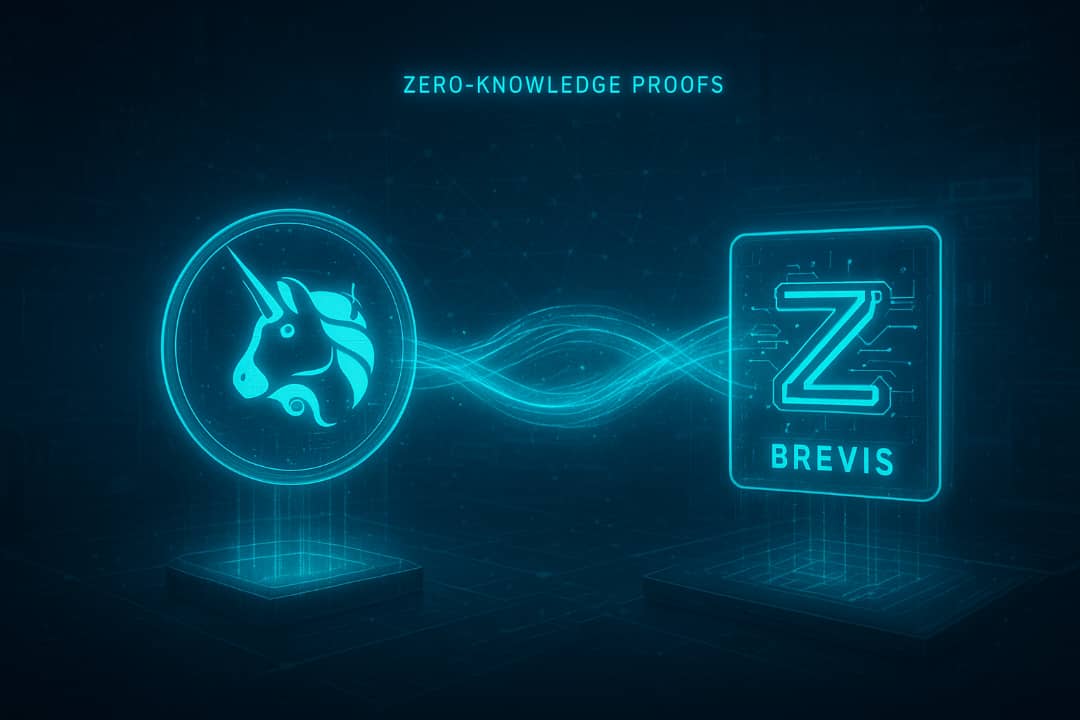
The Uniswap Foundation has awarded a grant of up to $9 million to Brevis, a leading zero-knowledge (ZK) infrastructure developer, to design and manage a Router Rebate Program. This initiative is the first of its kind, built entirely on zero-knowledge proofs, and aims to incentivize decentralized exchange (DEX) aggregators like 1inch and Matcha by providing gas rebates when routing user transactions through Uniswap v4 hooked pools.

## Driving Faster Uniswap v4 Adoption and Deeper Liquidity

The goal of this Router Rebate Program is straightforward: to accelerate the adoption of Uniswap v4, deepen liquidity in its pools, and reward routers that help power Uniswap’s next chapter. By offering a financial incentive, the program encourages aggregators to increase routing volume through Uniswap v4, ultimately benefiting the broader ecosystem.

## From Infrastructure Provider to Ecosystem Builder

This grant marks a significant milestone for Brevis. Previously known primarily as a ZK data coprocessor powering off-chain computation, Brevis is now stepping directly into the Uniswap ecosystem as a builder. The company will deploy, manage, and maintain the rebate system that connects zero-knowledge proof technology with on-chain economic incentives.

This collaboration brings real utility to zero-knowledge proofs in the DeFi space—not just for enhanced privacy but also for automated and cryptographically verified economic transactions.

## What the $9 Million Grant Covers

The Uniswap Foundation’s $9 million grant will fund the full development, deployment, and long-term management of the Router Rebate Program. Here’s what it entails:

– Up to $9 million in cashbacks will be distributed to DEX routers that integrate Uniswap v4 hooked pools.
– Rebates will be calculated and verified trustlessly using Brevis’s ZK Data Coprocessor and Pico zkVM.
– The program establishes a direct incentive loop: increased routing activity through Uniswap v4 results in more liquidity and fees flowing back into the ecosystem.

As the largest DEX by trading volume, Uniswap currently maintains over $5.6 billion in 24-hour activity. The introduction of a router rebate system could further solidify its dominance by enhancing aggregator integrations and improving execution speed.

## How the Rebate System Works

Gas costs remain a significant challenge for DeFi users, as every transaction consumes gas, and tracking these costs accurately can be complex. Brevis’s solution simplifies this process with zero-knowledge proofs:

1. Routers direct orders through Uniswap v4 hooked pools.
2. Brevis calculates the gas costs off-chain using its data coprocessor.
3. A zero-knowledge proof (ZK proof) is generated to verify the accuracy of the gas cost calculation.
4. The router submits this ZK proof on-chain to claim the gas rebate.

This creates a fully automated, trustless refund system with no need for centralized tracking, manual audits, or trust assumptions. Every rebate is cryptographically verified before payment, ensuring transparency and security.

## Why This Matters for Uniswap v4

Uniswap v4’s innovative architecture—centered around hooks and custom liquidity pools—enables new automated features but also introduces complexity for aggregators. The rebate program incentivizes routers to integrate with v4 early, leading to:

– ⚡ Faster Uniswap v4 adoption by major DEX aggregators.
– 🌊 Deeper liquidity in hooked pools as transaction volume scales.
– 🔄 Improved swap execution for end users through better routing efficiency.

Crucially, this program maintains DeFi’s trustless principles while fostering ecosystem growth.

## The Brevis ZK Advantage

Brevis has earned a strong reputation for developing scalable zero-knowledge proof systems capable of processing and verifying data from any on-chain or off-chain source. Its ZK Data Coprocessor securely performs heavy computational tasks—like gas tracking and routing cost analysis—off-chain and produces proofs for on-chain validation.

The use of Pico zkVM ensures this process is lightweight and verifiable without reliance on centralized servers or manual intervention. In essence, Brevis brings machine-verifiable economic computations to Uniswap v4, enhancing trust and automation within the protocol.

## Season 2 Activation: A Major Milestone

According to Brevis, the rebate integration is scheduled to launch in Season 2 after internal testing and protocol audits. This phase will focus on validating the entire system—from routers submitting proofs to automatic on-chain rebate distributions.

This development marks a significant advancement in how decentralized exchanges can reward routing activity. If successful, Uniswap’s rebate model could become a new DeFi standard for trustless incentive systems.

Brevis commented, “Tasks will focus on testing or using the trustless gas rebate system. This is a significant step for both Brevis and the Uniswap ecosystem.”

## A New Era for Decentralized Trading

The partnership between Uniswap and Brevis represents more than just a funding agreement—it signals a strategic direction toward increased automation and verifiability in decentralized trading. This system:

– Automates gas rebates.
– Verifies rebates trustlessly with zero-knowledge proofs.
– Removes the need for intermediaries.
– Maintains economic fairness and transparency.

As one analyst noted on X, “This isn’t just about rebates, it’s about turning proofs into incentives.”

## Ecosystem Impact

The program is expected to spark heightened competition among leading DEX aggregators such as 1inch, Matcha, and ParaSwap, each vying for a share of the $9 million reward pool. Aggregators that adapt quickly to the rebate mechanism could gain immediate profitability advantages, channeling more user activity through Uniswap v4 over competitors.

Over time, this competition should deepen liquidity, reduce slippage, and increase the total value locked (TVL) across v4 pools.

## Conclusion

The Uniswap Foundation’s $9 million grant to Brevis is more than a simple funding announcement—it’s a blueprint for how DeFi incentives can evolve by leveraging zero-knowledge technology. By aligning protocol economics with cryptographic trust, Uniswap is paving the way for a future where proof replaces trust at every layer of its stack.

If this rebate model succeeds, it won’t just make trading more affordable and efficient—it will redefine how infrastructure and incentives interact in decentralized finance.

For Brevis, this partnership marks a major evolution—from a ZK infrastructure provider to a core builder within the largest DEX ecosystem in crypto.

*Disclosure: This is not trading or investment advice. Always conduct your own research before buying any cryptocurrency or investing in any services.*
https://themerkle.com/uniswap-foundation-awards-9m-grant-to-brevis-for-trustless-router-rebate-system/

Apple, Google, Amazon, Microsoft & Meta are all donors to Trump’s White House ballroom project

Renovations have recently begun on the White House in Washington, D.C., as the building’s East Wing was demolished to make way for the construction of a new ballroom. This highly anticipated project marks a significant update to the historic residence.

The new ballroom is being funded through a combination of private donations, including contributions from former President Donald Trump and a group of prominent corporate donors. Notably, some of the biggest names in the technology industry are among the financial backers supporting this initiative.

The White House recently disclosed the full list of companies and individuals financially donating to the ballroom project, as reported by CNBC. The list features a diverse range of influential corporations and foundations, reflecting broad support from various sectors.

Among the corporate donors are:

– Apple
– Google
– Amazon
– Microsoft
– Meta Platforms
– Altria Group Inc.
– Booz Allen Hamilton Inc.
– Caterpillar Inc.
– Coinbase
– Comcast Corporation
– Hard Rock International
– HP Inc.
– Lockheed Martin
– Micron Technology
– NextEra Energy Inc.
– Palantir Technologies Inc.
– Ripple
– Reynolds American
– T-Mobile
– Tether America
– Union Pacific Railroad

In addition, several prominent individuals and foundations have also contributed, including:

– Adelson Family Foundation
– Stefan E. Brodie
– Betty Wold Johnson Foundation
– Charles and Marissa Cascarilla
– Edward and Shari Glazer
– Harold Hamm
– Benjamin Leon Jr.
– The Lutnick Family
– The Laura & Isaac Perlmutter Foundation
– Stephen A. Schwarzmann
– Konstantin Sokolov
– Kelly Loeffler and Jeff Sprecher
– Paolo Tiramani
– Cameron Winklevoss
– Tyler Winklevoss

This collaboration of corporate and private contributions underscores the significant interest and investment in the White House renovation project, particularly the new ballroom that promises to enhance the historic site’s functionality and appeal.
https://www.shacknews.com/article/146504/apple-google-amazon-microsoft-meta-trump-donation

Meta, TikTok hit with EU complaint

Technology

The Big Story: EU Finds Meta and TikTok Breached Tech Rules

The European Union (EU) has found that both Meta and TikTok violated transparency requirements under the bloc’s Digital Services Act (DSA).

The European Commission, which serves as the EU’s executive branch, has made a preliminary determination that Meta and TikTok did not fully comply with the regulations aimed at ensuring transparency and accountability in digital services.

These findings highlight the EU’s ongoing efforts to enforce stricter oversight of major technology platforms operating within its jurisdiction.

© iStock / Getty Images Plus


https://thehill.com/newsletters/technology/5572517-meta-tiktok-hit-with-eu-complaint/

3 Reasons WhatsApp’s New Storage Management Feature Is a Big Deal

**WhatsApp Is Tackling the Storage Nightmare**

If you’ve ever frantically deleted photos to make room for a new app, you know the pain of managing phone storage. WhatsApp is testing a solution that could make those cleanup sessions way less painful.

According to WABetaInfo, the messaging app is rolling out a new storage management feature directly within individual chat info screens. This means users can now handle space-hogging files without bouncing through multiple menus.

### 1. Saves Time With One-Stop Storage Management

No more digging through multiple app menus to free up space. The new WhatsApp storage management shortcut lives right in the chat info screen. You can manage the space consumed by chats and individual media files without leaving your conversation. This eliminates extra steps and makes routine cleanups much faster.

The feature is especially helpful in busy group chats where photos and videos pile up quickly. Anyone who’s dealt with WhatsApp automatically saving photos and videos knows how rapidly storage can disappear.

### 2. Empowers Custom Cleanups, Not Accidental Deletions

The new tool provides a complete overview of every file exchanged with a specific contact. Files are organized by size, giving users better visibility and control. You can quickly spot and remove large, unwanted files while saving those that matter.

Thanks to its cleaner layout, it’s easier to avoid accidentally deleting important photos or documents. This improvement is a welcome change for users who’ve struggled with managing WhatsApp chat history or dealing with compressed media files taking up unnecessary space.

### 3. Helps Keep Phones Running Smoothly

For users with limited device storage, the ability to bulk delete large files straight from a chat helps prevent slowdowns. Full devices often cause app crashes, especially on older phones.

Managing WhatsApp storage directly while conversing ensures the app remains fast and responsive. This is important not just for personal users but also for business communications.

With WhatsApp backups now counting toward Google Drive storage limits, local storage management has become more critical than ever.

The feature is currently available to some beta testers running WhatsApp beta for Android version 2.25.31.13 and is expected to roll out to all users in the coming weeks. Stay tuned for this handy upgrade that promises to make managing WhatsApp storage much easier!
https://phandroid.com/2025/10/24/3-reasons-whatsapps-new-storage-management-feature-is-a-big-deal/

EU says TikTok and Meta broke transparency rules under landmark tech law

The European Commission, the executive arm of the European Union, announced on Friday that it has preliminarily found both TikTok and Meta in breach of its transparency rules.

According to the Commission, both tech giants violated their obligation to grant researchers adequate access to public data under the Digital Services Act (DSA).

Additionally, the Commission found Meta—covering both Instagram and Facebook—in preliminary breach of its duties to provide users with simple mechanisms to notify illegal content. Meta also failed to allow users to effectively challenge content moderation decisions, the statement added.
https://www.cnbc.com/2025/10/24/eu-says-tiktok-and-meta-broke-transparency-rules-under-tech-law.html

Researchers Say AI Chatbots by Google, OpenAI, Others Overwhelmingly Favor Left-Wing Political Perspectives

**New Study Reveals Political Biases in AI Chatbots Like ChatGPT**

Recent research indicates that users turning to ChatGPT and other artificial intelligence chatbots in search of politically neutral answers may not be getting what they expect. According to a new study, many of these chatbots harbor political biases that are often not disclosed by the companies behind them.

As Americans increasingly integrate AI systems into their work and daily lives, many assume these tools provide unbiased information. However, the study reveals that when it comes to politics, this is not always the case. The research examined how leading platforms respond to user prompts and found notable ideological leanings.

These AI systems, technically known as large language models (LLMs), are trained on vast amounts of text to generate responses. The data technology company Anomify conducted the study and discovered that many LLMs exhibit consistent “personalities” or biases that remain unclear or invisible to users.

Many people perceive the answers provided by these language models as neutral, authoritative, and logical. Yet, researchers caution that beneath this apparent neutrality, the responses may actually reflect opinions shaped by biases in the training data, reinforcement learning, or alignment efforts.

>”Today’s leading LLMs differ not only in their technical skills but also in their responses to politically and socially charged questions,” the researchers conclude. “Many exhibit consistent ‘personalities’ or biases, often invisible to end users. Awareness of these differences is essential for everyone who builds or relies on these powerful systems.”

### Key Findings from the Study

The experiment involved popular platforms such as OpenAI and Google. Researchers designed prompts presenting two opposing statements across eight socio-political categories. Each prompt was run 100 times per model to capture a representative distribution of responses.

The study found that most models tended to:

– Support regulatory over libertarian ideals
– Lean toward progressive rather than conservative viewpoints
– Favor globalist over nationalist perspectives

For example, the chatbots almost universally supported the notion that abortion should be largely unrestricted in the United States. Almost all models also backed legal recognition of transgender rights—including access to medical transition—and promoted the idea that redefining social norms for greater inclusion and equality benefits society as a whole.

Other topics revealed a broader spectrum of opinions. Some models strongly supported restricting immigration at America’s southern border, while others advocated for reducing restrictions to allow more migrants to enter the country legally.

### What This Means for Users

The study warns that users might perceive AI-generated responses as “neutral fact,” yet a different model with an equally neutral tone could provide a vastly different answer. Because the choice of AI platform can influence the nature of information a user receives, understanding bias is a critical factor when selecting which system to use.

As AI continues to shape decision-making and information gathering, awareness of these built-in biases is essential—not only for developers but also for everyday users relying on these powerful chatbots for accurate and balanced insights.
https://www.nysun.com/article/researchers-say-ai-chatbots-by-google-openai-others-overwhelmingly-favor-left-wing-political-perspectives

Wallets Tied to Melania Trump Meme Coin Airdropped $1.2 Million in Meteora Tokens

Meteora Debuts Token with Controversial Airdrops to Melania and President Trump Meme Coin Wallets

On Thursday, Meteora officially launched its token, MET, distributing it through an airdrop to various users. The project emphasized its efforts to blacklist “malicious bad actors” from receiving tokens. However, the airdrop raised eyebrows within the crypto community when two wallets linked to the controversial Melania Trump meme coin received $1.2 million worth of MET tokens.

According to SolScan data, the wallets named melania-liquidity1.sol and melania-liquidity2.sol were credited with $784,200 and $454,724 of MET, respectively, totaling approximately $1.23 million. Both wallets are identified as part of the Official Melania Meme entity on the blockchain analytics platform Arkham Intelligence. Shortly after receiving the tokens, these wallets transferred the funds to various other addresses, sparking concern among observers.

In addition, three wallets connected to the President Trump meme coin were airdropped MET tokens totaling $4.2 million. These wallets were among the top five recipients of the airdrop and subsequently deposited their tokens to the exchange OKX, making it difficult to track their on-chain activity.

The episode drew criticism on social media. A user on X questioned, “Why is Hayden Davis getting a MET airdrop? You have to be kidding me,” referring to the CEO of Kelsier Ventures, the company that helped launch MELANIA. Meteora co-lead, Soju, responded by pointing out that the LIBRA launch wallets were excluded from receiving tokens, just an hour before the MELANIA-linked wallets received MET.

The timing of these controversial airdrops comes shortly after Meteora co-founder Benjamin Chow was named in a class action lawsuit filed by investors who allege he masterminded a “scam coin” operation involving at least 15 tokens. These tokens included well-known meme coins such as MELANIA, LIBRA, and ENRON, all of which experienced significant crashes soon after launch.

Court filings state that the operation, conducted under the Meteora name, was separate from the company’s legitimate automated market maker business. Benjamin Chow has since stepped down from his leadership role at Meteora. The company’s co-founder, Meow, cited “a lack of judgment and care” as reasons for his resignation.

The MELANIA token itself gained rapid attention after its launch. Just two days after President Trump introduced his meme coin in January 2024, former First Lady Melania Trump promoted a Solana-based meme coin using her name as its ticker. The token surged to nearly a $7 billion market cap before crashing by 99% to approximately $80 million in the following months.

Further scrutiny emerged after Argentinian President Javier Milei promoted a similar failed meme coin in February. On-chain analytics firm Bubblemaps linked this token back to MELANIA, which led to a fraud and racketeering class action lawsuit against the involved parties.

Meteora has worked with on-chain forensic teams, including sleuth Dethective and anti-scam tool Rugcheck, to prevent tokens from reaching malicious actors. Despite these efforts, it appears the Melania-linked wallets slipped through the cracks. None of the mentioned parties—Soju, Meteora, Dethective, or Rugcheck—immediately responded to requests for comment from Decrypt.

Despite the controversy, many airdrop recipients praised the MET token launch, noting a smooth claim process and sizable token allocations. Currently, MET ranks as the 269th largest cryptocurrency by market capitalization, valued at $263.2 million, according to CoinGecko.

However, criticisms have grown regarding the airdrops sent to wallets tied to the President Trump meme coin team. Although this meme coin has not yet been subject to fraud lawsuits, it has become embroiled in political debates, including allegations of conflicts of interest and potential foreign influence.

As Meteora moves forward with its token launch, the community and investors remain watchful of further developments, particularly concerning the project’s past leadership and connections to controversial meme coin endeavors.
https://decrypt.co/345768/wallets-melania-trump-meme-coin-airdropped-1-2-million-meteora-tokens

Exit mobile version
Sitemap Index