Bitcoin Risks Further Decline to $94K Amid STH Selling Pressure

Short-Term Bitcoin Holders Face Mounting Losses as BTC Drops to $96,041

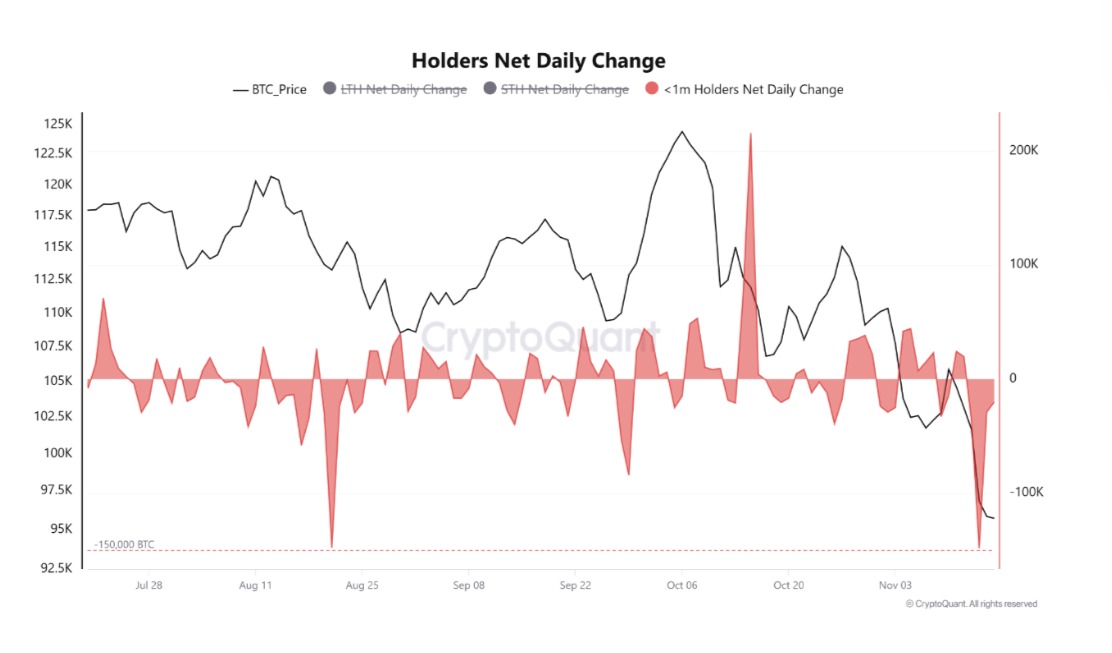
Bitcoin (BTC) has seen a significant decline, falling to $96,041, marking an 8.7% weekly loss. Realized losses among short-term holders have surged to levels not observed since April 2025, signaling widespread panic selling from recent buyers. Over 148,000 BTC was sold by short-term holders within a 48-hour period, with shark and fish investor cohorts contributing approximately 70,100 BTC to the sell-off.

Discover why Bitcoin short-term holder losses are accelerating in 2025, how STHs are dumping 148k BTC amid price weakness, and what this means for BTC trends and future trading strategies. Stay informed with key insights below.

What Are Bitcoin Short-Term Holder Losses and Why Do They Matter?

Bitcoin short-term holder (STH) losses refer to the unrealized and realized financial setbacks experienced by investors who have held BTC for less than 155 days. These losses occur particularly when market prices drop below their purchase price.

These losses are important because they often trigger widespread selling, amplifying market downturns and eroding confidence among newer investors. As of late November 2025, short-term holder supply in loss has climbed to 4.9 million BTC—a peak reminiscent of previous volatile periods.

How Have Short-Term Holders Contributed to Recent BTC Price Declines?

Short-term holders have played a pivotal role in Bitcoin’s recent price slide. Data from Checkonchain indicates a sharp rise in both realized and unrealized losses over the past few weeks. This surge has coincided with BTC’s price action, which has formed lower lows within a descending channel since late October.

The asset’s price at press time stands at $96,041, reflecting a 5.91% daily drop and an 8.7% weekly loss. The increased losses mainly stem from purchases made at higher levels—around $102,000 to $107,000—now well above BTC’s current valuations.

Historically, such elevated loss levels often precede intensified selling as holders attempt to minimize further damage. Market analysts note that when short-term holder supply in loss surpasses 4 million BTC, it often corresponds with broader capitulation phases. For example, in April 2025, prices hovered between $74,000 and $76,000 during a similar downturn.

This pattern highlights the vulnerability of newer investors to rapid price swings, thereby contributing to ongoing bearish momentum.

Supporting this, data from CryptoQuant reveals that short-term holders offloaded 148,000 BTC acquired below $100,000 over the past 48 hours. This shift from accumulation to distribution exacerbates downward pressure as BTC breaches key support zones.

For instance, shark cohorts—wallets holding 100 to 1,000 BTC—recorded a net balance change of -53,700 BTC over the 30-day period ending November 16, per Checkonchain metrics. Likewise, fish holders (10 to 100 BTC) experienced a -16,400 BTC change, showcasing a coordinated sell-off across retail and mid-tier investors.

Frequently Asked Questions

What Causes Bitcoin Short-Term Holder Losses to Spike During Market Downturns?

Bitcoin short-term holder losses spike when prices fall below the average purchase cost of coins held for under 155 days. This often prompts holders to realize losses through sales. In the current cycle, a drop from $107,000 peaks has left 4.9 million BTC underwater, leading to 148,000 BTC being dumped in 48 hours as holders cut losses to avoid deeper declines.

Is the Current BTC Sell-Off from Short-Term Holders a Sign of a Larger Market Bottom?

The intense sell-off from short-term holders may indicate nearing capitulation rather than a full market bottom. Historical data from CryptoQuant shows similar patterns before significant rebounds. Investors should watch for slowing sales and increased spot buying to confirm stabilization around $94,000 support, potentially setting up a recovery toward $99,000.

Key Takeaways

  • Accelerating Losses: Bitcoin short-term holder losses reached an 8-month high of 4.9 million BTC, driven by prices dipping below $100,000 cost bases.
  • Massive Dumping: Over 148,000 BTC sold by short-term holders in 48 hours, with sharks and fish contributing significant net outflows totalling 70,100 BTC.
  • Trading Outlook: Monitor for a reduction in selling pressure. BTC could test $94,000 on the downside or rebound to $99,000 if fresh demand emerges.

Conclusion

Bitcoin short-term holder losses have intensified significantly in late 2025, with 4.9 million BTC now underwater and over 148,000 coins sold amid broader market declines toward $96,041. This capitulation from recent buyers, backed by data from Checkonchain and CryptoQuant, highlights the risks associated with short-term positioning in volatile assets.

As selling pressure begins to ease, renewed spot demand could foster stabilization. Investors should stay vigilant for signs of reversal to navigate upcoming opportunities effectively.

Source: Checkonchain

https://bitcoinethereumnews.com/bitcoin/bitcoin-risks-further-decline-to-94k-amid-sth-selling-pressure/

Indian Court XRP Ruling May Complicate WazirX Hack Claims Process

**Madras High Court Mandates Bank Guarantee for WazirX User’s XRP Holdings Post-Hack**

The Madras High Court has delivered a landmark ruling affirming cryptocurrencies as possessable property under Indian law, a decision that could significantly impact how digital assets are treated following exchange hacks. This development comes in the wake of a major 2024 cyberattack on WazirX that resulted in a staggering $235 million loss, leaving the platform with insufficient tokens to meet all user liabilities.

### Significance of the Madras High Court Ruling on WazirX Cryptocurrency Claims

On Saturday, Justice N. Anand Venkatesh ordered WazirX’s operator, Zanmai Labs, to issue a bank guarantee worth approximately $11,800 to secure a specific user’s claim over 3,532 XRP tokens frozen after the hack. This ruling officially recognizes digital assets like XRP as property capable of being owned, possessed, and held in trust.

This important affirmation sets a precedent for handling user claims post-hack, particularly in cases involving frozen assets. It highlights the legal recognition of crypto holdings as trustable property and could influence how exchanges like WazirX manage liabilities, especially amid international restructuring efforts.

### Impact on WazirX Users Affected by the 2024 Hack

The 2024 cyberattack on WazirX compromised approximately $235 million worth of various cryptocurrencies. As a consequence, the exchange no longer holds enough tokens to cover all pending user claims. Since the incident, many affected users have faced prolonged uncertainty due to frozen assets intended to prevent further loss.

Justice Venkatesh’s order specifically targets a claimant whose XRP remains in Zanmai Labs’ custody, emphasizing the legal standing of such tokens. This introduces new legal considerations for WazirX, which operates under its Singaporean parent company Zettai Labs but has headquarters in India.

The ruling could complicate enforcement efforts within India and potentially conflict with Zettai’s court-approved restructuring plan under Singapore law dated October 13, 2024. According to legal experts cited by Bloomberg and Reuters, jurisdictional overlaps often delay dispute resolution in cross-border crypto cases.

### Broader Legal and Operational Implications

– **Local Enforcement:** Indian WazirX users may need to pursue local arbitration or court claims to access remedies, rather than relying solely on the Singaporean restructuring scheme.

– **Bank Guarantee as Interim Security:** The bank guarantee ordered by the court acts as a financial safeguard, ensuring the claimant’s rights are protected during ongoing proceedings.

– **WazirX’s Response:** Following the ruling, WazirX has reiterated its commitment to fair distribution and has resumed trading after a year-long halt. The court documents note that the hack severely depleted liquid tokens, prompting Zettai Labs to develop a structured repayment plan under Singapore Companies Act supervision.

– **Regulatory Impact:** With over 100 million crypto users in India as reported by the Reserve Bank of India and industry analyses like PwC, this ruling underscores the need for regulatory clarity. It enforces the view that exchanges must treat user assets as fiduciary obligations, aligned with global standards such as those from the Financial Action Task Force (FATF).

Fintech lawyer Aarav Gupta observes that WazirX’s recent zero-fee trading initiative aims to rebuild user trust, although full recovery remains uncertain. The case exemplifies evolving legal landscapes in India as courts adapt existing laws to accommodate blockchain assets.

### Frequently Asked Questions

**What does the Madras High Court ruling mean for claiming frozen XRP on WazirX after the hack?**
The ruling allows Indian users to pursue arbitration for frozen XRP holdings, legally recognizing them as trust-held property. Zanmai Labs must provide a bank guarantee of roughly $11,800 for 3,532 XRP tokens, securing claims during legal proceedings. This facilitates quicker resolution for affected users within India.

**How will WazirX’s Singapore restructuring plan interact with Indian court decisions on crypto hacks?**
While WazirX’s parent company, Zettai Labs, received approval for its restructuring plan in Singapore, Indian court orders such as this may require local compliance measures like bank guarantees. As a result, the interaction of jurisdictional frameworks could lead to hybrid solutions overseen by both Indian and Singaporean courts.

### Key Takeaways

– **Cryptocurrency as Legal Property:** The Madras High Court has formally recognized digital assets like XRP as possessable and held in trust, bolstering user rights in hack cases.

– **Bank Guarantee Requirement:** Zanmai Labs must secure claims with financial guarantees to prevent further delays in recovery.

– **Impact on Restructuring Efforts:** Indian court decisions may extend the timeline or alter the enforcement of WazirX’s Singapore-approved repayment scheme. Users should stay informed and file claims promptly.

### Conclusion

The Madras High Court’s ruling on WazirX marks a pivotal advancement in the recognition of cryptocurrency under Indian law. By affirming digital assets as trustable property and mandating bank guarantees to secure user claims, the court has set a precedent that could influence how crypto exchanges and users navigate the complex aftermath of hacks.

As WazirX works through its international restructuring, affected users—particularly those in India—may experience changes in how claims are addressed, with greater emphasis on legal protections and fiduciary responsibilities. This case highlights the growing need for clear regulatory frameworks in the expanding Indian crypto market and signals a maturing judicial approach to blockchain-related disputes.

Stay tuned for more updates on cryptocurrency regulations and WazirX’s ongoing developments.

*Published by [Your Website Name]*
*Date: [Insert Date]*
https://bitcoinethereumnews.com/tech/indian-court-xrp-ruling-may-complicate-wazirx-hack-claims-process/?utm_source=rss&utm_medium=rss&utm_campaign=indian-court-xrp-ruling-may-complicate-wazirx-hack-claims-process

.
Privacy Policy Data
Exit mobile version