

By Jessica Damiano | The Associated Press I’ll be the first to admit there have been a few frights in my garden over the years, starting with the English ivy and pea-gravel mulch I inherited when I moved into the house and ending with the mint I foolishly planted directly in the ground many years ago, when I didn’t realize it would still be around to haunt me today. Did I say “ending with?” Who am I kidding? I’m still causing all sorts of mayhem in my beds and borders. Recently, I had to hire a landscaper to remove the creeping Liriope I mistook for the clumping type. The poor guy toiled with a pickaxe for more than three hours. I’m just glad he didn’t come after me with it. In the process, I lost many of the weedy groundcover’s mature perennial and bulb neighbors, and it will be years before the new plantings mature and the border returns to its former abundant glory. Plenty of blame Some ghastly garden scenarios, like my mint mishap, are clearly our own fault, but the blame for others can fall squarely on outsiders, like the nurseries that mislabel plants or the squirrels that “plant” invasive species among our natives. Either way, the cleanup falls to us. Nobody knows this better than John and Mary Richardson of Port Jefferson Station, New York, who wrote to tell me about that one time they were advised to apply cayenne pepper around their vegetable plants to repel the critters that were wreaking havoc on their harvests. “We happily and liberally sprinkled it in every bed in the garden,” they told me, adding that they took care to repeat the application after every rainfall to ensure “the protection would continue.” Before long, the couple said, pepper plants were taking over all their vegetable and flower beds. “It had never occurred to us to use ground cayenne and not pepper flakes, which are seeds,” they admitted. Speaking of seeds reminds me of a tale recounted years ago by a reader who was perplexed by the weekly disappearances of tomatoes from his vines. After checking to assess the ripeness of one particularly plump heirloom beauty, he decided to hold off on harvesting for one more day, when he planned to enjoy a tomato-sandwich lunch. But when the salivating sower went out to pick it, that tomato, too, was nowhere to be found. It was lawn-mowing day, he said, and it didn’t take long for him to discover “the landscapers had tomato seeds in their teeth.” I also once heard from a desperate reader who was battling the running bamboo that had been planted by his next-door neighbor. The viciously invasive, iron-rooted plant had grown under the fence dividing their properties and was poking up through his swimming pool liner. I wonder if he had to move. ‘The ultimate rookie mistake’ Then there’s Alyssa Sirek from Granbury, Texas: “With years of horticulture experience, I made the ultimate rookie mistake,” she admitted. “I put a bird feeder directly over our freshly landscaped rockscape and forgot that bird seed is, in fact, seed. “Between the birds flinging seeds like confetti and a few solid Texas rainstorms, our clean rockscape transformed into accidental chaos,” she said. Committed to avoiding pesticides, Sirek spent hours “hand-pulling surprise sprouts, collecting ant bites, knee scrapes, and a bruised ego along the way.” Months later, she said, stray seedlings still pop up from time to time, particularly after storms. Hoping for a fun project to do with her kids, she ordered ladybug larvae by mail. “I released them onto my zucchini plants, later to find out they were actually squash beetles,” she said. “They decimated all of my plants.” And sometimes, it comes with the job. Alice Raimondo says she sees a lot of strange things working as a horticultural lab coordinator at the Cornell Cooperative Extension’s diagnostic clinic in Riverhead, New York, where homeowners bring diseased plants and creepy insects for identification. Once, a woman brought in a wreath she was making out of cones that she’d collected, Raimondo remembers. “She liked the way the cones looked, but after working with a few of them, (she noticed) they wriggled,” she said. “Turns out, they were bagworms,” destructive pests that wrap themselves in “bags” that they construct from leaves and other plant parts. The woman “was pretty grossed out,” Raimondo said. As these brave gardeners can attest, one simple mistake can turn into a gruesome cautionary tale. ___ Jessica Damiano writes weekly gardening columns for the AP and publishes the award-winning Weekly Dirt Newsletter.
https://www.pasadenastarnews.com/2025/11/20/from-errant-birdseed-to-mint-mishaps-gardening-can-be-as-scary-as-any-halloween-night/
Author: admin
Securitize to Launch Institutional Assets on Plume’s Nest Protocol
Plume a blockchain focused on real-world asset finance (RWAfi) with $159 million in total value locked announced Thursday that tokenization platform Securitize will deploy institutional-grade assets on its Nest staking protocol. Nest currently holds over $39. 5 million in distributed assets, down nearly 30% over the past month, according to RWAxyz. The upcoming deployment will connect Securitize’s tokenized assets with Plume’s network of roughly 280, 000 RWA investors, according to a press release viewed by The Defiant. Securitize also tokenized BlackRock’s BUIDL fund the largest RWA product with over $2. 5 billion in assets. The deployment onto Nest will start with Hamilton Lane funds and expand throughout 2026 to include additional issuers and asset classes. The fund is targeting $100 million in capital, the release noted. The move highlights how RWA and decentralized finance (DeFi) projects are increasingly exploring compliant ways to bring traditional assets on-chain for trading, staking, and other DeFi use cases. As part of the initiative, Solv Protocol, a Bitcoin finance platform with over $2. 8 billion in assets, will invest up to $10 million in Plume’s RWA vaults. Users can trade and stake these assets on Plume, which is backed by Apollo Global Management, while keeping them under Securitize’s regulated framework. “Bitcoin’s role is becoming the foundation for real, yield-bearing capital markets,” said Ryan Chow, co-founder and CEO of Solv Protocol. “As regulated on-chain markets emerge, Bitcoin will underpin a new generation of yield, credit, and liquidity infrastructure, where demand for yield-bearing Bitcoin with RWA-backed yields replaces passive treasuries as the next phase of institutional adoption.” The deployment will also utilize Bluprynt’s Know-Your-Issuer (KYI) system to verify assets and issuers. The move comes a little over a month after Plume announced it would be acquiring Dinero, the developer of a liquid staking protocol on Ethereum. The deal added institutional staking products for Ethereum (ETH), Solana (SOL), and Bitcoin (BTC) to Plume’s platform, The Defiant previously reported. Earlier this year, Plume also partnered with World Liberty Financial (WLFI), a DeFi project with ties to President Donald Trump, to make USD1 the official reserve asset for its native stablecoin, pUSD. Plume’s native token (PLUME) is down 5% in the past day, per CoinGecko data.
https://bitcoinethereumnews.com/tech/securitize-to-launch-institutional-assets-on-plumes-nest-protocol/


JBS N.V.: A Tricky Consumer Staples Company With A Significant Upside
Analyst’s Disclosure: I/we have a beneficial long position in the shares of NSRGY either through stock ownership, options, or other derivatives. I wrote this article myself, and it expresses my own opinions. I am not receiving compensation for it (other than from Seeking Alpha). I have no business relationship with any company whose stock is mentioned in this article. While this article may sound like financial advice, please observe that the author is not a CFA or in any way licensed to give financial advice. It may be structured as such, but it is not financial advice. Investors are required and expected to do their own due diligence and research prior to any investment. Short-term trading, options trading/investment and futures trading are potentially extremely risky investment styles. They generally are not appropriate for someone with limited capital, limited investment experience, or a lack of understanding for the necessary risk tolerance involved. I own the Canadian tickers of all Canadian stocks I write about. Please note that investing in European/Non-US stocks comes with withholding tax risks specific to the company’s domicile as well as your personal situation. Investors should always consult a tax professional as to the overall impact of dividend withholding taxes and ways to mitigate these. Seeking Alpha’s Disclosure: Past performance is no guarantee of future results. No recommendation or advice is being given as to whether any investment is suitable for a particular investor. Any views or opinions expressed above may not reflect those of Seeking Alpha as a whole. Seeking Alpha is not a licensed securities dealer, broker or US investment adviser or investment bank. Our analysts are third party authors that include both professional investors and individual investors who may not be licensed or certified by any institute or regulatory body.
https://seekingalpha.com/article/4846114-jbs-tricky-consumer-staples-company-significant-upside?source=feed_all_articles


Dan Goor & Luke Del Tredici’s PI Comedy Takes Step Toward NBC Pilot Order With California Tax Credit
Already considered a sure thing for a pilot greenlight, NBC‘s single-camera comedy from Brooklyn Nine-Nine co-creator/executive producer Dan Goor and executive producer Luke Del Tredici may have sealed the deal with a $1. 4M tax credit from the California Film Commission to shoot the pilot in Los Angeles. Described as one of the strongest comedy pitches to hit the TV marketplace in awhile, the untitled project was bought by NBC with a pilot production commitment and an intent to make the pilot. In an anticipation of a green light, the project’s studio, NBC sibling Universal Television, a division of Universal Studio Group, where both Goor and Del Tredici are under overall deals, applied for a tax break, which has been granted, cementing the comedy’s chances. Co-written and executive produced by Goor and Del Tredici, the half-hour is a workplace comedy set in the world of private detectives. Per the creators, it continues the proud tradition of Los Angeles private eyes that began with Philip Marlowe and will end with this show. As the logline indicates, this is a Los Angeles-set show, and the intention had been to film it in California.
https://deadline.com/2025/11/dan-goor-luke-del-tredici-pi-comedy-nbc-pilot-tax-credit-1236624433/

Michelle Obama is the First Lady of Complaints
Former First Lady Michelle Obama is in the news again with another grievance. In an interview to promote her new book, The Look, Mrs. Obama is complaining again. When asked about running for President, Obama claimed that Americans “aren’t ready for a woman President” and have “a lot of growing up to do.” Last year, Michelle Obama campaigned for Democratic presidential nominee Kamala Harris. During a speech in Michigan, Obama called Harris “extraordinary,” and wondered “why on earth is this race even close?” She also asked whether “as a country, are we ready for this moment?” These are absurd comments since two of the last three Democratic Party presidential nominees have been women. The stage is certainly set for the right female candidate to become President. This victorious female candidate who will make history will never be Michelle Obama. There are several reasons for this prediction, but, primarily, she has refused to display any appreciation for this great country or all the many benefits she received for being married to Barack Obama. Incredibly, Michelle Obama offers a steady stream of complaints about the American people and how she has been treated in her life. As First Lady, Obama said she was under a “particularly white-hot glare,” and grumbled that her family “didn’t get the grace that I think some other families have gotten.” Of course, that complaint is ludicrous because Barack and Michelle Obama were treated as royalty in America. They received fawning media coverage from the very beginning. Those who pushed too hard and asked tough questions were labeled “racists.” Yet, Michelle Obama claimed that the “we were all too aware that as a first Black couple, we couldn’t afford any missteps.” The Barack Obama presidency was nothing but a series of “missteps,” but he not only won reelection, but he also completed his two terms without any impeachment hearings. Barack Obama could have been impeached over any number of scandals in his presidency, such as the disastrous Benghazi attack on our consulate, or the “Fast and Furious” gun running operation or the Internal Revenue Service improperly targeting Tea Party organizations. Instead of impeachment, Barack Obama received a pass from Republicans in Congress, who were too timid to push for thorough investigations and feared being called “racists.” In contrast, President Donald Trump was impeached for a “perfect” phone call to Ukrainian President Zelensky and for a speech on January 6, 2021, in which he called for his supporters to “peacefully and patriotically make your voices heard” at the U. S. Capitol. Trump was not responsible for the violence on that day. Instead, he wanted more National Guard troops for protection, and his requests were denied. The President’s wonderful wife, First Lady Melania Trump, has also been mistreated. Despite her history as a world-renowned fashion model and being internationally recognized for her beauty and accomplishments, Mrs. Trump was never invited to be photographed for the cover of Vogue magazine. However, the perpetual complainer, Michelle Obama, graced the cover of Vogue three times. Not bad for someone who whined that she did not “get the grace” that other First Ladies received. Michelle Obama has been criticizing her country for years. In February 2008, as her husband was on the path to the presidency, she said that “for the first time in my adult lifetime I am really proud of my country.” Thus, she was only proud of America because her husband was succeeding politically. In 2019, at a leadership conference for the Obama Foundation in Malaysia, she said that the United States was “still not where we need to be. when it comes to race.” Even though her husband had been elected twice as President, Michelle Obama said, “People thought electing Barack Obama would end racism. That’s four hundred years of stuff that was going to be eliminated because of eight years of this kid from Hawaii. Are you kidding me?” The “kid from Hawaii” is a particular source of Michelle Obama’s complaints on her podcast that she hosts with her brother. She is often denigrating or ridiculing her husband on the show. This seems disrespectful for no one in America would know anything about Michelle Obama if not for the “kid from Hawaii.” Even though she is ungrateful, Barack Obama has been taking care of his wife for many years. After his political stock soared in his home state, then Illinois Governor Rod Blagojevich said he was asked to make phone calls to the University of Chicago Medical Center on behalf of Michelle Obama. She eventually was hired in 2002 and served in several roles, including Vice President for Community and External Affairs. In that position, she was paid $317,000 before taking a leave of absence to campaign for her husband. Among her responsibilities was “neighborhood outreach,” remarkably similar to her husband’s famous position as “community organizer.” Michelle Obama was paid very well for “neighborhood outreach,” and, despite her many complaints, has been treated very well by the country she seems to despise. Jeff Crouere is a native New Orleanian and is a political columnist, the author of America’s Last Chance, and provides regular commentaries on the Jeff Crouere YouTube channel and at Crouere. net. For more information, email him at jcrouere@gmail. com.
https://www.evangelinetoday.com/editorial-columns/michelle-obama-first-lady-complaints

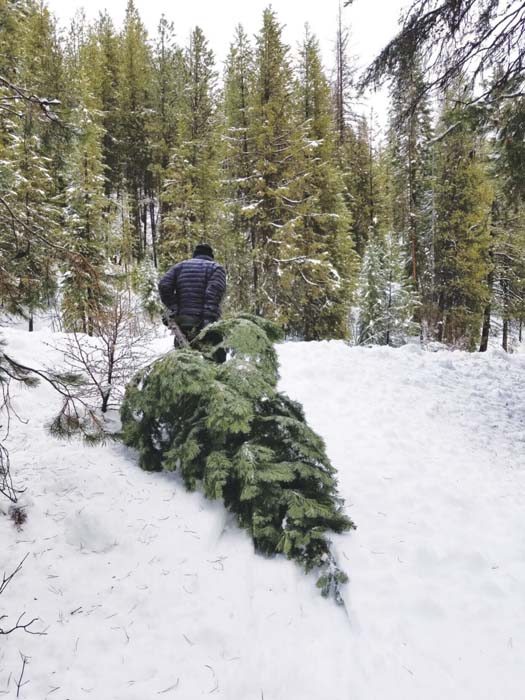
National forests Christmas tree permits now available
EASTERN OREGON Christmas tree permits are now available to purchase at the offices of the Umatilla, Wallowa-Whitman and Malheur national forests, several businesses in Northeastern Oregon and online. To purchase a Christmas tree permit online, visit Recreation. gov and search for permits for the specific national forest. The Forest Service advised it is important to carefully read the overview and need-to-know information prior to purchasing the permit. Visitors also will need to set up or log in to a Recreation. gov account to complete the transaction. Permits are $5 per tree. Visitors may purchase up to five permits for trees on the Wallowa-Whitman and Malheur national forests, but the Umatilla National Forest allows only one purchase. There also is $2. 50 fee for permits purchased through Recreation. gov. For purchases in person, visit any national forest office or one of the local vendors for 2025 Christmas Tree Permits: Ace Hardwares in Boardman and Hermiston. Athena Convenience Store, Athena. Bi-Marts in Baker City, La Grande and Pendleton. Burnt River Market in Unity. D&B Supply in Baker City. Dale Store, Dale. Dollar Stretcher in Enterprise. Elgin Food Town, Elgin. The Gold Post in Sumpter. Halfway Market in Halfway. Hells Canyon NRA in Clarkston, Washington. Heppner Mobil, Heppner. Hitchin’ Post Grocery in Richland. Hometown Hardware in Union. Island City Market & Deli in Island City. J&D’s Food Mart, Pilot Rock. Rhode’s Supply, Ukiah. Smitty’s Outpost, Hermiston. Sports Corral in Joseph. Tollgate Crossing Store, Tollgate. Wallowa Food City in Wallowa. York’s in Baker City. Wallowa Food City in Wallowa. Zip Zone 2, Milton-Freewater. Fourth graders with an Every Kid Outdoors pass are eligible for a free Christmas tree permit and can apply by entering the pass or voucher number when purchasing a permit online. There is $2. 50 reservation fee. Cutting a Christmas tree also improves forest health, according to the Forest Service. The permit system helps thin densely populated stands of small-diameter trees. Local forest health experts identify areas that benefit from thinning trees that tend to be the perfect size for Christmas trees. Removing these trees in designated areas helps other trees grow larger and can open areas that provide forage for wildlife.
https://bakercityherald.com/2025/11/20/national-forests-christmas-tree-permits-now-available/


First aid, CPR and AED classes offered at Centennial Park
The Paso Robles Recreation Services Department will offer two opportunities for community members to become certified in first aid, CPR, and the use of an AED for adults, children and infants. Each class is four and a half hours and will take place at Centennial Park at 600 Nickerson Drive in the Live Oak Room from 9: 30 a. m. to 2 p. m. on Dec. 6 and Dec. 13. The cost is $100, and qualified participants can use scholarship funds to help cover the fee. “We are thrilled about the opportunity to be able to offer these classes to the community for the first time,” said V. Teeter, aquatics coordinator. “Every person trained and confident in an emergency situation makes our community that much safer.” For information about scholarships or to register, visit prcity. com/recreation or contact Paso Robles Recreation Services at (805) 237-3988 or recservices@prcity. com.
https://pasoroblesdailynews.com/first-aid-cpr-and-aed-classes-offered-at-centennial-park/216207/


Live Updates: Jobs Report for September Could Show a Cooling Market
The report was delayed by the government shutdown, which has also interfered with data gathering in October.
https://www.nytimes.com/live/2025/business/jobs-report-economy


Putin’s Army Is Bleeding Out in Ukraine
Russia is pushing hard on two fronts, driving toward Pokrovsk in Donetsk while probing thin Ukrainian lines in the south, especially in Zaporizhzhia. Read Full Article ».
https://www.realclearworld.com/2025/11/20/putins_army_is_bleeding_out_in_ukraine_1148659.html


Max Verstappen makes an alarming confession about his health as he talks about the current era of ground effect cars
Max Verstappen has shared a concerning update about his physical state, which is being affected by the current generation of F1 cars. The sport reintroduced ground-effect cars in 2022 for the first time in 40 years, with the cars exploiting the Venturini effect, which creates more downforce and, in turn, better cornering. 2025 is the last year of the ground-effect cars, with 2026 about to bring entirely new technical regulations, which will shuffle the pecking order, with Mercedes expected to be the top dog. But car performance aside, Max Verstappen has not found the ground-effect challengers to be the most pleasing to drive. Ahead of the Las Vegas Grand Prix, the Red Bull driver commented about the ground-effect cars, which are over 100 pounds heavier than the previous-gen cars. He shared that it has taken a toll on his physical health, with his back and feet bearing the brunt. “It hasn’t been comfortable at all, all these years my whole back is falling apart, and my feet always hurt. Physically, it hasn’t been the best. When you do scans, they don’t look good.” The last time Max Verstappen complained about back pain or any physical difficulty was after his victory at the 2024 Emilia Romagna Grand Prix. However, that was only partially related to the ground-effect cars, and more about the bumpy nature of the Imola circuit left him “broken” and wanting painkillers and a massage. The 2026 F1 technical regulations aim to reduce the weight of the car by 30 kgs (66 pounds), make it more nimble, introduce active aerodynamics, and provide more electric power with a push-to-pass system for overtaking. Max Verstappen reveals the performance flaws of ground-effect cars In the ground-effect era, most F1 races have become a processional, with limited overtaking possible unless on long straights. George Russell recently complained about it after the United States GP, saying that the races are races only until Turn 1 of lap 1. While his comment was partially directed at the lack of tire degradation, Max Verstappen feels that following in the current-gen cars had become difficult because of the dirty air effect, and thus, preventing effective slipstreams. “I won’t miss these cars,” the Dutchman said on Wednesday in Las Vegas. “It was good for a while in the beginning [the dirty air], but not anymore. I do think you can follow a bit better, a bit more controlled anyway.” Comparing the ground-effect cars with their predecessor, the Dutchman added: “With those old cars, you really had extreme oversteer or understeer in certain places, and you don’t have that now. Now there’s just less downforce, and you have the problem that the slipstream with these cars isn’t as efficient anymore. On some tracks, it’s simply not enough for overtaking.” Though the ground-effect cars are one of the quickest in F1 history, Fernando Alonso also shared Max Verstappen’s view about not missing them in 2026. He complained about the weight, size, and closeness of the cars to the ground.
https://www.sportskeeda.com/f1/news-max-verstappen-makes-alarming-confession-health-talks-current-era-ground-effect-cars