CZ Takes Aim At Peter Schiff, Questions Gold’s Verifiability Amid Fort Knox Audit Concerns

**Binance Founder Changpeng Zhao (CZ) Sparks Debate on Gold vs Bitcoin, Takes a Dig at Peter Schiff**

Binance founder Changpeng Zhao, popularly known as CZ, has once again ignited discussion on X regarding the ongoing debate between gold and Bitcoin. This time, CZ took a sharp dig at critic Peter Schiff by highlighting one of gold’s key limitations compared to digital assets: its verifiability.

### CZ Sparks the Fort Knox Discussion

The debate comes amid growing curiosity over the long-delayed audit of Fort Knox’s gold reserves. A user on X recently asked, “What ever happened to the audit at Fort Knox?” To this, CZ responded bluntly, “Gold is difficult to verify.” He also referenced Peter Schiff, a well-known gold proponent who frequently criticizes Bitcoin, dismissing it as “a speculative asset with no intrinsic value.”

For context, the United States Treasury reportedly holds approximately 261.5 million troy ounces of gold, with about 147.3 million ounces stored at Fort Knox. Reports suggest that the last full audit of these reserves took place decades ago, fueling calls for greater transparency.

### Verifying Crypto vs Gold

CZ’s remarks underscore the comparative advantage cryptocurrencies have over gold in terms of verifiability and transparency. Unlike gold, verification of reserves is neither real-time nor public. Access to gold stores is limited, audits are infrequent, and records lack full transparency.

In contrast, cryptocurrencies operate on blockchain technology, which ensures a fully transparent and real-time record of every transaction. This highlights how gold’s verifiability is inherently limited compared to the open and traceable nature of digital assets.

### The Tokenized Gold Debate

Recently, Peter Schiff announced plans to launch a tokenized gold product, arguing that gold is ideal to be put on a blockchain because it could deliver benefits that Bitcoin promises but cannot.

However, CZ quickly pushed back on this concept, stating that tokenized gold is not truly “on-chain.” Instead, it depends on trusting a third party to hold and deliver the physical gold. He further warned that external factors such as management changes, operational delays, geopolitical crises, or even war could impact these holdings.

### CZ’s Perspective on Gold’s Practicality

CZ has also previously expressed that while gold holds value, it is not practical for everyday use. This emphasizes that although gold has long been considered a trusted store of value, its verification and transparency fall short compared to modern digital assets.

In summary, the ongoing gold versus Bitcoin debate highlights the growing importance of transparency and verifiability in asset ownership. CZ’s comments serve as a reminder that while gold holds historical significance, digital assets backed by blockchain technology offer a new standard of openness that traditional assets struggle to match.
https://coinpedia.org/news/cz-takes-aim-at-peter-schiff-questions-golds-verifiability-amid-fort-knox-audit-concerns/

Dogecoin May Encounter Resistance at $0.20 with Over 11 Billion Coins Accumulated

**Dogecoin’s $0.20 Resistance: On-Chain Insights and What’s Next for DOGE Price**

Dogecoin faces a crucial barrier at the $0.20 price level, with recent on-chain analysis underscoring why this zone acts as a significant supply wall. According to data from Glassnode, approximately 11.12 billion DOGE tokens were accumulated around $0.20, creating heavy resistance during market recoveries.

Currently, Dogecoin trades near $0.18, having seen a 7% surge. However, the price remains below this key threshold, and breaking the $0.20 barrier could potentially signal the start of a stronger rally.

### What is the $0.20 Resistance Level for Dogecoin?

The $0.20 resistance zone is a critical area where a large volume of DOGE was previously purchased, forming a natural barrier to price advances. Glassnode’s on-chain data reveals that over 11.12 billion DOGE tokens accumulated at this level, emphasizing significant investor interest and activity.

This accumulation transforms the $0.20 region into a supply-heavy area. For Dogecoin to advance further, buyers need to absorb this massive supply, overcoming potential selling pressure from holders aiming to break even or realize profits.

### Why Has Dogecoin Seen Heavy Accumulation at $0.20?

Glassnode’s cost-basis distribution heat map highlights a dense concentration of DOGE holdings near $0.20. Many investors likely entered the market during earlier cycles at this price point, leading to high levels of accumulation.

This cluster of holdings often results in selling activity as the price revisits this level. Crypto analyst Ali Martinez recently explained that such accumulation zones tend to act as strong resistance, especially for volatile assets like Dogecoin.

Holding 11.12 billion DOGE at this threshold represents a substantial chunk of the circulating supply, underscoring the area’s significance. In meme coin markets, these patterns frequently emerge, largely driven by retail investor behavior.

When Dogecoin tests these levels, typical market dynamics—such as profit-taking and break-even selling—reinforce the resistance wall. Recent failed attempts by DOGE to break above $0.20 reflect the strength of this on-chain signal.

### On-Chain Data: A Reliable Indicator

Experts and financial analysts agree that real-time, unbiased blockchain metrics are essential for understanding crypto price action. Glassnode offers transparent insights into holder distribution, allowing traders to anticipate resistance levels based on data rather than speculation.

The broader crypto market has recently seen a shift in sentiment, with leading assets rebounding after corrections. As the most popular meme coin, Dogecoin follows these trends but must contend with unique, community-driven price behaviors. On-chain metrics like the holder distribution around $0.20 provide a factual lens for predicting future moves.

## Frequently Asked Questions

**What Causes the Dogecoin $0.20 Resistance Based on On-Chain Data?**
Dogecoin’s $0.20 resistance emerges from the accumulation of 11.12 billion DOGE at this price, as shown by Glassnode’s cost-basis heat map. Those who bought at this level may sell to recoup losses or lock in gains, creating significant selling pressure and forming a supply barrier that demands strong buying interest to surpass.

**How Might Dogecoin Break Through Its $0.20 Resistance Level?**
DOGE could break through $0.20 if robust trading volume and improved market sentiment persist, reducing the sell-wall from holders and attracting new buying interest. A definitive close above $0.20, particularly on high volume, would offer bullish confirmation and may pave the way for a rally.

## Key Takeaways

– **Dogecoin’s $0.20 zone holds 11.12 billion tokens:** Significant accumulation forms a major resistance level impacting short-term price action.
– **Recent volatility keeps DOGE below $0.20:** Despite a 7% move higher, Dogecoin trades at $0.18, needing more volume to advance.
– **Breaking resistance requires bullish catalysts:** Watch for sustained buying interest and positive sentiment for a possible rally beyond $0.20.

### Conclusion

Dogecoin’s critical $0.20 resistance level is shaped by the accumulation of billions of tokens, forming a decisive barrier to price gains. Traders should closely monitor trading volume and on-chain distribution to gauge the likelihood of a breakout. Stay informed on crypto trends—explore more insights and analysis as Dogecoin continues to evolve in a rapidly changing market.
https://bitcoinethereumnews.com/tech/dogecoin-may-encounter-resistance-at-0-20-with-over-11-billion-coins-accumulated/

21Shares Files Amendment for First U.S. Spot XRP ETF, 20-Day Countdown Begins

**21RP ETF: 20-Day Countdown Begins**

The world’s first and largest crypto Exchange-Traded Product (ETP) issuer, 21Shares, has made a significant move in the U.S. market. If the U.S. Securities and Exchange Commission (SEC) does not intervene within the next 20 days, the 21RP ETF could receive automatic approval by November 27, 2025.

**21RP ETF Clock Ticking**

On November 7, 2025, 21Shares filed Amendment No. 3 to its S-1 registration form with the SEC. This filing initiates a 20-day review period during which the SEC can either respond or allow the ETF to go live automatically on November 27. Bloomberg’s senior ETF analyst, Eric Balchunas, highlighted that if the SEC remains silent, it would mark a notable breakthrough for 21RP, which has long struggled to gain regulatory recognition in the U.S.

**Other Firms Join the XRP ETF Race**

This move comes amid heightened activity in the altcoin ETF space. Just prior to 21Shares’ filing, institutional giants such as Franklin Templeton, Grayscale, and Bitwise submitted similar amendments to their own ETF applications. Each of these filings triggers a new short approval countdown, signaling a growing wave of optimism for altcoin ETFs.

**WisdomTree Files for CoinDesk 20 ETF**

Adding to the momentum, WisdomTree has filed for a Physical CoinDesk 20 Spot ETF. This diversified fund will track the top 20 cryptocurrencies by market capitalization, offering investors exposure to a broad basket that includes Bitcoin (31.02%), XRP (19.60%), Ethereum, Cardano, Solana, and others.

**From Legal Victory to Wall Street Momentum**

Ripple’s 2023 legal victory against the SEC has significantly boosted institutional interest in XRP. Analysts like Nate Geraci view this as the start of a new era where altcoins can finally compete on Wall Street without regulatory concerns.

That said, uncertainty remains. The SEC could still intervene, delay, or deny the approval. However, if it does not, the 21RP ETF could make history as one of the first altcoin ETFs approved in the U.S.

Meanwhile, XRP’s price has seen a 4% increase, trading at around $2.32, with a market capitalization of approximately $139.19 billion.
https://bitcoinethereumnews.com/tech/21shares-files-amendment-for-first-u-s-spot-xrp-etf-20-day-countdown-begins/

Zcash Surges 19% as Crypto Market Declines, Boosting Privacy Coin Interest

**Zcash (ZEC) Surges 19% Amid Broader Crypto Market Decline**

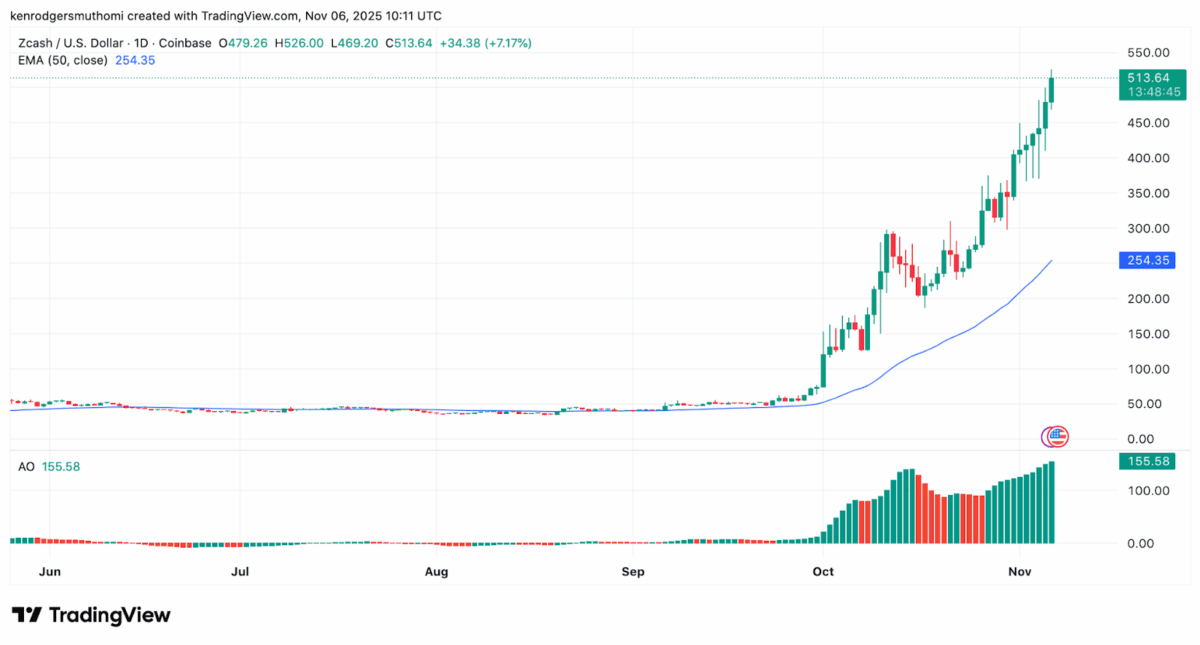
Zcash (ZEC) has surged over 19% in the past 24 hours, trading at $526 with a robust $1.68 billion in volume, according to CoinMarketCap data. This impressive gain stands out as the wider cryptocurrency market experiences significant declines. Bitcoin (BTC), for example, briefly fell below the $100,000 mark, dragging many other digital assets downward.

### What Is Causing the Zcash Price Surge?

The recent Zcash rally stems largely from renewed interest in its advanced privacy features during a time of market-wide sell-offs. While most cryptocurrencies have struggled, Zcash’s unique technology—built around zk-SNARKs—has drawn traders looking for anonymity and security amid volatile conditions.

This divergence highlights the growing value of shielded transactions that protect user identities and transaction details, a feature increasingly sought after given rising regulatory scrutiny in the crypto space.

### How Do Zcash Privacy Features Drive Market Performance?

Zcash utilizes zk-SNARKs (zero-knowledge succinct non-interactive arguments of knowledge), a zero-knowledge proof protocol allowing users to verify transactions without exposing sender, receiver, or transaction amount.

Unlike Bitcoin’s fully transparent ledger, Zcash offers optional shielding which appeals strongly to privacy advocates. According to blockchain analysts at Electric Coin Company, over 10% of Zcash transactions are now shielded, up from previous quarters. This adoption boost correlates closely with the token’s recent price momentum.

As the Zcash developer team lead puts it:
*“Privacy is a fundamental right in digital finance, and zk-SNARKs deliver it efficiently without compromising network security.”*

In essence, zk-SNARKs reduce data exposure while maintaining proof integrity—a tech edge that resonates in today’s uncertain market.

### Technical Indicators Support ZEC’s Bullish Momentum

Zcash’s price has been on an upward trajectory since early October, rallying from roughly $30-$60 to above $500. This sharp move has caught traders’ attention, especially as most major cryptocurrencies struggle to hold ground.

Key technical indicators highlight this strength:
– **50-Day Exponential Moving Average (EMA):** ZEC’s price currently sits well above its 50-day EMA, which is trending upward. This pattern indicates sustained buying pressure and a positive trend.
– **Awesome Oscillator (AO):** The AO has turned solidly positive at 155.58 with increasing green bars, signaling rising bullish momentum.

Together, these tools reflect genuine market support rather than short-term speculative spikes. The Awesome Oscillator, which compares recent to older price bars, shows buyers gaining control when green bars grow, reinforcing the uptrend.

### Rising Popularity and Social Sentiment Fuel ZEC Rally

Beyond charts, social media sentiment has played an influential role in Zcash’s price action. Comments from prominent figures helped boost interest:

– Billionaire investor Naval Ravikant stated, *“Bitcoin is insurance against fiat. Zcash is insurance against Bitcoin.”*
– BitMEX Co-Founder Arthur Hayes chimed in on October 31, *“Let me jinx this. EC to $400 and beyond!”*

Following these remarks, ZEC price surged as much as 36%, despite a prevailing market downtrend. Such endorsements attracted retail traders, amplifying trading volumes and enthusiasm.

### Why Does the Zcash Rally Stand Out?

Zcash’s strong performance contrasts sharply with the broader market decline, highlighting privacy features as a differentiator amid uncertainty. As the crypto community debates transparency versus privacy, Zcash’s optional shielding positions it uniquely.

However, the sustainability of this price surge remains uncertain, especially if overall market conditions persist weak. Investors are closely monitoring developments in the coming days to gauge whether the uptrend will hold.

### Is Zcash a Good Investment During Market Volatility?

Zcash’s privacy advantages make it appealing in volatile markets, and its price holding above key EMAs strengthens its technical case. While the recent 19% rally is promising, investors should remember that past performance is not a guarantee of future results.

On-chain data showing increased adoption and rising daily active addresses—up 15% last month—signal growing use cases, especially in DeFi privacy protocols. Nonetheless, consulting financial advisors is recommended for personalized guidance when considering ZEC as part of a diversified portfolio.

### Key Takeaways

– **Privacy Innovation:** Zcash’s zk-SNARKs enable anonymous transactions, differentiating it from transparent blockchains like Bitcoin.
– **Bullish Technicals:** The 50-day EMA and Awesome Oscillator confirm sustained upward momentum since early October.
– **Sentiment Boost:** Remarks from Naval Ravikant and Arthur Hayes have driven retail interest amid market sell-offs.

### Conclusion

Zcash stands out in the current turbulent crypto landscape by delivering strong privacy features coupled with solid technical momentum. Its recent 19% rally amid a broad market downturn underscores growing investor interest in privacy coins. While challenges remain, Zcash’s unique value proposition may continue to attract attention as traders seek security and anonymity in digital finance.

Stay tuned for further developments as the market evolves.

*For more insights and updates on privacy-focused cryptocurrencies, keep following [Your Site or Blog Name].*
https://bitcoinethereumnews.com/crypto/zcash-surges-19-as-crypto-market-declines-boosting-privacy-coin-interest/

Bitcoin, Ethereum ETFs Shed $2.6 Billion in Assets Over the Past Week

Investors have cashed out a combined $2.6 billion from U.S. Bitcoin and Ethereum exchange-traded funds (ETFs) over the past week, marking one of the largest redemption periods in the funds’ history. Since October 29, more than $1.9 billion has left Bitcoin funds, while $718.9 million has been pulled out of their Ethereum counterparts, according to data from Farside Investors. These significant outflows have contributed to downward pressure on the two largest cryptocurrencies by market value.

On Tuesday, Bitcoin dropped below $100,000 for the first time since May. BTC was recently trading at slightly over $103,428, up 2.6% on the day but still about 18% below its October record of $126,080, according to CoinGecko data. Ethereum was changing hands for $3,439, marking a more than 5% 24-hour jump, although it has plummeted by 13% over the past week. The second-biggest digital coin by market capitalization has struggled to trade near its August record of $4,946.

Investors have largely veered away from crypto and other risk-on assets since October amid concerns over several factors. These include U.S. President Donald Trump’s escalation of the trade war against China, the ongoing government shutdown, low market liquidity, and diminishing prospects of a third U.S. interest rate cut before the end of the year.

Despite Trump’s pro-crypto rhetoric and policy stance, Bitcoin has experienced shocks along with tech stocks in recent months. These challenges have stemmed from ongoing macroeconomic uncertainties. Notably, in February, spot Bitcoin ETFs endured their longest and most difficult losing streak, with investors withdrawing over $2.2 billion during eight consecutive days following the president’s tariff announcements.

Financial advisor Ric Edelman, who heads the Digital Assets Council of Financial Advisors, struck an optimistic tone. He highlighted the significant inflows both categories of funds have generated within their brief histories. The Bitcoin ETFs had the most successful debut in ETF history following their January 2024 approval and now manage a total of $145.4 billion in assets.

“Looking at dollar flows distorts the picture,” Edelman told Decrypt. “The Bitcoin ETFs have collected more than $100 billion in assets, so while $2 billion in outflows sounds like a lot, it’s only 2% — hardly noteworthy.”

He added, “What is noteworthy is that, despite these outflows, Bitcoin’s price hasn’t crashed. This is because of the strong institutional inflows that are simultaneously occurring. This wouldn’t have been the case 10, five, or even two years ago, and shows the continuing maturity of this asset class.”
https://bitcoinethereumnews.com/bitcoin/bitcoin-ethereum-etfs-shed-2-6-billion-in-assets-over-the-past-week/

US-China Tariff Reductions Signal Eased Trade Tensions

**China and the United States Initiate Tariff Adjustments Signaling Potential Trade Easing in November 2025**

Following recent economic consultations, China and the United States have begun adjusting tariff measures, indicating a possible easing of trade tensions starting November 2025. These adjustments are poised to enhance bilateral trade, particularly impacting the agriculture and mineral sectors. This shift may also foster growth in commodity-linked cryptocurrencies and decentralized finance (DeFi) protocols, although no immediate effect on principal crypto assets is expected.

### US-China Tariff Easing Spurs Agricultural Expansion

Both nations have implemented tariff removals as a direct result of recent negotiations. The United States announced initiatives to lift the “Fentanyl Tariff” and suspend certain “Counterpart Tariffs,” aligning with ongoing bilateral efforts to stabilize economic exchanges.

In response, the Chinese government initiated corresponding adjustments to ease trade barriers. Immediate changes include targeted tariff reductions to facilitate smoother trade in commodities and agricultural products. Beyond tariffs, the two countries are cooperating on fentanyl drug control efforts and the supply of critical minerals.

Huo Jianguo, a key economic analyst, described these steps as foundational, predicting future agreements covering wider trade topics such as maritime logistics. He explained,

> “The current implementation between the two sides is the first aspect of the consensus outcome, involving tariff adjustment and reciprocal measures; future steps will include origin rules and maritime sector restrictions as well as drug control and agriculture cooperation.”

### Financial and Market Implications

The financial impact of these tariff revisions is significant. Reduction in tariffs is expected to bolster U.S. exports while increasing Chinese imports, helping to counteract the strain from previous trade tensions. The U.S. Treasury has emphasized the importance of monitoring these changes closely to maintain macroeconomic stability.

Community feedback across digital platforms reflects mild optimism, as many in digital markets see these developments as a positive shift toward more stable economic relations.

### Tariff Revisions Echo 2020 Trade Movements

It’s worth noting that the 2025 tariff reductions resemble the Phase One Agreement reached in 2020. That agreement marked a pivotal shift in trade relations through structured purchases and tariff reductions, setting a precedent that appears to be influencing today’s negotiations.

### Cryptocurrency Market Snapshot

– **Bitcoin (BTC)** is currently valued at **$103,434.87**, capturing **59.90%** market dominance, according to CoinMarketCap.
– With a market capitalization of **$2.06 trillion** and a circulating supply of **19,944,128 BTC**, Bitcoin has seen a **2.68%** increase in the last 24 hours despite a **-17.09%** decline over the past 30 days.
– Trading volume reached **$76.26 billion**, down by **30.94%**.

These figures suggest that while principal crypto assets like Bitcoin may not experience immediate effects from the tariff changes, the broader impact on commodity-linked cryptocurrencies and DeFi markets could be more pronounced over time.

**Stay tuned for ongoing updates as US-China trade relations continue to evolve and impact global markets.**
https://bitcoinethereumnews.com/tech/us-china-tariff-reductions-signal-eased-trade-tensions/

Kiyosaki Urges Bitcoin Investment Amid Fears of Shifting U.S. Politics After NYC Election

What Is Robert Kiyosaki’s Advice on Bitcoin and Ethereum?

Robert Kiyosaki, the renowned author of Rich Dad Poor Dad, recently urged his followers to invest in Bitcoin (BTC) and Ethereum (ETH). He describes these cryptocurrencies as “people’s money” and essential tools for protecting financial freedom—especially in light of significant political shifts.

Why Does Kiyosaki Warn About America’s Shift Toward Marxism?

Kiyosaki’s warning comes after far-left candidate Zohran Mamdani won the New York mayoral race. Mamdani campaigned on policies such as rent-stabilized housing and city-owned grocery stores—moves Kiyosaki views as steps toward socialist governance in the world’s financial capital.

• Erosion of Capitalism and Democracy
• Threats to Personal Freedom
• Importance of Real Financial Education

Kiyosaki argues that without practical money-management skills, individuals risk losing control over their wealth. He sees BTC and ETH as decentralized alternatives that bypass traditional, policy-driven financial systems.

Political Uncertainty and Crypto Adoption

Analysts note that political changes often influence market dynamics. Blockchain analytics firms report a 15% uptick in cryptocurrency adoption during periods of uncertainty. Bitcoin is seen as a hedge against fiat-currency instability, while Ethereum’s smart-contract ecosystem offers utility in decentralized applications.

Kiyosaki’s Market Forecast

In past posts, Kiyosaki projected that Bitcoin could reach at least $180,000 by year-end—an estimate reported by COINOTAG. He bases this forecast on:

• Potential U.S. dollar devaluation
• Inflationary pressures
• Growing regulatory scrutiny

Ethereum complements Bitcoin in a diversified crypto portfolio. Experts at Bloomberg and other outlets highlight its role in driving Web3 innovations and long-term value.

Why Follow Kiyosaki’s Advice?

Robert Kiyosaki has nearly 3 million followers on X, where his wealth-building tips spark global discussions on asset allocation. Recent data from Chainalysis shows a 25% increase in institutional cryptocurrency adoption over the past year, reflecting growing confidence in digital assets as tools for financial sovereignty.

Frequently Asked Questions

1. What prompted Kiyosaki’s recommendation now?
The New York mayoral election result signaled to him a shift toward socialist policies. He believes BTC and ETH can safeguard wealth outside government control.

2. How do Bitcoin and Ethereum protect against economic change?
Both operate on decentralized networks that resist single-entity interference. Historically, Bitcoin has delivered strong returns—averaging 200% annually during uncertain periods. Ethereum’s robust ecosystem adds utility beyond a store of value.

Key Takeaways

• Invest in “people’s money” (BTC and ETH) to safeguard financial independence.
• Build true wealth through real financial education.
• Monitor political events—they can be early indicators of economic risk.
• Diversify your portfolio with decentralized assets for long-term stability.

Start Investing Today for Long-Term Security
https://bitcoinethereumnews.com/bitcoin/kiyosaki-urges-bitcoin-investment-amid-fears-of-shifting-u-s-politics-after-nyc-election/

Canada Follows U.S. in Regulating Stablecoins in Budget

**Canada to Establish New Stablecoin Laws, Mirroring the U.S. GENIUS Act**

Stablecoins are gaining worldwide attention for their ease of use in payment transactions. In response, Canada is on track to introduce new regulations for stablecoins, aligning its approach with recent legislative developments in the United States.

### Canada Moves Forward with Stablecoin Regulations

As disclosed in the Canadian government’s 2025 budget released on Tuesday, November 4, 2025, stablecoin issuers will soon need to meet specific criteria under proposed federal legislation. These requirements include holding sufficient reserves and establishing clear redemption policies. Additionally, issuers must implement robust risk management frameworks designed to protect personal and financial data.

Starting in the 2026-2027 fiscal year, the Bank of Canada will allocate $10 million over two years to oversee a smooth regulatory rollout. Following this initial phase, stablecoin issuers are expected to cover an estimated $5 million annually in regulatory costs. These rules will come under the ambit of the Retail Payment Activities Act.

The government’s primary goal is to deliver faster, cheaper, and safer digital transactions to benefit Canada’s 41.7 million residents. This effort also forms part of a broader initiative to modernize the country’s entire payment system.

### No Central Bank Digital Currency for Now

Currently, Canada does not have a Central Bank Digital Currency (CBDC). The country canceled its digital loonie project in September 2024, with Bank of Canada Governor Tiff Macklem stating, “No strong case yet.” Since then, Canada has shifted focus from developing a digital currency toward modernizing its domestic payment infrastructure.

### Canada’s Stance Amid Market Movements

In an unexpected move, the National Bank of Canada adopted a bearish stance towards Bitcoin. The bank filed documents with the U.S. Securities and Exchange Commission (SEC) to exercise a put option on its BlackRock iShares Bitcoin Trust ETF holdings, valued at more than $1.3 million.

Despite this cautious approach towards cryptocurrencies, Canada is eager not to lag behind in regulatory frameworks and global competition. The move to establish clear stablecoin laws follows the United States’ passage of the GENIUS Act in July 2025, signaling a growing emphasis on regulating digital assets.

### Stablecoin Market Expansion

The introduction of regulatory frameworks in both the U.S. and Canadian markets comes amid rapid expansion in the stablecoin sector. Currently, the stablecoin market sits at approximately $309.1 billion. The U.S. Treasury estimated in April 2025 that this figure could surge to $2 trillion by 2028.

Stablecoins have already become dominant in several markets. For example, in Latin America, Tether (USDT) and USDC stablecoins hold a leading position. In Argentina, stablecoins make up 72% of all cryptocurrency purchases in 2024, far surpassing Bitcoin, which accounts for only 8%.

### Innovation in Stablecoin Payments

Partnerships are accelerating the adoption of stablecoin payments worldwide. Recently, DeCard partnered with Polygon Labs to enable stablecoin payments across over 150 million merchants globally. This platform allows users to convert popular cryptocurrencies like USDT and USDC into traditional fiat currencies, which can be spent anywhere cards are accepted.

In Canada, payment platforms such as Tetra Digital are emerging as key players in the stablecoin space. Tetra Digital has raised $10 million to create a digital version of the Canadian dollar, backed by investments from major firms including Shopify, Wealthsimple, and the National Bank of Canada.

Canada’s regulatory efforts and market innovations indicate a significant step toward integrating stablecoins into mainstream finance, ensuring secure and efficient digital payment options for Canadians.
https://bitcoinethereumnews.com/tech/canada-follows-u-s-in-regulating-stablecoins-in-budget/

Standard Chartered CEO Predicts Blockchain Settlement for All Transactions

Standard Chartered CEO Bill Winters announced on November 3 that both the bank and Hong Kong SAR leadership foresee eventual blockchain settlement for all transactions and full currency digitization. Winters’ statement underscores a strong institutional and governmental commitment to blockchain technology, which could drive significant shifts in financial markets and impact cryptocurrencies like Bitcoin and Ethereum amid global digital currency trends.

This bold prediction highlights Standard Chartered’s strategic alignment with governmental agendas, positioning the bank for potential first-mover advantages as blockchain frameworks become widespread. However, no public fund allocations or new projects were explicitly announced alongside this statement.

Geoffrey Kendrick, Head of Digital Assets Research at Standard Chartered, shared his outlook: “I would expect at least another $20 billion by year-end [in Bitcoin ETF inflows], a number which would make my $200,000 year-end forecast possible.”

**Blockchain Adoption’s Broader Financial Implications**

Did you know? Standard Chartered’s move echoes previous blockchain adoptions by global financial institutions, including pilot programs from BlackRock and JPMorgan. These developments reinforce the ongoing transition toward digital assets and signify a growing institutional embrace of blockchain technology.

According to CoinMarketCap, Bitcoin (BTC) is currently priced at $107,904.20, with a market capitalization of $2,152,011,730,482 and a dominance of 59.53%. It has experienced a 1.90% drop over the last 24 hours, contributing to a 5.56% decrease over the past 90 days. Meanwhile, trading volume surged by 71.14%, indicating an active and dynamic trading environment.

As blockchain integration gains momentum, the financial landscape is poised for transformation, with digital currencies and decentralized technologies playing increasingly central roles.
https://bitcoinethereumnews.com/blockchain/standard-chartered-ceo-predicts-blockchain-settlement-for-all-transactions/?utm_source=rss&utm_medium=rss&utm_campaign=standard-chartered-ceo-predicts-blockchain-settlement-for-all-transactions

Polkadot System Chains Upgrade Passes as DOT Tests Lower Bollinger Band Support at $2.88

**Polkadot (DOT) Price Analysis and Market Update**

**Quick Take**
– DOT trading at $2.88, down 2.7% in the last 24 hours
– Unanimous system chains upgrade referendum signals strong community backing
– Price currently testing lower Bollinger Band support at $2.83
– Follows Bitcoin’s weakness amid broader risk-off market sentiment

### Market Events Driving Polkadot Price Movement

This week’s most significant development for Polkadot was the unanimous passage of a referendum to upgrade all system chains and schedule the Asset Hub Migration. This technical advancement highlights robust community consensus and positions the network for enhanced functionality. Despite the current price weakness, this provides a positive fundamental backdrop for DOT.

Polkadot is also set to participate in Hong Kong Fintech Week from November 3-7. This event adds a further layer of institutional exposure, showcasing the network’s interoperability solutions to a global audience, which may prove beneficial for Polkadot’s medium-term outlook.

Conversely, the failure of the Staking Dashboard funding referendum reflects some community friction over resource allocation. However, this had minimal impact on the market.

In the absence of significant breaking news catalysts, DOT’s price action is primarily influenced by technical factors and broader cryptocurrency market sentiment. The token currently faces selling pressure, tracking Bitcoin and other major cryptocurrencies as risk-off sentiment dominates trading decisions.

### DOT Technical Analysis: Testing Critical Support Zone

**Price Action Context**
DOT price currently sits below all major moving averages, trading at $2.88 compared to the 20-day SMA at $3.01 and the 50-day SMA at $3.59. This positioning signals sustained bearish pressure, with the token down approximately 26% from its 52-week high of $5.31.

The price movement indicates that Polkadot is closely following Bitcoin’s weakness rather than exhibiting independent strength. Trading volume on Binance’s spot market reached $14.4 million over 24 hours, reflecting moderate institutional interest but lacking the momentum needed to trigger a sustained reversal.

**Key Technical Indicators**
– The Relative Strength Index (RSI) stands at 38.18, in neutral territory but approaching oversold conditions, which could signal potential for a technical bounce.
– The MACD histogram shows a slight bullish divergence at 0.0218, suggesting weakening selling pressure despite the overall negative MACD value of -0.1722.
– Most importantly, the %B indicator at 0.1532 shows DOT price near the lower Bollinger Band at $2.83, a level that has historically provided support in previous corrections.

### Critical Price Levels for Polkadot Traders

**Immediate Levels (Next 24-48 Hours):**
– **Resistance:** $3.01 (20-day moving average and psychological resistance)
– **Support:** $2.83 (lower Bollinger Band and recent 24-hour low)

**Potential Breakout/Breakdown Scenarios:**
– A break below the $2.83 support level could trigger further selling pressure, pushing the price toward the next major support zone at $2.77. Note that the 52-week low at $2.87 was recently breached.
– Conversely, a successful defense at $2.83 and a move above the $3.01 resistance could open the door for a rally toward the immediate resistance at $3.34.

### DOT Correlation Analysis

– **Bitcoin:** DOT’s price movements are closely correlated with Bitcoin’s bearish momentum, with both assets experiencing similar percentage declines in recent sessions.
– **Traditional Markets:** Risk-off sentiment spilling over from equity markets appears to be weighing on cryptocurrencies broadly.
– **Sector Peers:** Polkadot is currently underperforming some layer-1 competitors, indicating there may be specific selling pressure beyond the general market weakness.

### Trading Outlook: Polkadot Near-Term Prospects

**Bullish Case:**
If DOT can successfully defend the $2.83 lower Bollinger Band support, combined with positive momentum stemming from exposure during Hong Kong Fintech Week, a technical bounce toward $3.01 resistance is possible. Additionally, the unanimous referendum passage provides a supportive fundamental outlook for the medium-term.

**Bearish Case:**
Failure to hold current support levels amid continued Bitcoin weakness could see further declines toward the strong support zone around $2.77. Broader cryptocurrency market sentiment remains fragile, increasing the risk of additional downside.

**Risk Management:**
Traders are advised to consider tight stop-losses below $2.80, given the proximity to critical support. The daily Average True Range (ATR) of $0.23 suggests that position sizing should account for potential daily price swings of approximately 8% in either direction.

*Stay updated with the latest developments as Polkadot navigates a challenging market environment supported by strong community fundamentals.*
https://bitcoinethereumnews.com/tech/polkadot-system-chains-upgrade-passes-as-dot-tests-lower-bollinger-band-support-at-2-88/?utm_source=rss&utm_medium=rss&utm_campaign=polkadot-system-chains-upgrade-passes-as-dot-tests-lower-bollinger-band-support-at-2-88

Exit mobile version
Sitemap Index